Welcome to ned Productions (non-commercial personal website, for commercial company see ned Productions Limited). Please choose an item you are interested in on the left hand side, or continue down for Niall’s virtual diary.
Niall’s virtual diary:
Started all the way back in 1998 when there was no word “blog” yet, hence “virtual diary”.
Original content has undergone multiple conversions Microsoft FrontPage => Microsoft Expression Web, legacy HTML tag soup => XHTML, XHTML => Markdown, and with a ‘various codepages’ => UTF-8 conversion for good measure. Some content, especially the older stuff, may not have entirely survived intact, especially in terms of broken links or images.
- A biography of me is here if you want to get a quick overview of who I am
- An archive of prior virtual diary entries are available here
- For a deep, meaningful moment, watch this dialogue (needs a video player), or for something which plays with your perception, check out this picture. Try moving your eyes around - are those circles rotating???
Latest entries: 
It does feel weird to have free time back. I haven’t had any in so long, I am not used to not constantly having to find time to pare down chores lists. I am using the opportunity to clear backlog, all day today was chores and all day tomorrow will also be chores. Same as last weekend, and the weekend before that. But if this goes on much longer, I might actually have to do something non-chore which would be very novel given the past two years.
I did refine the outhouse buildup I described last post to remove the heavy concrete roof, which in turn reduces loading on the foundations which in turn means I can economise on strength of materials used, reducing costs. I think this will be pretty close to my final design:

The structural calculations look fine with very healthy safety margins. The flat roof with the 622 centres will have quite a bit of flex when you walk on it, but I expect to almost never walk on it, so I don’t care and having 622 centres means I can avoid cutting the blocks of EPS which come 600 mm wide. The lintels should be all very straightforward, the widest span should be 2.4 metres, online tables think a 3200 x 215 x 100 lintel should be fine which is a one block overlap each side. As it is such a simple building, there isn’t really much more to it.
Obviously as the house design is finalised, and nothing more can happen until the timber frame design begins, there isn’t really much else to report. The previous mortgage offer from the AIB expired as there was no way to draw it down, so we now have to apply for a new mortgage again from scratch. Yay. The rebooted Passive House certification after our previous certifier couldn’t proceed is proceeding very slowly, my architect clearly has other work on and forward progressing the PH certification is not a high priority. After all, we already did this bit with the previous certifier, so we are simply re-treading the same process without much expected gain from it. Going through the motions as it were. We will only return to new ground later on in the process.
Right now, if there weren’t a thick blanket of cloud above me, there would be aurora borealis which are exceedingly rare this far south. I caught a brief seven minute long or so view of them last night before heavy cloud rolled over them. I had never seen them before in my life, and they were very cool.
I saw greens, reds, pinks and purples all with the naked eye stretching over most of the sky. They were quite noticeably twisting and pulsing in the sky even within my seven minute window. I could see the cloud rolling in, so I just stayed there and drank it in knowing my time would be short. It is quite possible I will never see them again in my lifetime.
I didn’t have my phone with me as I didn’t expect to see them, and I didn’t want to miss any of them by returning inside and ruining my night vision. So I did not take any pictures. Megan missed them entirely last night, and took a ninety minute drive after dark around the country back roads to try and luck out on a gap in the clouds. She returned deflated, having failed to secure anything more than a very fleeting glimpse.
All this was where my rented house is, which gets a fair bit of light pollution from all the urban build up. Out where my site is is much nearer the Irish dark sky reserve and has as close to dark skies as remains possible in Europe. Unsurprisingly you get even better views there than here. My neighbour at the site Rob managed to snap these:


That first picture that’s my site on the right, and the second is a 180 degree turn from the first. The pictures are much more colourful than with the naked eye of course, modern phone camera sensors are better than human eyes. But multiple colours were very much visible without electronic aid, which I read online is unusual enough even very far north. This coronal mass ejection being strong enough to reach so far south might only happen every twenty years or so, and not usually in a way the whole northern hemisphere can see it two nights in a row.
Real shame about the cloud cover though.
Anyway here’s hoping this time next month we might be making forward progress on building this damn house instead of me having to actually go do a non-chore activity!
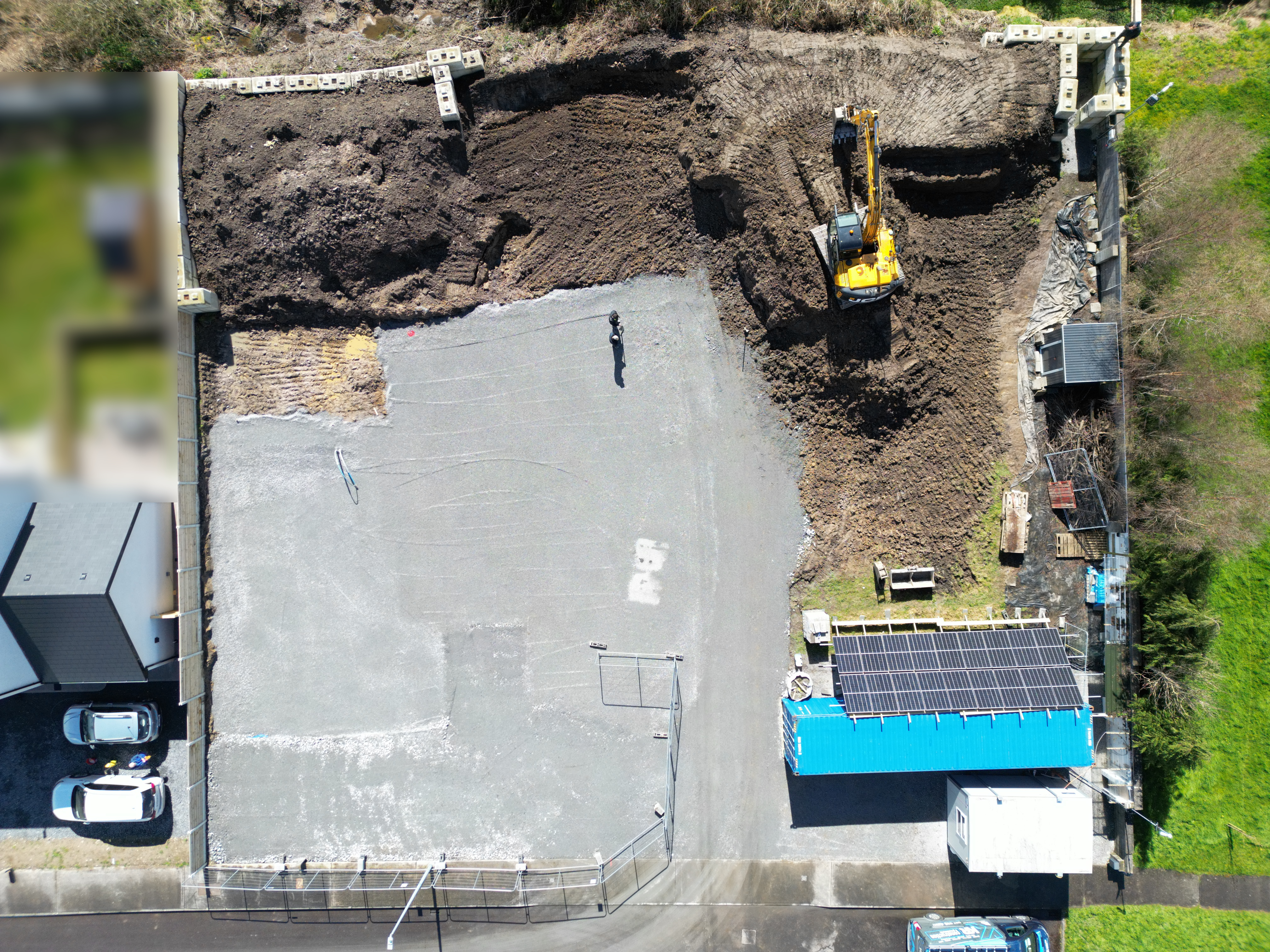
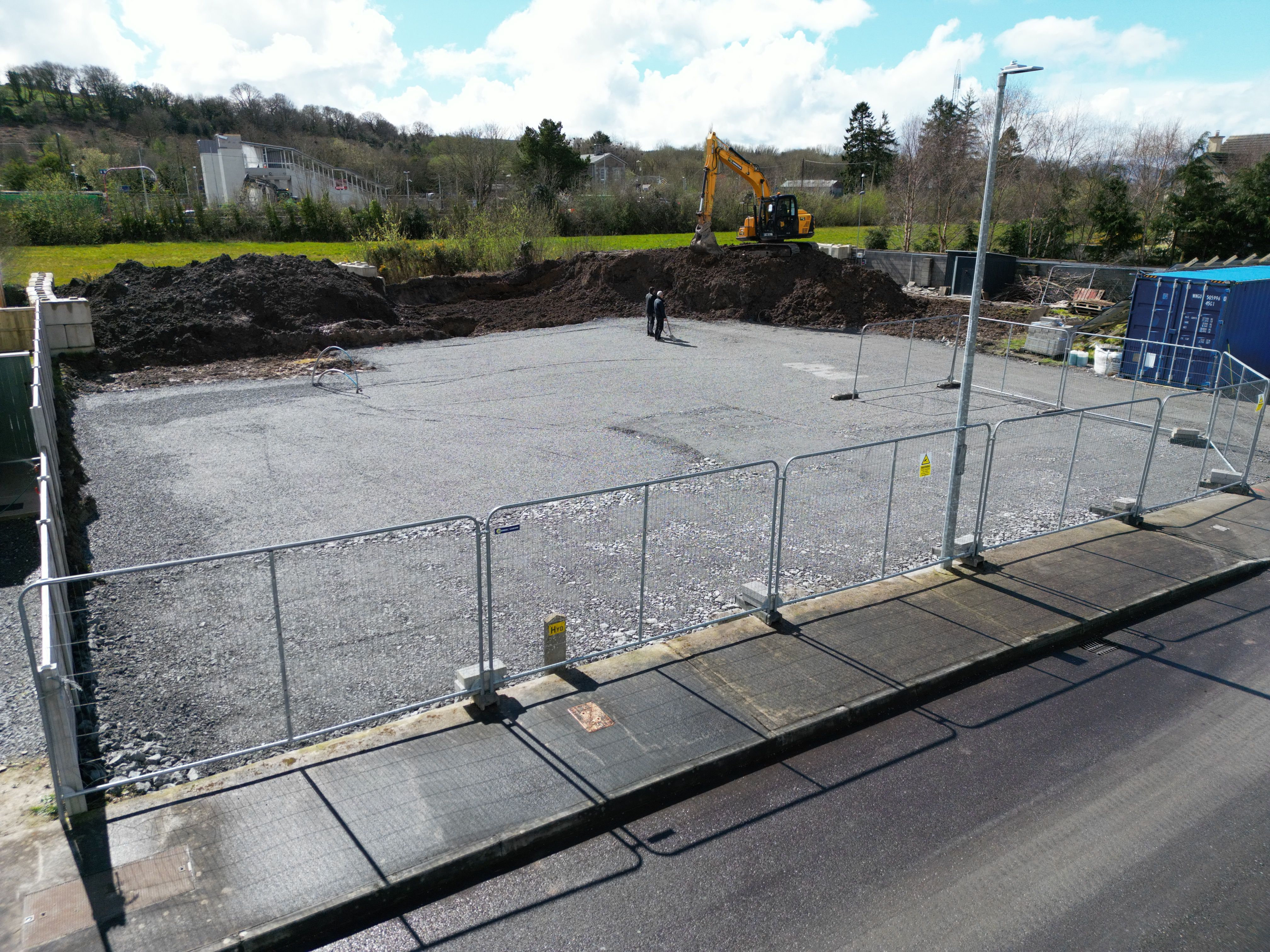
We ended up not fitting neither the land drain nor the soakaway as the soil 1.5 metres down turned out to be much more dry than expected, and thus capable of handling an inundation more than needing additional drainage:
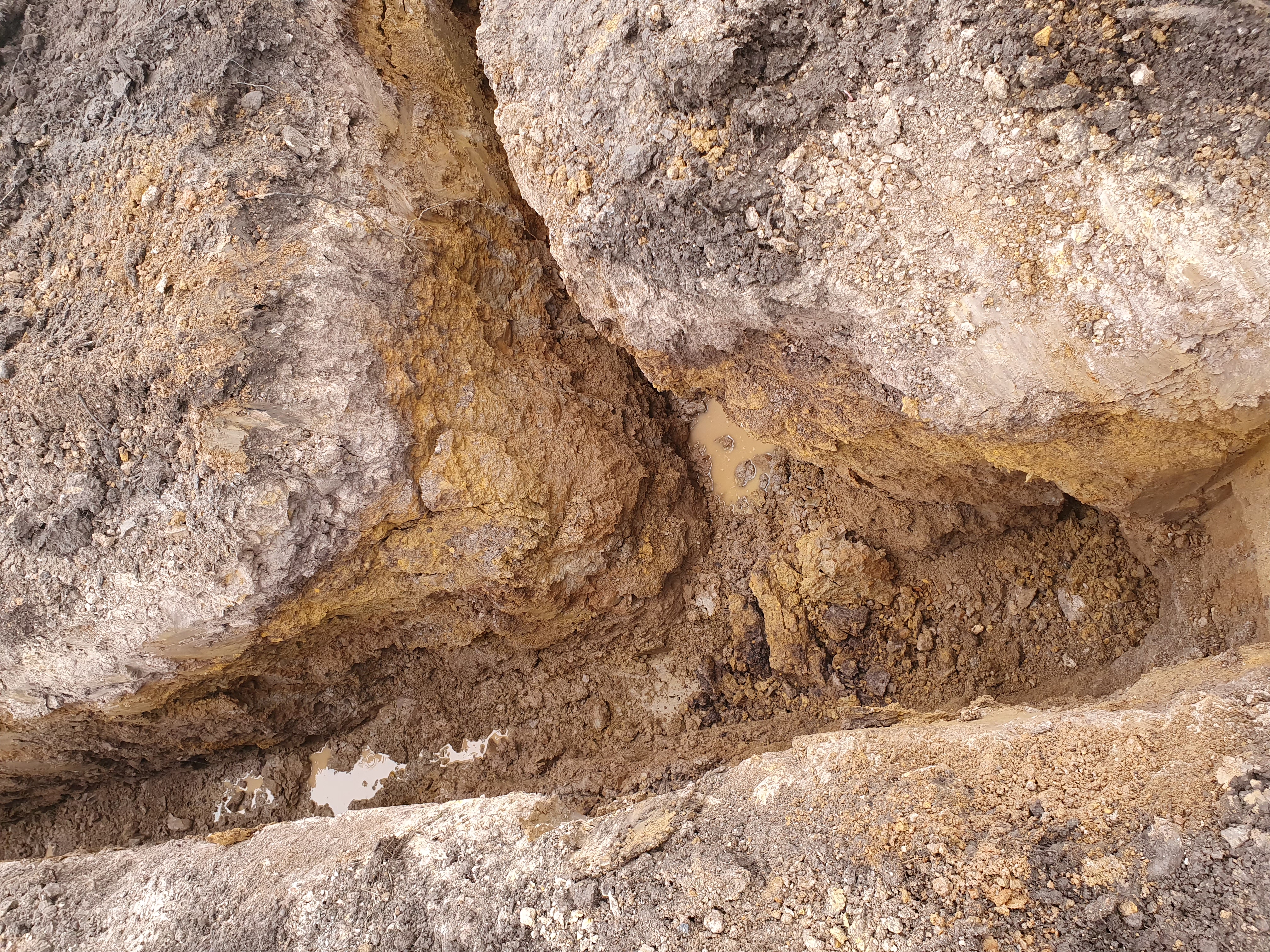
(the pool of water at the bottom shown is due to rain at the time, at the point of excavation the subsoil was surprisingly dry)
As the land drain would get crushed by heavy machinery if installed now, and seeing as it wasn’t necessary given how dry the subsoil is, we left it off until the outer block leaf gets erected, which is when the services will be installed.
First thing which went in is the subsoil heat exchanger, which is 150m of HDPE water pipe buried at 1.5 metres down. Here is its trench mid-completion:
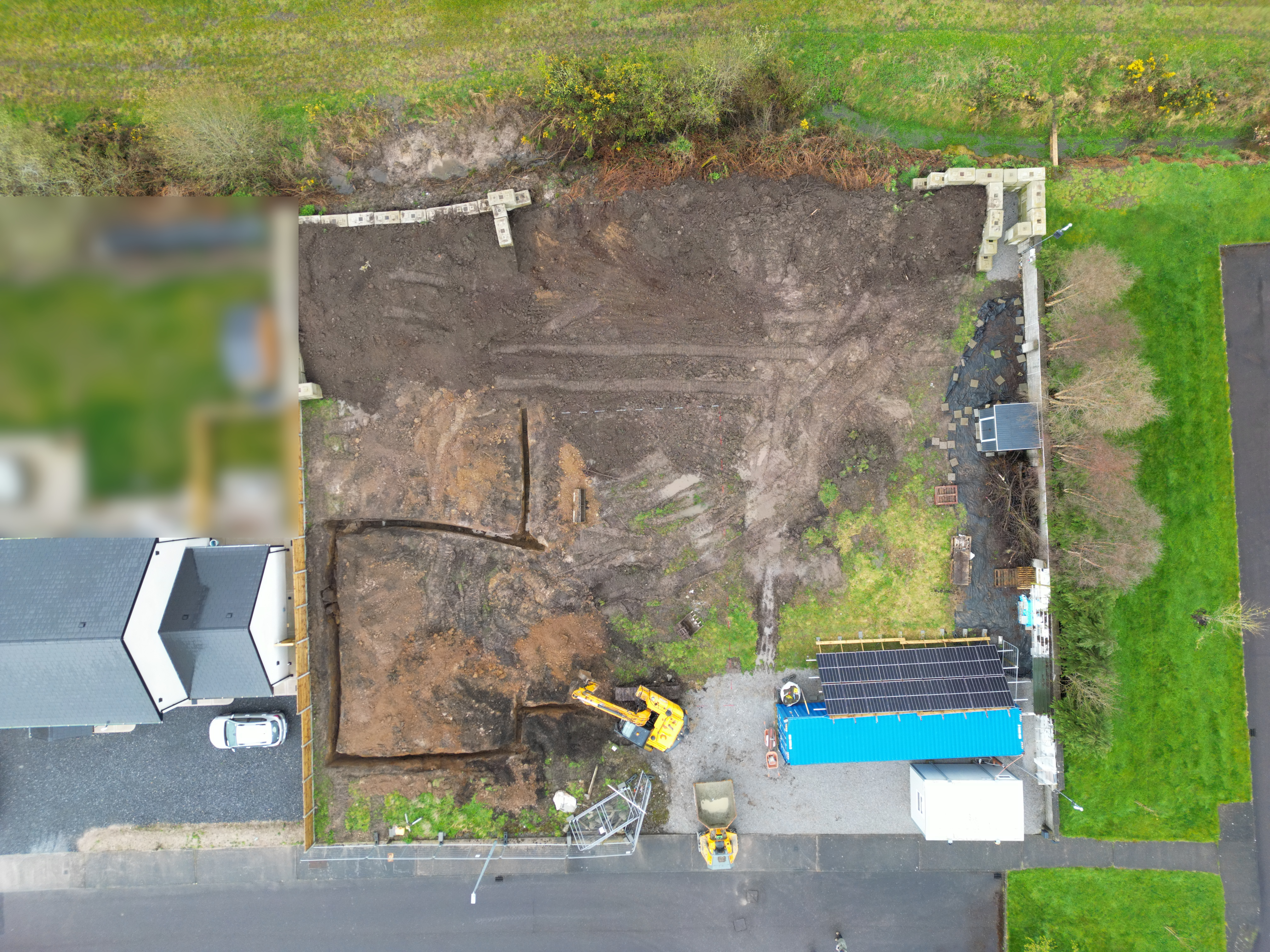
On top of that came a very great deal of T2 stone, which one of the truck drivers cheerfully informed me is one of the most expensive loads they do at €505 ex VAT per twenty tonne load. Yay. The stone came from the quarry at Ballyhest West, approx 13.2 km away from site. This is a quarry whose limestone originated in shallow waters and therefore has a distinctive blue tint, unlike the white limestone of deeper waters.
Last post I estimated that 150 m3 of T2 rock would be needed. I can tell you now that nineteen twenty metric tonne loads were delivered, which is 380 tonnes which is approx 190 m3. The reason we went a quarter over estimated is because some of the excavations exposed soft soil which had to be dug out deeper to reach subsoil. In particular, just under the master bedroom at the front right there was a €505 ex VAT costing hole, as that is what one truck load of T2 stone cost me:
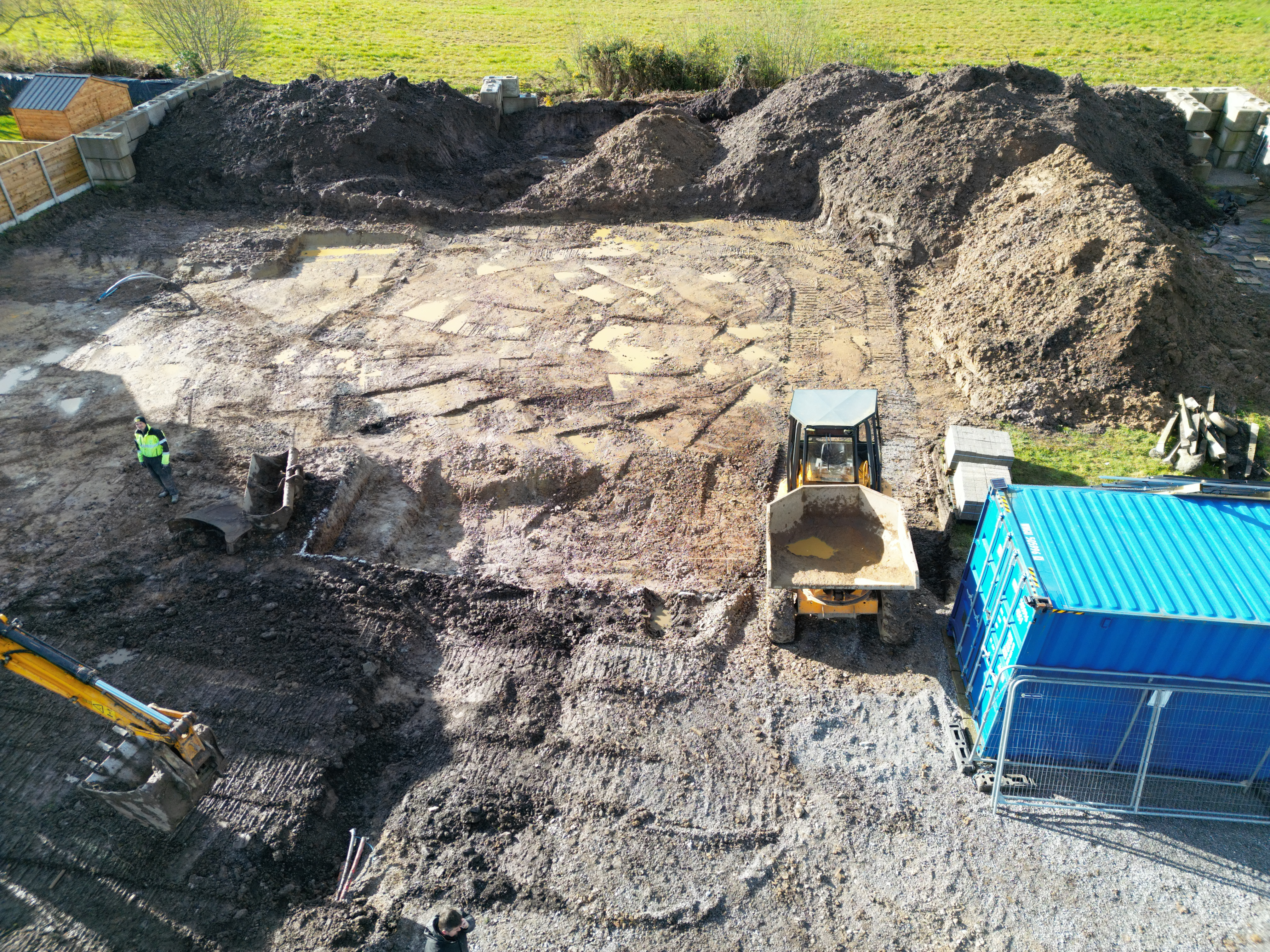
As much as I was rather wincing watching a full truck load fill what will be supporting my future bedroom and nothing more, it could have been far worse. One of my fellow neighbour self builders Patrick happened to pop by, and he was telling me how he had to drive forty-three piles to support the foundations of his future house. Due to driving piles, no insurer will cover his self build, and so he is exposed to unlimited liabilities if anything goes wrong. I spent two weeks trying to find somebody who would insure my self build. It turns out there are exactly three insurers on the current Irish market willing to underwrite a self build timber frame (there would be far more if it were a concrete block build aka ‘standard build’ (which is defined to exclusively be concrete block in Ireland), or if a main contractor were doing most of the work). Anyway I went with https://selfbuildprotect.ie which is a trading name for MDRB insurance, one of the larger brokers in Ireland for a cool €2,200 for eighteen months. If that seems a lot, it is, however it is proportional to the cost of rebuild which for me is rather a lot.
T2 stone is very much ‘expensive gravel’, it has the consistency of gravel, it looks like gravel, it feels like gravel, and it compacts like gravel i.e. it is barely worth running a whacker over it, though we did so anyway. Unfortunately it must be guaranteed cleaner than gravel, and you can see here the juxtaposition of the T2 stone with the cheap-as-possible gravel previously at the front of my site:

Both came from Ducon Concrete, whose head office is just up the road from me. But T2 stone comes with guarantees, whereas the cheapest possible chipped limestone from them does not. Hence the price (and colour) difference.
We did not in the end lay entirely T2 stone everywhere precisely because it really is like gravel i.e. unstable. We put four inch down towards the front where the future driveway will be, and then more four inch down to the right where the future patio will be, and between now and the future patio it will be where the heavy trucks will drive in. On top of the four inch down we put a layer of two inch down. Both four inch down and two inch down are quite a bit cheaper than T2 stone, so doing this saved me a few hundred euro. However unlike T2, both four inch and two inch down compact themselves into a rock solid surface almost like a road – indeed, this is what a Roman road was, compacted crushed rock of layers ever decreasing in granularity, and their roads lasted centuries before becoming unusable due to wear and tear.
Finally, a full twenty-three loads of soil were removed, at approx 20 tonnes per truck, which is four hundred and sixty tonnes of soil. So 380 tonnes of expensive stone in, 460 tonnes of soil out. Each truck of soil removal cost me €270 ex VAT, because I live in the EU and anything which could potentially involve waste removal is hideously expensive (in most parts of the world topsoil removal means them paying you for the topsoil, but not in the EU where removing a valuable commodity costs you money). In case you’re wondering why?, the answer is apparently any unregulated transfer of soil from anywhere to anywhere else comes with a €50,000 fine. So basically due to regulatory capture, the price of disposing of anything at all gets tainted by the 1% of disposals which are very expensive to dispose of, and for obvious reasons if you’re disposing of toxic waste you’re getting an absolutely wonderful deal at €270 ex VAT per tonne with the costs spread onto everybody else. Yay.
What may not be obvious from the photos is we kept the very best of the topsoil which is a dark brown material, very very good topsoil. That is currently a three metre high mound in our future walled garden.
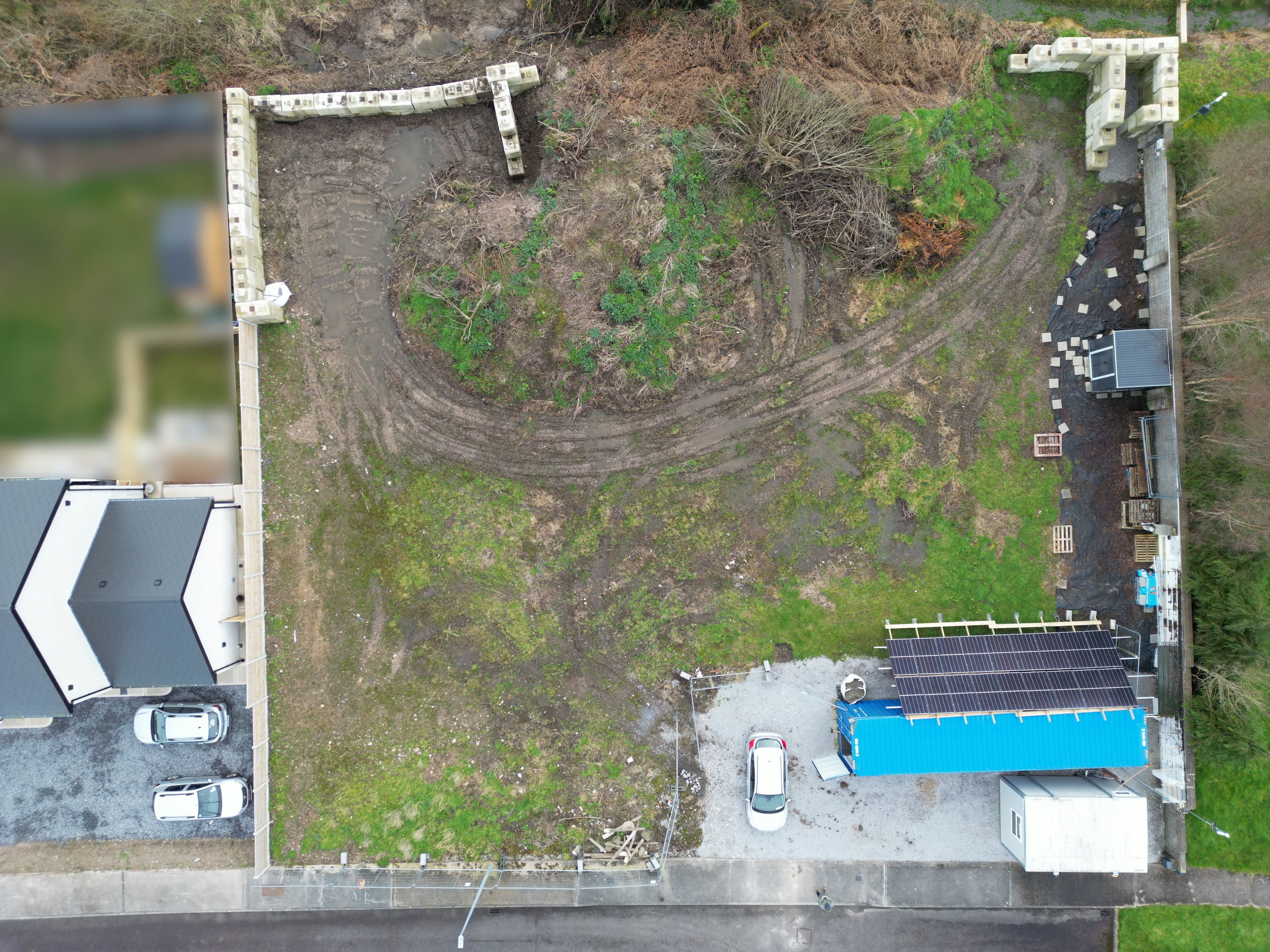
As much as installing the pre-foundations cost me at least €20k (I haven’t actually gotten the bill yet, but at least that much materials went in or were removed), it does leave a rather pleasant ‘sea of stone’ which even walking around is somewhat satisfying. Here it is being flown around by the drone:
In case you were wondering, the stoned levelled area is approx 630 m2. The total site is 1400 m2. So, approximately 45% of the total site will be put under stone initially, with pockets later carved out as grass. I very much agree that it doesn’t look like half the site by area has been stoned – it looks like much more – but that there is what the maths says.
Outhouse
The groundworks guys double-triple-quadruple recommended to me in the strongest possible terms to not lay the sewers for the house until no more heavy machinery would be traversing the site. That effectively means that us moving into our house is blocked by the completion of the outhouse, so it has just leapt up the priority queue.
To be honest, I really hadn’t given it much thought until now outside its basic design which was needed for planning permission, which is this:
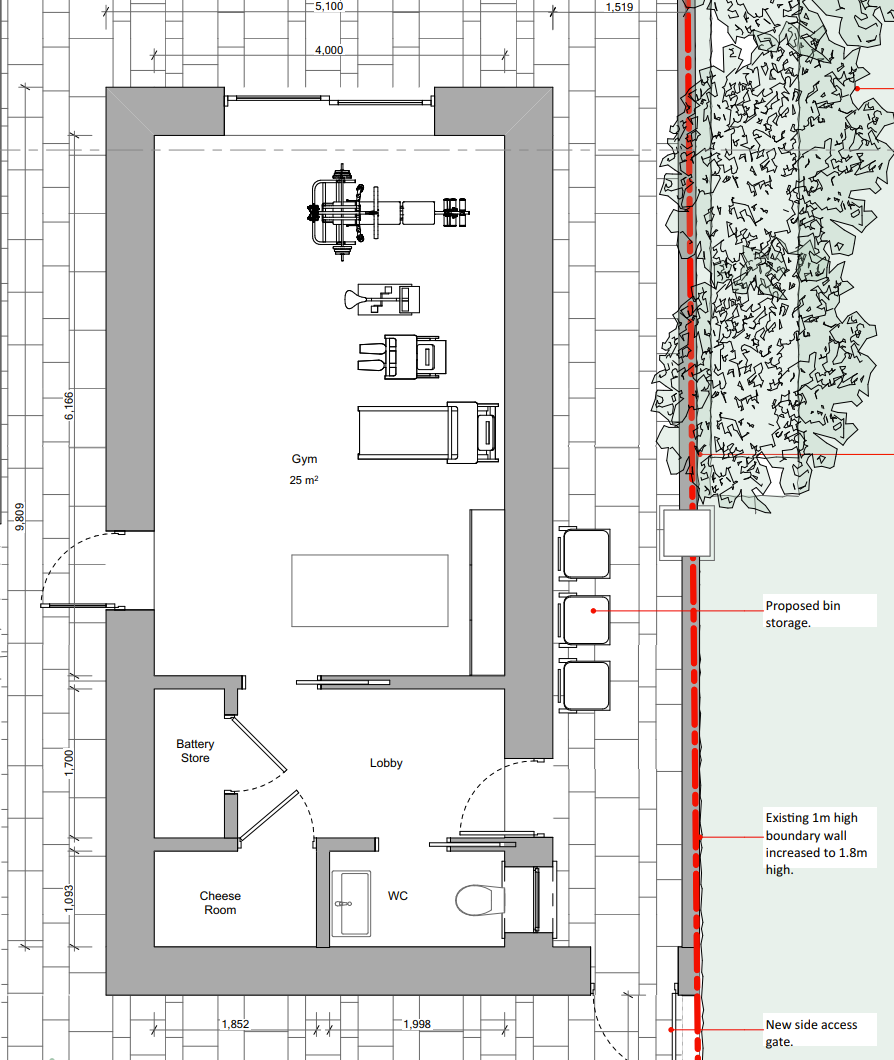
Neither me, my architect, nor anybody else has touched that design in well over a year. It’s been that low priority.
I had had some ideas of maybe building it with ICF i.e. polystyrene hollow blocks you pour concrete down the insides of. But the house quotes I got for ICF were ridiculous, and for a crew to come out to do a small box 10.36 x 5.1 metres there would surely be a substantial premium for them turning up at all.
I could do timber frame again for the outhouse … but that kinda feels lazy. Plus, I really don’t need passive spec for the outhouse, and as it’ll mainly be a gym, concrete block inside walls would be very attractive for hanging mirrors, bars and other heavy things. Plus, painted concrete blocks is very much how gyms are, so it would give the desired ‘feel’.
That got me onto wondering how you’d do this if it were a conventional new build in Ireland, how much that would cost and so on. Generally new builds in Ireland are still strip foundations where you dig out where the walls will be to about 1.2 metres down, fill the bottom of that trench will liquid concrete to provide a footing, then raise the walls using block on flat from there (often called the deadwork, as it’s all underground). As you near the floor level, you switch to expensive aerated concrete blocks to provide a thermal break, usually three layers, with 200 mm of expanded polystyrene (EPS) insulation under the room floors and a 50 mm screed to yield a floor with an average 0.18 u-value, which is the legal maximum in Ireland since 2019.
Note my qualifier ‘average’. Those aerated concrete blocks they have seven times lower thermal conductivity than standard concrete blocks, but EPS has a thermal conductivity 42.9 times better. If you are perforating your floor insulation at regular intervals with a thermal bridge seven times more thermally conductive, you get much worse quality floor insulation. Yes, the average might be good, but it won’t be even, there will be ‘cold spots’ and if they are cold enough relative to moist air, they’ll condense i.e. you get mould. Most new Irish builds even post 2019 regs still develop mould after a few years – much better than pre-2019 no doubt where some of those new builds became riddled with mould within a year. But still, not great.
It would annoy me if my gym got mould into it, so I’m rather liking the idea of wrapping the foundations in continuous EPS so there are zero thermal breaks. In fact, let’s just wrap the whole building in unbroken EPS:
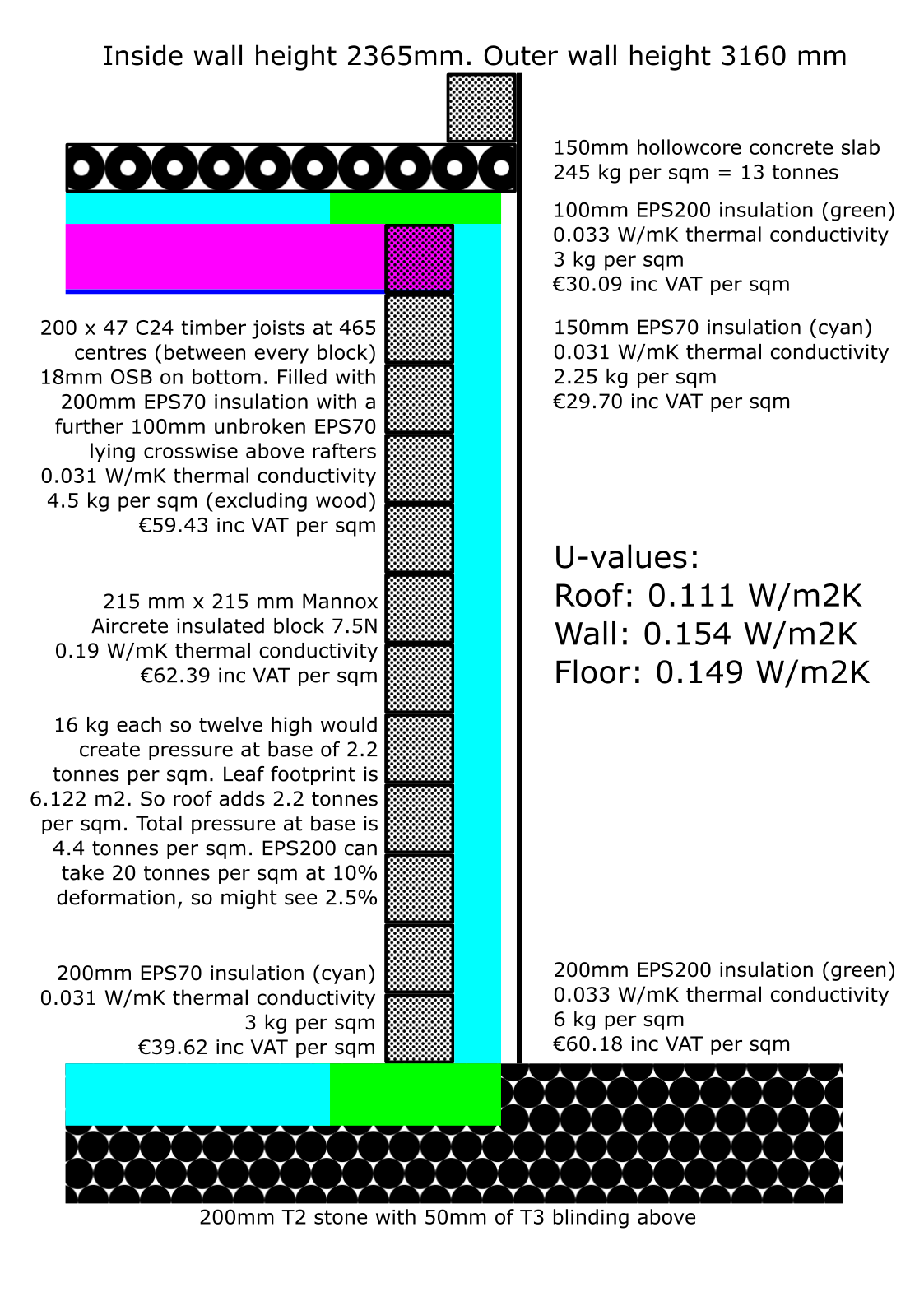
All the above is 100% my design and calculations, and I am neither an architect nor the right kind of engineer. Still, designing the main house has gotten me much more familiar with structural and thermal design than I was. A simple box of a building is now well within my capabilities, and I kinda enjoyed testing my new skillset above.
You might wonder why use the expensive aerated blocks within when they are completely thermally broken from the outside? It’s a good point, and that may get jettisoned yet for cost reasons as they are more expensive per sqm than anything else. Standard concrete blocks cost about €30 inc VAT per sqm, so less than half the cost. I had been thinking weight reduction, but also that you wouldn’t get problems such as condensation on these from sudden temperature changes which will be likely, as the gym won’t be in continuous use and will instead usually go from cold to warm very quickly for short periods of use.
The other thing I’d like to get rid of is the concrete slab for the roof if possible. It creates a cold roof and all the insulation being on the inside will risk interstitial condensation. It would be better if the insulation went right up to the flat roof membrane, thus making a warm roof. However to achieve that, I can’t see any way of avoiding the roof joists themselves becoming thermal bridges as they’d need to poke out far enough to provide shelter for the wall insulation. At 0.13 W/mK timber is better than those aerated concrete blocks, but still many many times worse than EPS. I would also need a continuous slab of EPS200 between the joists and the roof membrane, which is €1,600 inc VAT of EPS just for that alone.
Or would I? What actual weight lies on that roof? EPS70 can take seven metric tonnes per sqm with a deformation of under ten percent, and there is absolutely zero chance of that kind of weight.
The KORE EPS70 comes in 600 x 1200 slabs, so I’m wondering if I made the roof joists at 600 centres, a 220 x 44 joist should span 4.385 metres and the gap between the inside walls is 4.27 metres. The other package for KORE EPS70 comes in 1200 x 1800 slabs (exact same price per sqm), so if a warm roof won’t take much load, why not sandwich a 80 mm EPS70 board between two 18mm OSB sheets, and that’s your warm flat roof?
I reckon such a build up would have a roof u-value of 0.12 W/m2K; if the EPS70 between the OSB boards were 50 mm instead, then 0.135 W/m2K. That does feel more cost effective, and maybe I’ll do up the detail for that with costings at a later point.
Anyway, for the detail above:
- There is 52.84 m2 of roof and floor, let’s call that 53.
- There is 89.67 m2 of wall minus approx 13 m2 of glazing = 77 m2.
- 13 m3 of T2/T3 stone needed which would be 26 tonnes or so, so €600 inc VAT.
- Twenty-two lengths of 220 x 44 x 6m wood needed at €35 inc VAT each is €770 inc VAT total.
- Approx €3,150 inc VAT for the roof insulation.
- Approx €2,100 inc VAT for the floor insulation.
- Approx €2,300 inc VAT for the wall insulation.
- Approx €4,804 inc VAT for the insulated block wall.
- Approx €6k inc VAT for the charred larch outer cladding.
- Approx €8k inc VAT for the glazing.
- Approx €28k inc VAT in total excluding labour.
Obviously I omitted the hollowcore slab as I’m hoping to engineer it out of being needed, but it seems reasonable to me I can get that outhouse done for about €50k inc VAT or thereabouts. I originally had €80k inc VAT as a guessestimate, so that’s rather better than expected back when I first started planning this a very long time ago.
Anyway bed time for me! I should send some emails enquiring about progress before I go to bed …
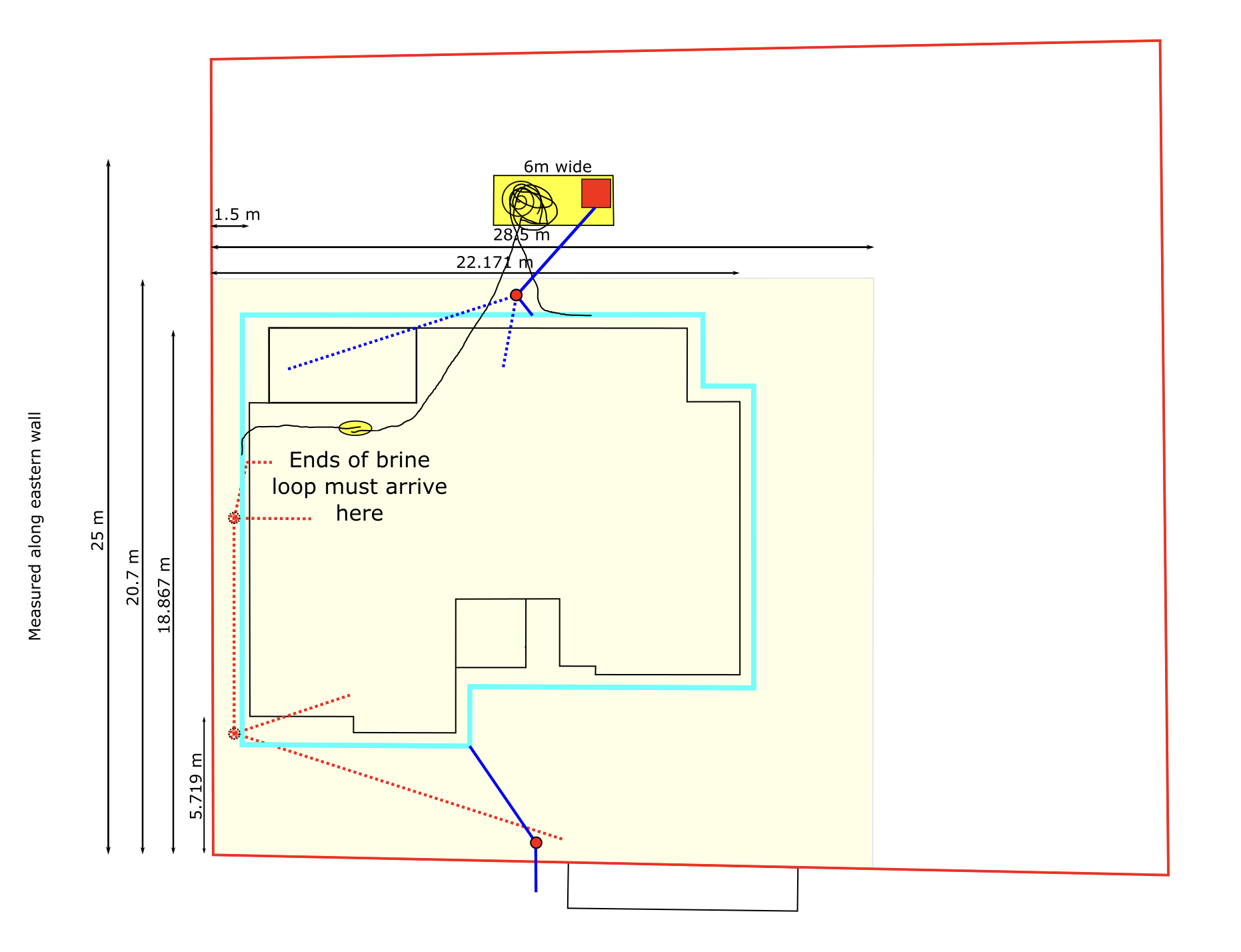
As the structural engineering isn’t done yet, we don’t know the locations of any of the service popups for sure, so we can’t do those. As this will be a raft not strip foundation, there isn’t any deadwork, the house ‘floats’ on a ‘sea’ of chunky crushed rock about a quarter metre deep. In some ways this makes installing the pre-foundations easy – instead of having to pour concrete footings and lay concrete blocks to support the future walls, you just lay (in this case) a 28.5 metre x 20.7 metre x 0.25 metre layer of T2 stone which is crushed rock between 4 and 40 mm in size. On top of that LL Structures our timber frame suppliers will compact and level T3 blinding, which is crushed rock between 0 and 4 mm in size, but that will be after the groundworks guys come back to dig up what they’re about to lay down to install all the service popups, which is some months away yet after their locations have been written into stone (heh!), and a surveyor has come out to mark out the exact locations of every pop up to within one centimetre. According to the groundworks guys, laying it down and then digging it up again is how you achieve exact service popups in any case, it is why raft foundations are ‘not good value for money’ compared against strip foundations, so the work would have to be done exactly as we are doing in anyway. We just have bumped this first stage up to before April 24th to claim the subsidy, that’s all.
As you can see in the diagram above, around the outside of the house there needs to be a land drain about 0.25 m from the outer walls. We need to install this now otherwise rain would fill this hole we are digging with a standing pool of water, which is not good for retaining a solid footing. It will be temporarily connected to a soakaway at the back and to mains stormwater at the front, and that should hopefully keep these sub-foundations from getting waterlogged.
I reckon about 150 m3 of T2 rock will be needed. Assuming 0.75 m3 per tonne, that would be 200 tonnes @ maybe €60 inc VAT per tonne so that’s €12k just for the rock alone. Plus €3-4k for pipes, inspection chambers etc, so €15-16k just for raw materials. Sigh. So much money.
But then, it is rather a lot of space, we shall be filling maybe half the total area of the site. To put it into context:
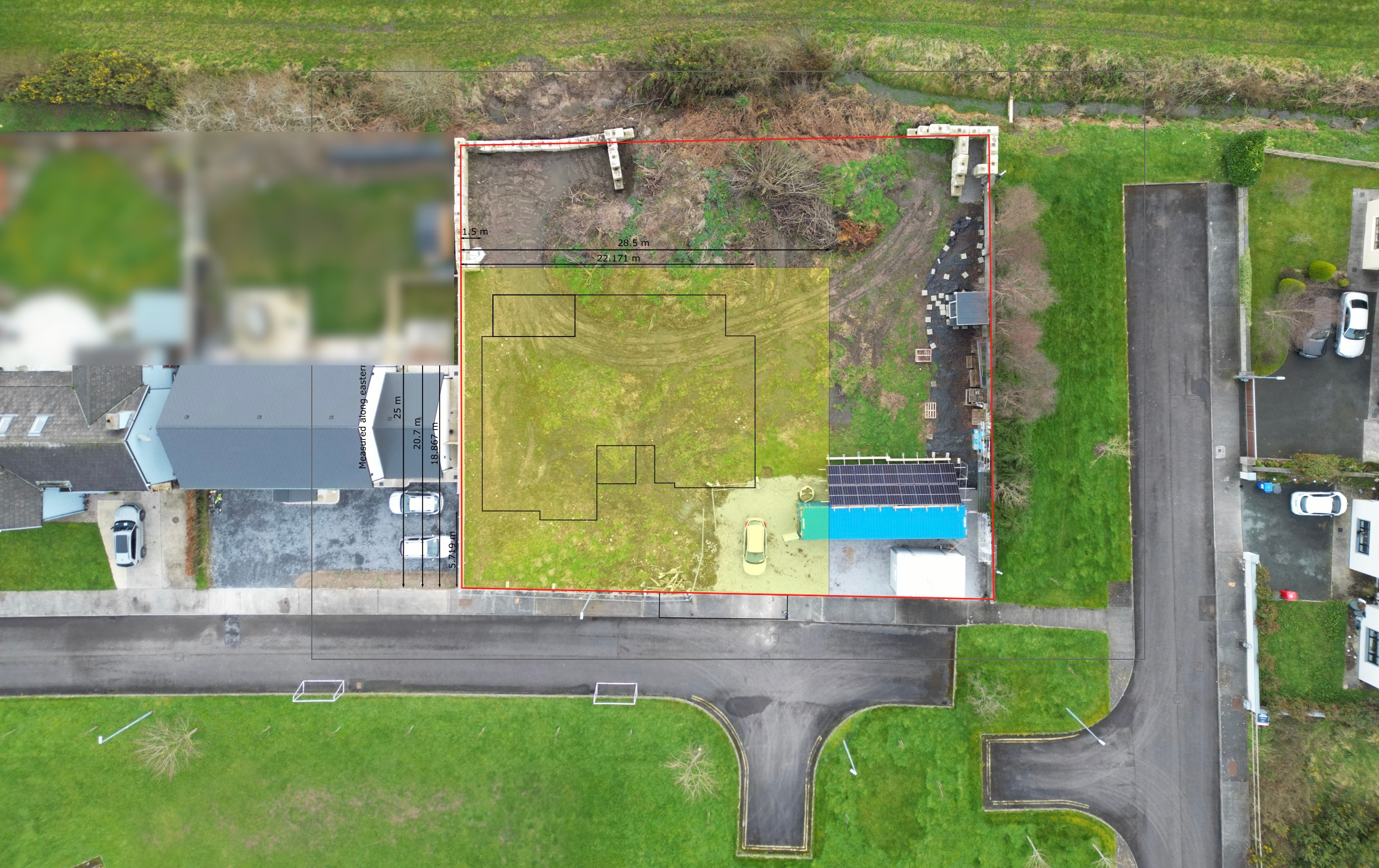
There is obviously a lot of rock going in around the house. This is dual-use – initially it will support the crane dropping in the timber frame panels and the other heavy machinery, however after that it will be the foundations for the footpath surrounding the house, the patio to the west (right of house in this picture), and the driveway to the north (bottom of house in this picture). So all of it will be needed, and none of it will be wasted. If you build a big house, it costs a lot of money!
The aerial photography
Those who read regularly may be thinking ‘aren’t those fine looking shots from above?’ especially when the satellite images I purchased from startup SkyFi weren’t great. You would be correct – they were taken by a new acquisition of mine, a second hand DJI Mini 3 Pro.
Even purchased second hand, this is not a cheap drone, they cost well over a grand new if purchased with the controller with a screen which saves faffing around with a mobile phone. The money does buy you rather good images though, the picture above is considerably downsampled from its original 48 MP image in which I can clearly see individual leaves on plants. DJI, being the world leader in drones and having overwhelming dominance in the drone market worldwide do come with a price premium, but in return you get a polished experience. Flying the thing is very fluid, very easy and natural. It copes surprisingly well in gusty windy weather, doing a very good job of holding position in all three axes. It has a bunch of safety gear on it to prevent you running into things when flying. It weighs under 250g, which means you are allowed to fly it over people once you have gained your drone pilot’s licence, which I have.
There are some negatives though. The first is the very annoying and completely artificially imposed limitations in features in software – for example, the Mini 3 Pro has the hardware to execute a preprogrammed flight path in 3D space like the Mini 4 Pro, but DJI have locked it out as product segmentation. They do allow a particularly braindead implementation (more on that later) because the hardware is capable, and they may enable the full fat unrestricted implementation in a future firmware update (it wouldn’t be the first time, they have a history of enabling ‘new model’ features on older models after a while), but for now it’s irritating to be locked out by software like this. The second negative is the DJI Fly App, it is huge and very heavy on resources. This is acceptable on a high end smartphone, but they did not fit their screened controller with a high end CPU, so the DJI Fly app on their own DJI RC 2 controller is slow, laggy, and annoying to use. Finally, the third negative is getting everything to register with everything else was far, far harder than it should have been. I ended up having to hard factory reset every bit of DJI hardware from a PC using a USB cable and DJI’s PC diagnostic utility before they’d talk to each other. Maybe that’s the price of used kit, I don’t know, but it made for a very frustrating (and slightly nervewracking) first few days after receiving the delivery. I will say in fairness the internet is chock-a-block full of helpful advice with DJI kit, and I fixed each problem as it arose quickly enough. It just took more time and hassle than it should have in my opinion.
Anyway, onto the preprogrammed flight path facility. This works by you telling the drone to fly between various points in 3D space with various camera angles, recording video as it goes. If you execute this daily, you could build a timelapse video of the house being constructed as you pan around the building because the video would overlay exactly onto the others over time.
As mentioned above, the Mini 3 Pro does have this feature, but it is restricted to an implementation which takes a photo every three seconds as the drone moves very very slowly between the programmed waypoints. It then stiches together the photos to make a video. Here is my last attempt at this, but transcoded down to 720p from the 4K original:
I’ll firstly apologise for the random slowing down and speeding up, that above is my best attempt so far, eyeballing out how to equispace programmed waypoints is harder than it looks.
There are plenty of other issues not my fault though. Firstly, if the sun comes in and goes away during the approx fifteen minute shooting time to generate twenty seconds of video, you get a most unpleasant lighting change between frames as that video demonstrates in full. Secondly, there is no motion compensation applied as there is when recording video normally, so any gusts in wind are very noticeable in the video as things move around more than they should. Thirdly, it just takes so damn long to do the recording, generally consuming most of a battery, for what ends up being a very short video for all that time and effort. Again, what really irks me here is that the hardware is more than capable of that drone whizzing around those waypoints video recording in 4K and 60 FPS with motion compensation running – which would produce vastly vastly better results, and be done in a minute or two rather than me waiting around fifteen to twenty minutes bored.
There is another annoyance – if you really are going to force it taking photos every three seconds, why are they capped to 4K and not giving me the full 48 MP it’s capable of? Then at least I’d get 8K video for all the time it takes. DJI, not that you’ll read this nor care anyway, your artificial software lockouts just suck.
First person view
In addition to the drone, I also purchased the DJI Goggles and DJI Motion 2 joystick controller. Yup, you can become the drone, and fly around rather like a bird or an airplane. I also purchased the wide angle lens which makes more sense for the FPV view, but I forgot to fit it before recording this which as a 4K 60 FPS video is far too big for my website, so here it is on youtube:
This was my very first time operating the thing in FPV, so you probably noticed I got much less jerky in the controls towards the end whereas at the beginning I was like ‘ahhh tree!’ and I yanked it away. I had the safeties on, which limits maximum speed so the collision detection has time to react. Those can be turned off, and the drone will go about twice as fast again.
What isn’t obvious from the video is the effect the googles have on your constitution. I’m fairly tolerant to VR goggles compared to most, I can wear them for an hour or so before they get to me. Well, at least for the Oculus or Google’s now abandoned phone based VR. I can’t say the same for these, even soaring high up over the estate as a bird had me wedging myself against the shipping container as I was finding it hard to keep standing. When I began swooping over the site, I began to feel very unwell indeed. Luckily, I had little in my stomach that morning, and I made myself keep going until the batteries on the drone ran out which was a few minutes after that video ended. After which I felt quite, quite nauseous for several hours, and even watching it again there now it’s bringing back the yacks a bit.
The headset drone experience – at least for me personally – is definitely best had far up in the sky ideally sitting down on a chair. The goggles do head tracking, so you can look around in 3D as if you were in VR, and in fairness to DJI it’s pretty seamless, though I suspect the likely hundreds of milliseconds of latency needed to actually physically turn the drone to match your head is what induces the disorientation. I could definitely see me using them to experience spectacular nature as if a bird, and I can see them being useful when checking the build of the house, so I’ll be keeping them, at least for now.
Indeed, I didn’t spend all this money on drones and accessories just for aerial photos and pretty timelapses. It will be used during the build to inspect the work being done in order to save me having to climb up onto the scaffolding or put up ladders. I don’t care for heights, plus it’s time consuming to set up and tear down height scaling equipment. It is much quicker just to fly the drone nearby and use its excellent camera to zoom in, and that’s the principle reason I bought it.
All the testing so far indicates my research was accurate, and it is more than fit for this purpose, especially as it will also fly indoors which lets me checking the roof of the vaulted ceilings without having to bother with the scaffolding tower. I think it’ll get good use and save me a lot of time and hassle.
Unfortunately we had to go get a new builder, so we have been pushed back by six months to the end of his queue and the cost of the build has jumped by over €100k. Which really sucks.
What went wrong?
The builder we had up until now had started making cold feet noises around October of last year. Up until then he was taking us to Builder’s Finish, now he was refusing to give quotes for Builder’s Finish and would only talk about Timber Frame Supply and Install, which isn’t what I had wanted as I had been specifically seeking project management. That got worse as we approached Christmas, and despite me having paid him a retainer, getting information about what he was willing to build and for what price became ever harder. As we are not building a standard Irish house, but rather the first certified Passive House Plus (note the Plus, it is one grade stricter than normal Passive House), we can’t and never were going to be able to use standard Irish build techniques. Indeed, we can’t even use standard Passive House techniques. The builder who has many years of experience building Passive House, knew we were targeting certified Plus from the outset. But I don’t think he was prepared for just how custom that was going to make the build, and time needed to define cost effective build approaches in the very shallow Irish building supplies market where there isn’t much choice, and prices for some materials are unusually high compared to elsewhere in Europe. As we didn’t know and couldn’t know if some material combination was cost effective or whether the builder was willing to do it at all, that necessarily involved a lot of back and forth, and the builder he was not supportive of this dialogue.
Furthermore, as recounted last entry, over Christmas we had to move from rigid phenolic foam insulation to 300 mm cellulose which needed a twin stud, as the unusually humid Banteer climate is too much for rigid foam insulation. That obviously needs more work to make the frames, and more insulation to fill them. So just as we were about to pay the first big deposit, in came a revised quote €110k higher. This came as bit of a shock at the time. It was 31% higher than the preceding quote.
Now, to be fair, I think that quote was fair for the spec involved. I didn’t think so at the time obviously, so I went and re-sought quotes for the post-Christmas build spec, some came in under, some over, but the ballpark was similar. To put it bluntly, if you move from a 0.16 u-value to a 0.11 u-value, that is a 31% improvement in insulation. The considerably thicker walls now need more timber, more support, more effort to manufacture to nail all those bits of timber together. It is as simple as that: one third more house costs one third more.
Choosing a new builder
While our former builder had given a fair quote I think, unfortunately once you enter that price per sqm now being charged, the landscape changes somewhat. At sub-€1,000 per sqm for sub and super structure supply and install, you get an economy-orientated custom design house build, so while the design is unique (and therefore a step above a catalogue once off build), there will be a single cost-optimised system and you can’t deviate from it (as has since become very obvious). In addition to a fixed choice build system, there will be various small compromises in terms of customer experience and build quality, but overall you get good bang for your buck, if you’re happy with what that system delivers.
However once you’re into the ~€1,250 per sqm shell price range, you’re getting into wealthy person builder territory – as in, the kind of builder who caters only to the very wealthy, where custom build-ups, custom materials, and custom ways of assembling them become more normal. This is because you’re now into performance-orientated or quality-orientated building, rather than optimising mostly for cost.
As an example, take Advanced Housing Systems who are a British based builder we got a quote from. They take you to nearly the end of First Fix, with only electricals, plumbing, and ventilation missing – but all the internal plasterboard and insulation is done (you might wonder how this works, they build conduit and ducting into their premanufactured panels for all the wiring, plumbing etc). They only use wood cut from their own forest in Devon, and only sheep’s wool from their own flock of sheep as insulation. Everything is done in-house, no subcontractors, so everything gets the personal touch. They’ll deliver and install your house anywhere in greater Europe, from an empty site they are done within one month.
This probably sounds expensive, but they come in at €2,083 inc VAT per sqm. That price includes M&E design, structural design, all the engineering, getting the stuff over to Ireland and hotels for the workers to erect it. Once everything is factored in, they’re actually very price competitive overall to an Irish builder, all the u-values are 0.10 compared to the 0.15’s you see from ‘passive standard’ builders, theirs is undoubtedly a superior quality build for the discerning client. And you’re probably thinking there must be a catch here?
Indeed there is: it’s financing. There are three mortgage lenders in Ireland who do self builds. Their stage payments are hardcoded to six stages based on the assumption everybody builds a concrete block house, and they pay in arrears. They do not allow for the large advance payments necessary to fund the offsite construction of timber frames. They do not allow borrowing in addition to the mortgage. You therefore need to front huge amounts of unborrowed cash in advance, and for that, you need to have in your bank large amounts of cash. Which I do not, as I’ve spent it as you’ve seen in the quarterly House build spend updates.
AHS because they supply more than most in their package they have larger upfront cash flow needs than most, so how Irish bank mortgages work is particularly ill suited for them especially, and that was the sole reason I had to rule them out (I would have loved to have chosen them otherwise). And, in fact, this same problem of financing also affected the former builder, because he supplied all the plasterboard and internal insulation (unfitted) you’ll need, and thus like with AHS his higher cost quote created a substantial cash flow problem for me. When he increased his quote by that much, it’s not that I couldn’t afford it overall, it’s that I can’t raise the cash flow to make the stage payments paid in arrears work anymore. You may remember that my mortgage is capped to 90% of valuation, so I can’t borrow more, I can’t borrow elsewhere, and I just don’t have the cash needed nor can I get it. It’s as simple as that.
So, when choosing a new builder, I had to choose ‘less is more’: the less they supplied in their package in one go, the less cash upfront I needed before the bank mortgage pays out in arrears. Paradoxically, this almostly certainly increases the overall cost as much more now needs to be done by direct labour, also it also hugely increases the amount of project management I need to do as much more needs to be done now once the builder has departed. Most unfortunate, but that’s the main reason why poor people remain poor: they don’t have the cash flow to avoid being forced into expensive poorly timed purchases. Same principle applies here: my lack of cash flow will increase my costs overall.
The builder chosen: Long Life Structures from Galway
We ended up plumping for Long Life Structures from Galway who have quoted the supply and install of foundations and timber frame for €1,234 inc VAT per sqm to airtightness. Internal partitions will be studded out, but all internal insulation and plasterboard will be supplied by me. It also doesn’t include the considerable fees I have spent and have yet to spend on M&E design and structural engineering, which the AHS quote included. As I mentioned earlier, I think the AHS quote cheaper overall, and certainly for the u-values for the euro they are far better bang for the buck, but in cash flow terms I can’t afford AHS.
LL Structures aren’t too bad for the u-values though in their standard buildup (which is a cost optimised derivative of those from Ecological Building Systems):
- Floor: 0.10
- Wall: 0.134
- Roof (sloped): 0.15
- Roof (flat): 0.09
These u-values are from my own calculations incidentally. You may not be surprised to learn that some u-value claims by some builders don’t add up. LL Structures actually claim worse u-values than the Passive House u-value calculation method, so I think those numbers above are almost certainly an upper bound, and we’ll get quite a bit better than those in practice. More like walls and sloped roof at 0.11.
What isn’t described by u-values alone is thermal bridging, which is something a lot of ‘passive standard’ builders particularly skimp on when thermally breaking the timber studs from bridging between inside and outside (u-values are the average, thermal bridges are the quality). You may see no thermal break at all, or a 25 mm or 50 mm break, and usually to the inside of the AVCL as that is cheaper though inferior, as it moves the interstitial condensation boundary inwards, which means you get things like condensation around the edges of your window frames, which can become mould growth. LL Structures apply 80 mm of thermal break to the wall studs, and it is on the outside not inside which is the more expensive but superior option. Similarly, for their flat roof they thermally break the rafters on the outside with 130 mm of unbroken cellulose. Where they do fall a bit short (as you can probably guess from the u-values above) is on the sloped roof, there the rafters are only mildly thermally broken, using a 220 mm + 75 mm nailed together stud, which is still better than an unbroken stud. The 295 mm space is fully filled with cellulose. We do have roof windows, however if you use the more expensive insulated flashings then moving the interstitial condensation boundary inwards by adding more insulation internally won’t produce the same mould problems as you’d get for wall windows, so that should work okay.
As would be usual for builders in their per sqm price range, they use only 100% natural materials and nothing synthetic, so no PIR board for insulation, no plastics, nothing with volatile organic compounds except where required by law (timber preservative impregnation). Like with AHS, they don’t use subcontractors, everything is done in house by their own employees to ensure the personal touch. Obviously I did ask around about them before hiring them, multiple independent sources said they were good. I pulled all their recent company accounts from the public record, they had a bad few years from covid lockdowns and the build material costs going up so suddenly, but they’re back into profit as of last year. I went to see one of their sites mid-build, construction quality and detail was better than average. I saw multiple small touches here and there, stuff most builders don’t bother doing. Nice.
Here’s hoping it’s all smooth sailing from now on!
New Passive House certifier
Passive House certification comes in two stages: (i) design preassurance and (ii) the actual certification. Bob Ryan our certifier, has decided to retire from certifying so he had only done (i). That means I will need to hire somebody to replace him for (ii), which is inconvenient.
I have received a quote from a potential replacement, and hopefully that will be the end of yet another thing going wrong.
New mortgage
As there is now no way of drawing down the mortgage before May, we will
need it extended. However the cost has also gone up, so of course they
want me to reapply in full from scratch  .
Which is something like the third time I’ve had to supply them with all
my financial statements blah blah blah.
.
Which is something like the third time I’ve had to supply them with all
my financial statements blah blah blah.
I’ve been effectively applying for the mortgage now for two years. I’m going to have to go rejump all those hoops once again like a good little show pony. It’s getting really very tiresome. This is the kind of hassle and inconvenience which results when you change builder last minute – if you can, try to avoid doing so yourself!
Still no entrance door
Last post I had a picture and a cool video for a Sika entrance door. I was hopeful of acquiring one at the time, since I am not.
Sometimes it really sucks to be on an island far off the coast of Europe, and nowhere near a big enough city. Finding decent entrance doors for a good price really shows this. That Sika entrance door (manufactured in Northern Ireland) had a quote for a cool €4,990 inc VAT for supply and install. I know for a fact you can pick up the door in Dublin for under €2k inc VAT, but then you’d need to transport it and install it.
€5k is at least better than the €9k Internorm wanted to supply and install their entrance door. But both quotes are quite frankly ridiculous. It’s a single fucking door, it’s not worth the cost of replacing my or Megan’s car, which is what a spare €5k would do for us. I did hunt around for other reasonably priced doors and we’ve shrunk the door opening to a standard 1000 x 2100 to aid that, however I’m currently thinking I’m just going to ask Nordan for the entrance door too, despite that their entrance doors kinda suck. It’s just easier and there are bigger fish to fry.
New pictures of insides
Last post I mentioned that there had been a few design changes after the PH design assurance stage, mainly that the walls have become thicker and the steel structural support has been moved inside the airtightness layer. Two years ago I rendered images using the then state of the art Unreal Engine 5 which involved a lot of work to convert the BIMX to TwinMotion, and from there to UE5. Back then, the 3D render from Graphisoft for their BIMX was best described as ‘basic’, but they’ve made very significant strides forward even in the past six months such that these look okay, and my urge to render them via UE5 isn’t as strong.
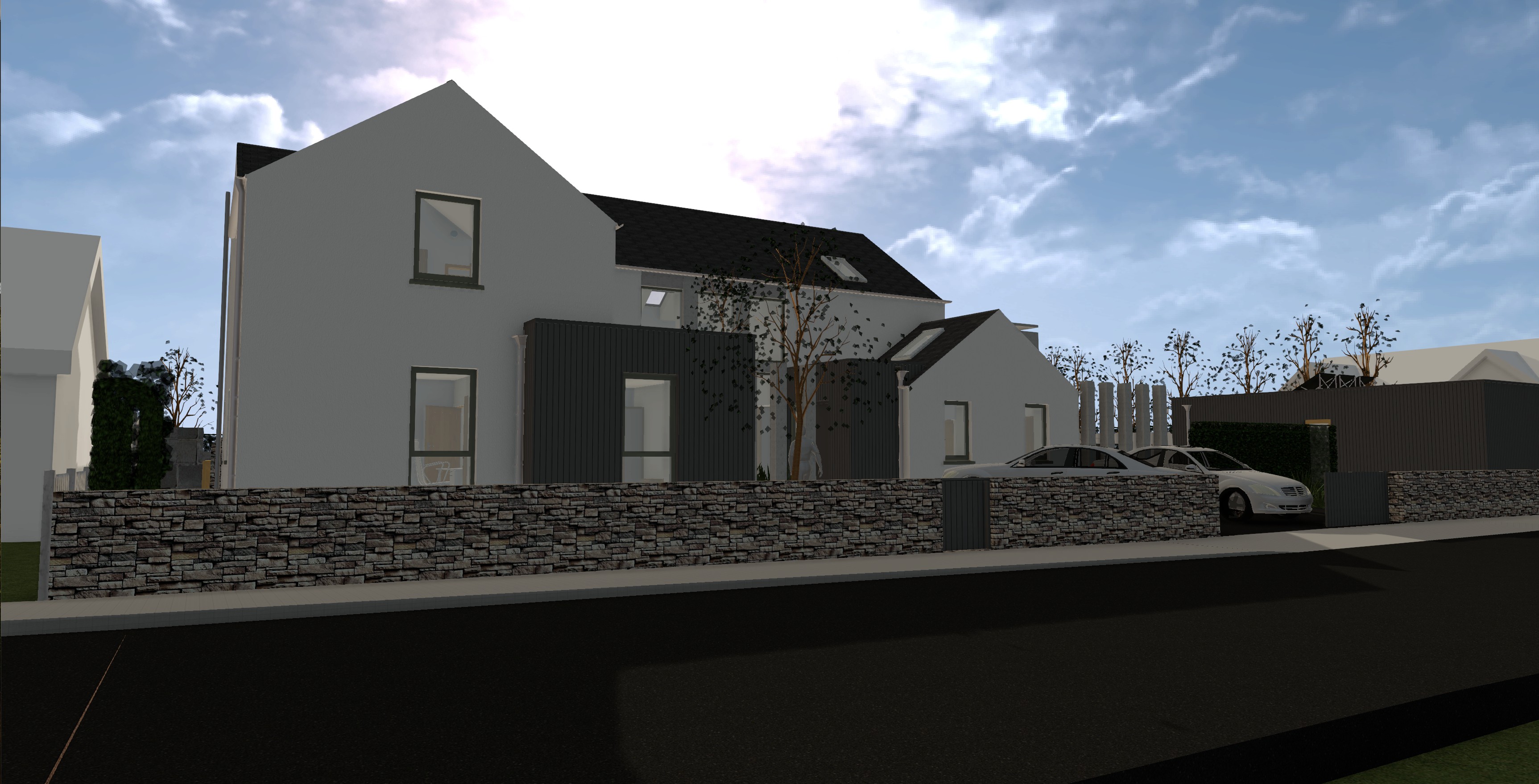
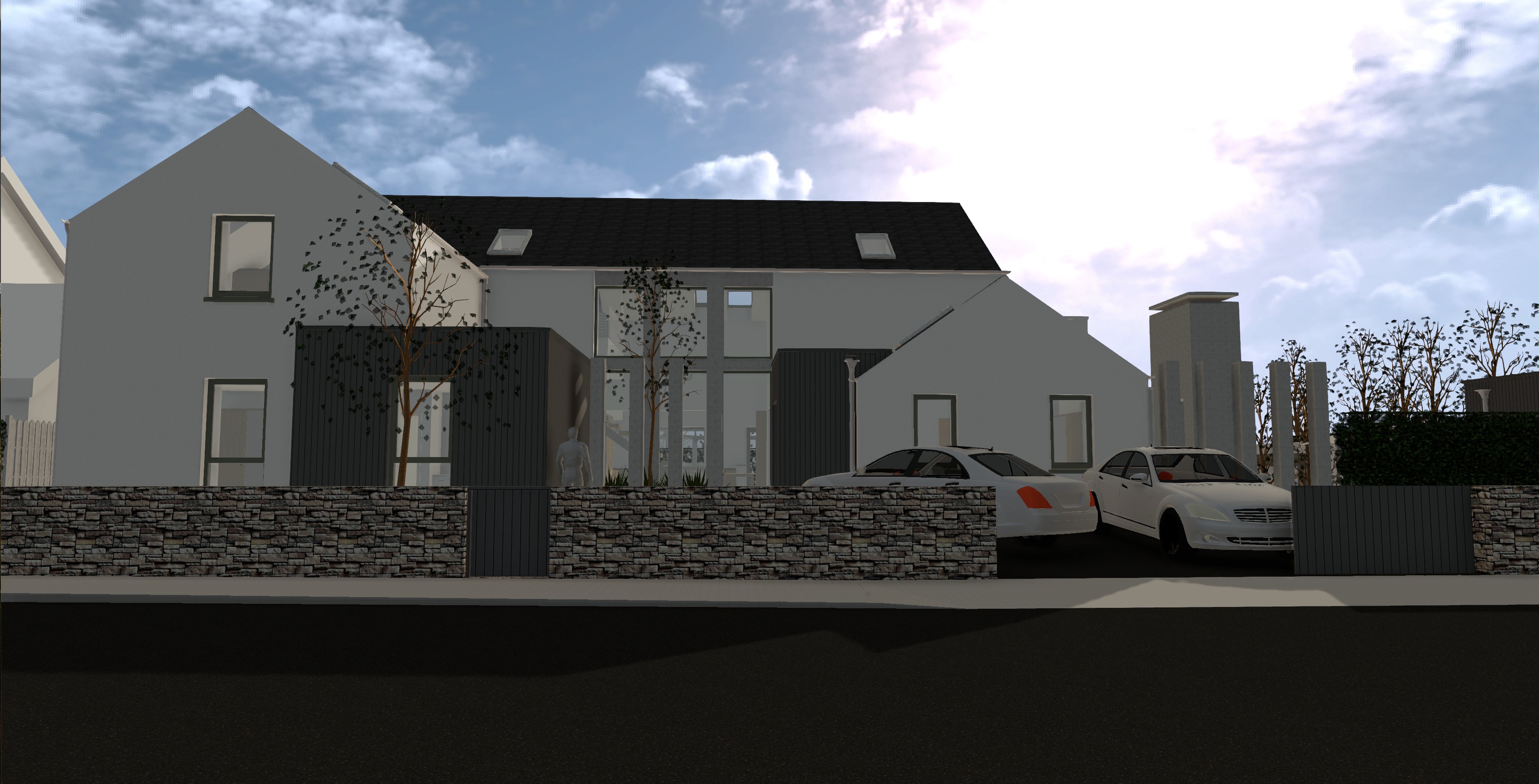
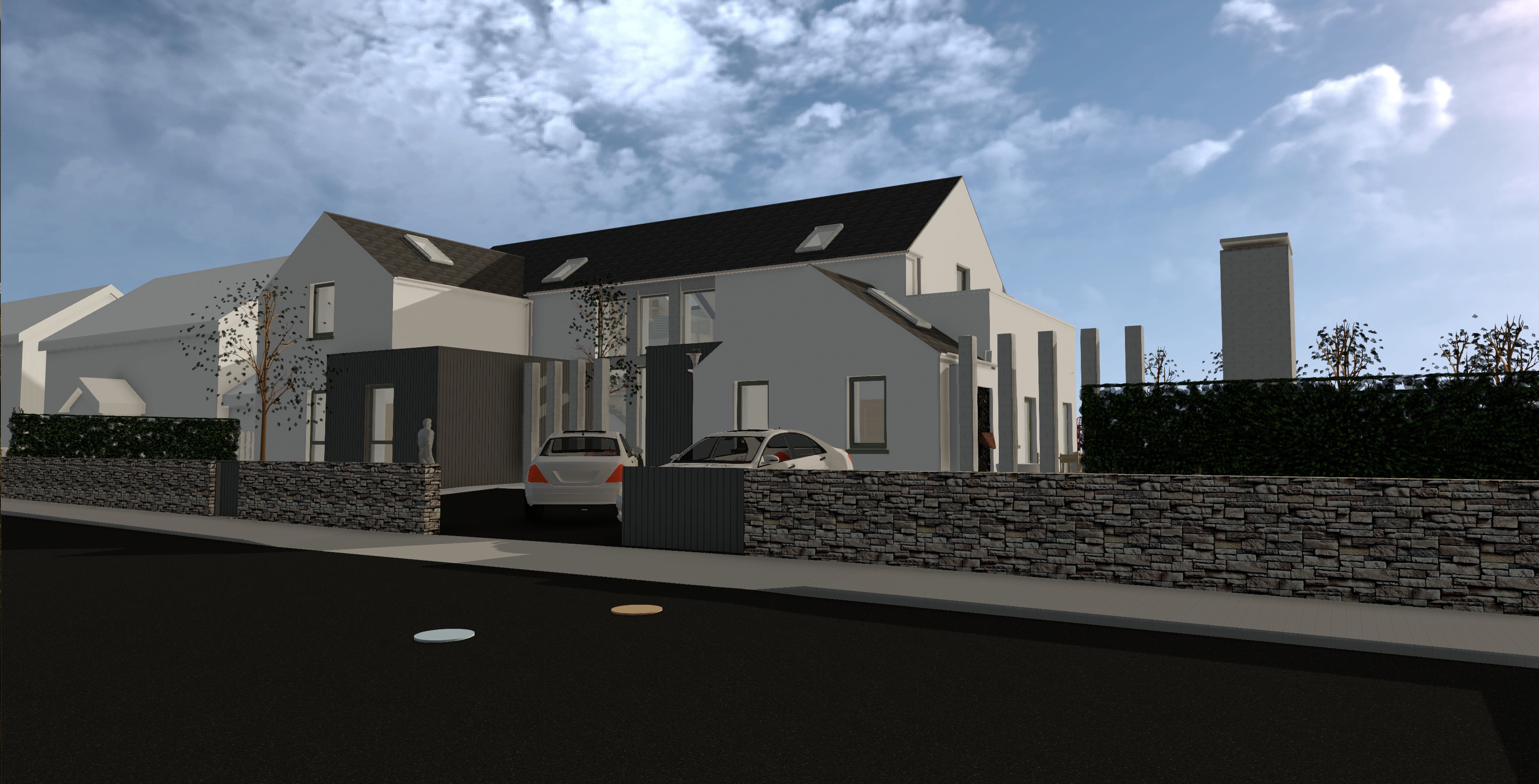
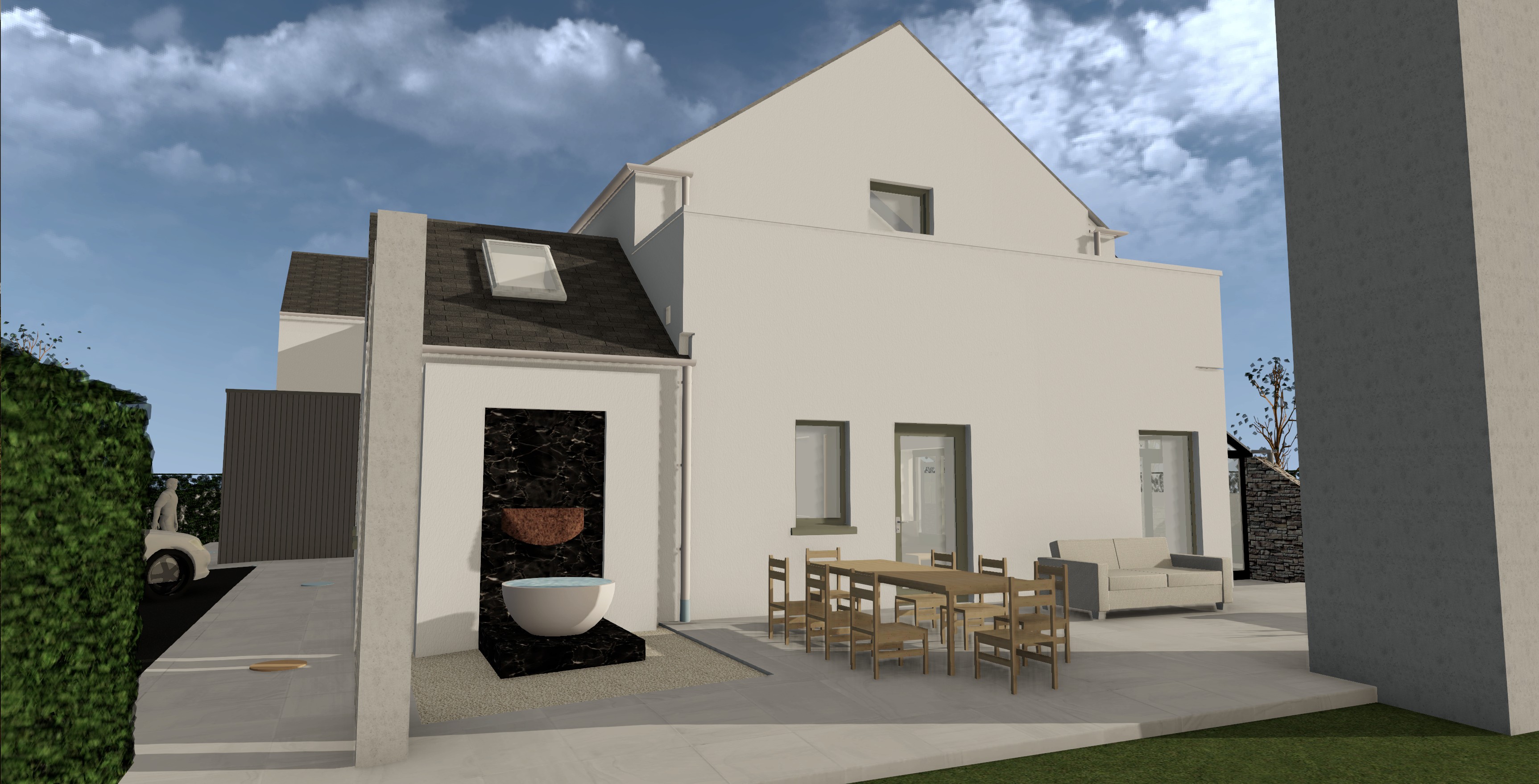
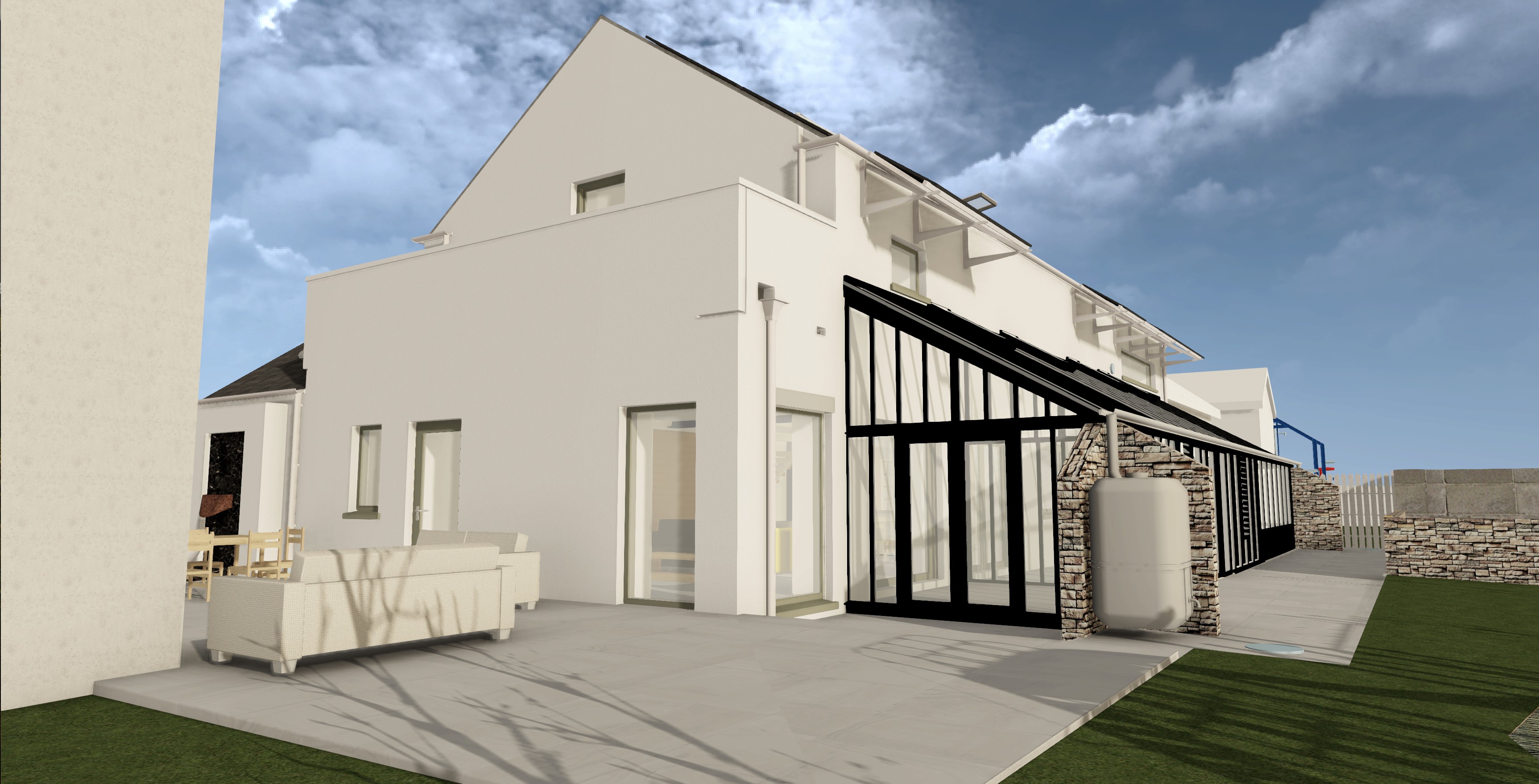

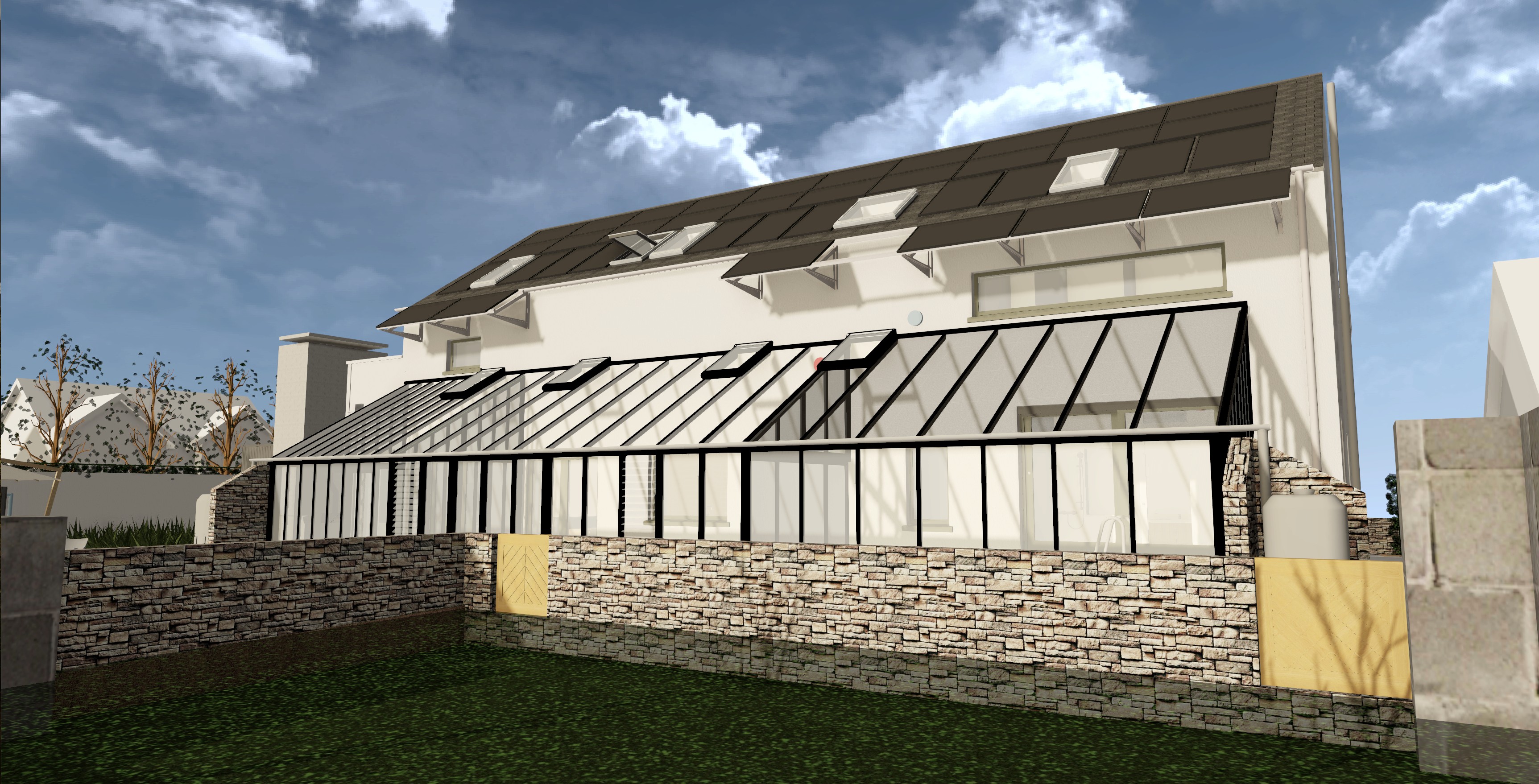
Those definitely aren’t terrible, there is now a reasonable attempt at accurate shadows and lighting, and the high resolution skydome does no harm either. Without doubt nowhere near as good as Unreal Engine 4 never mind 5 – the lack of light bounce and reflection is especially noticeable – but these are sufficiently good that I’m not leaping up and down to go through the hassle of a TwinMotion to UE conversion cycle. These will do.
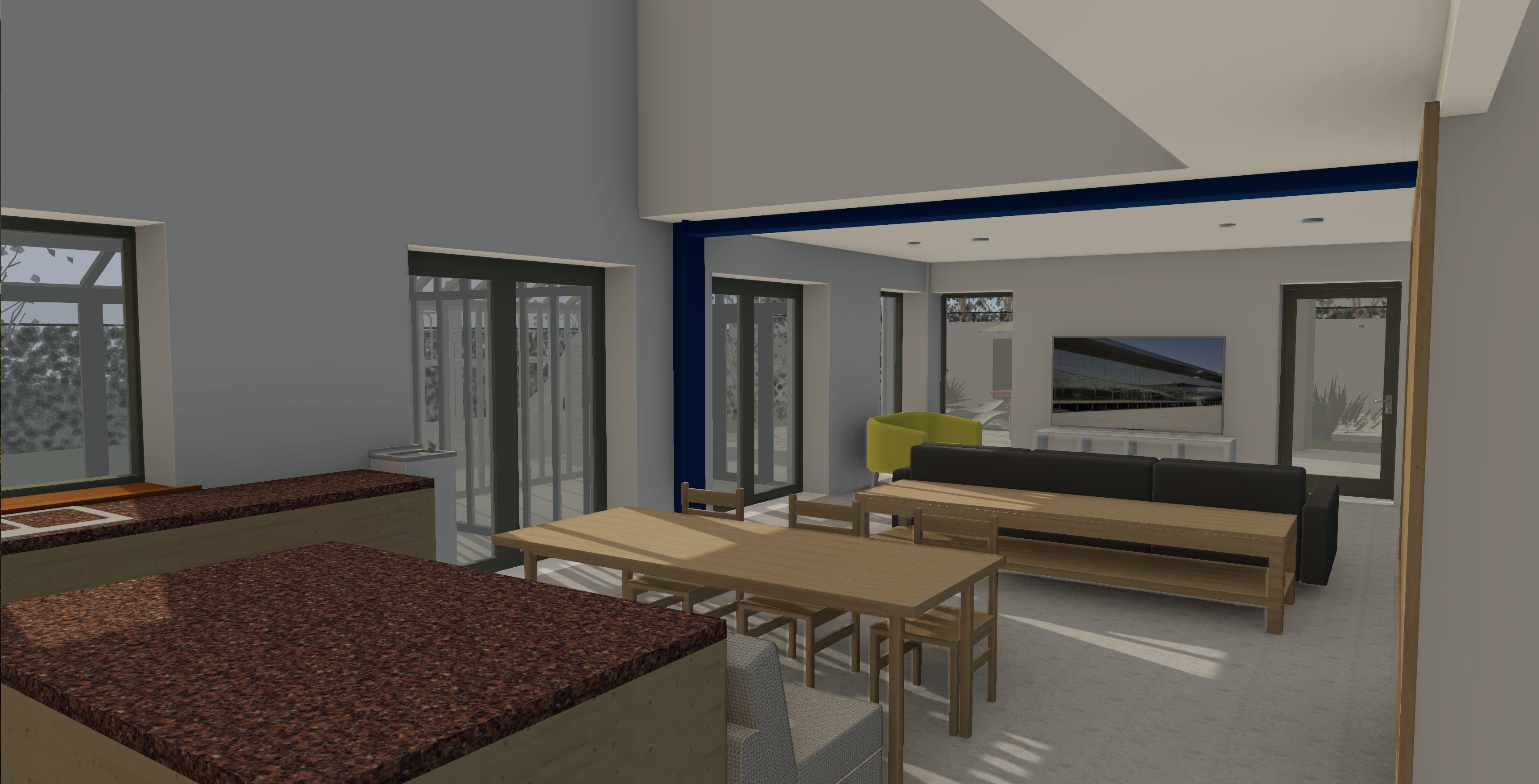
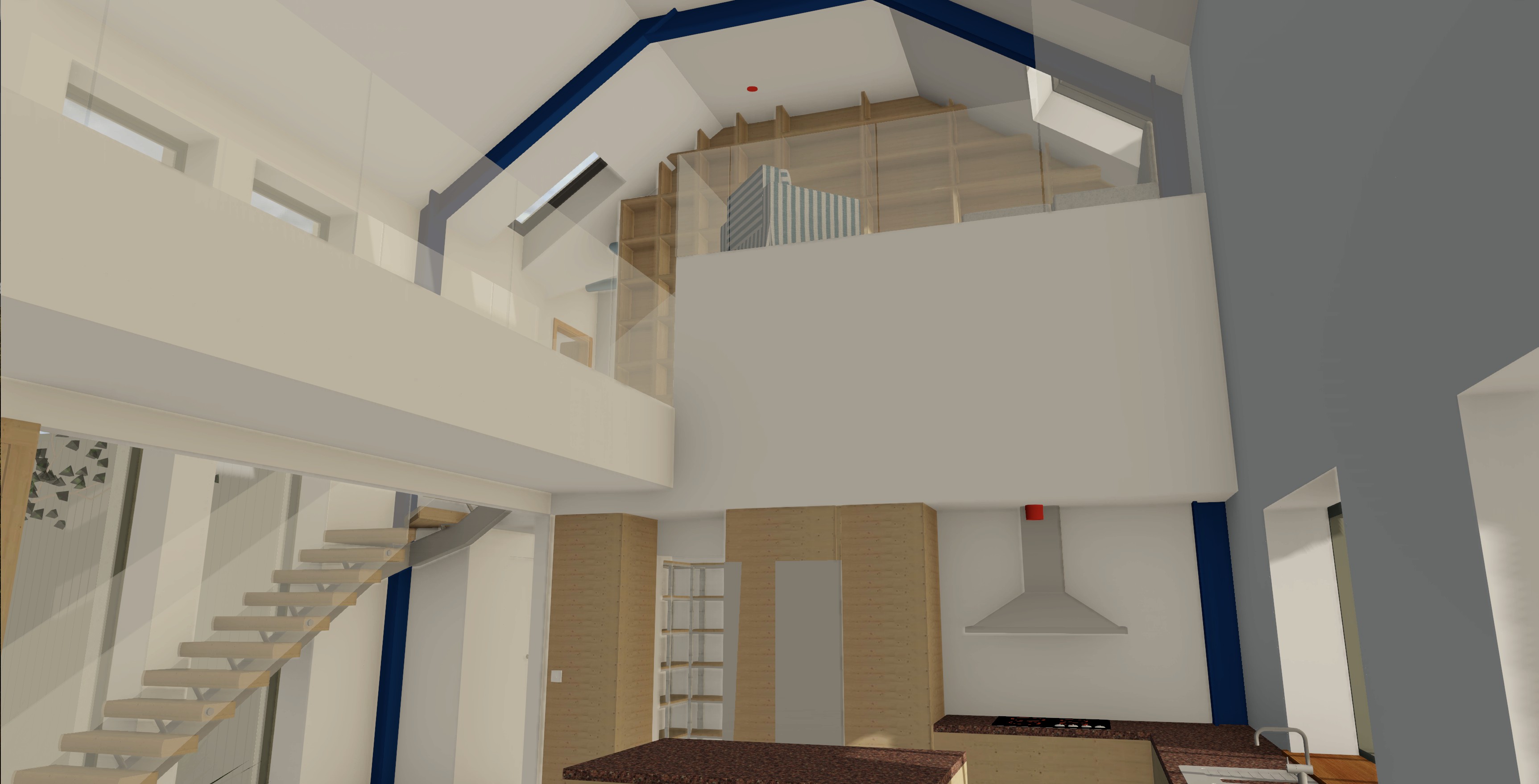
There is now a pronounced steel beam, coloured here blue (we will be using ochre red in reality). We deliberately have it exposed where possible now, so you can see it holding up the house over the mezzanine, and within the home office.
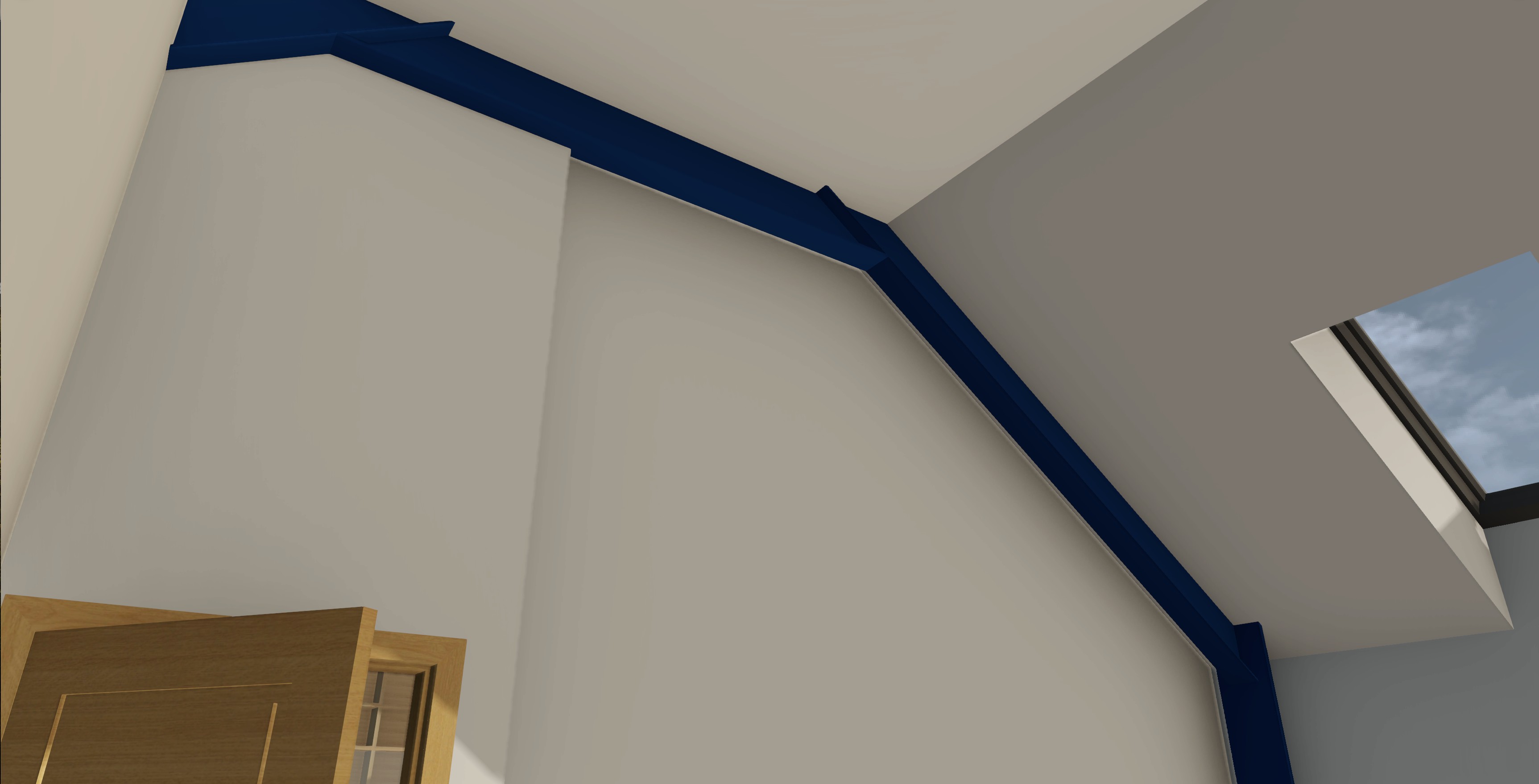
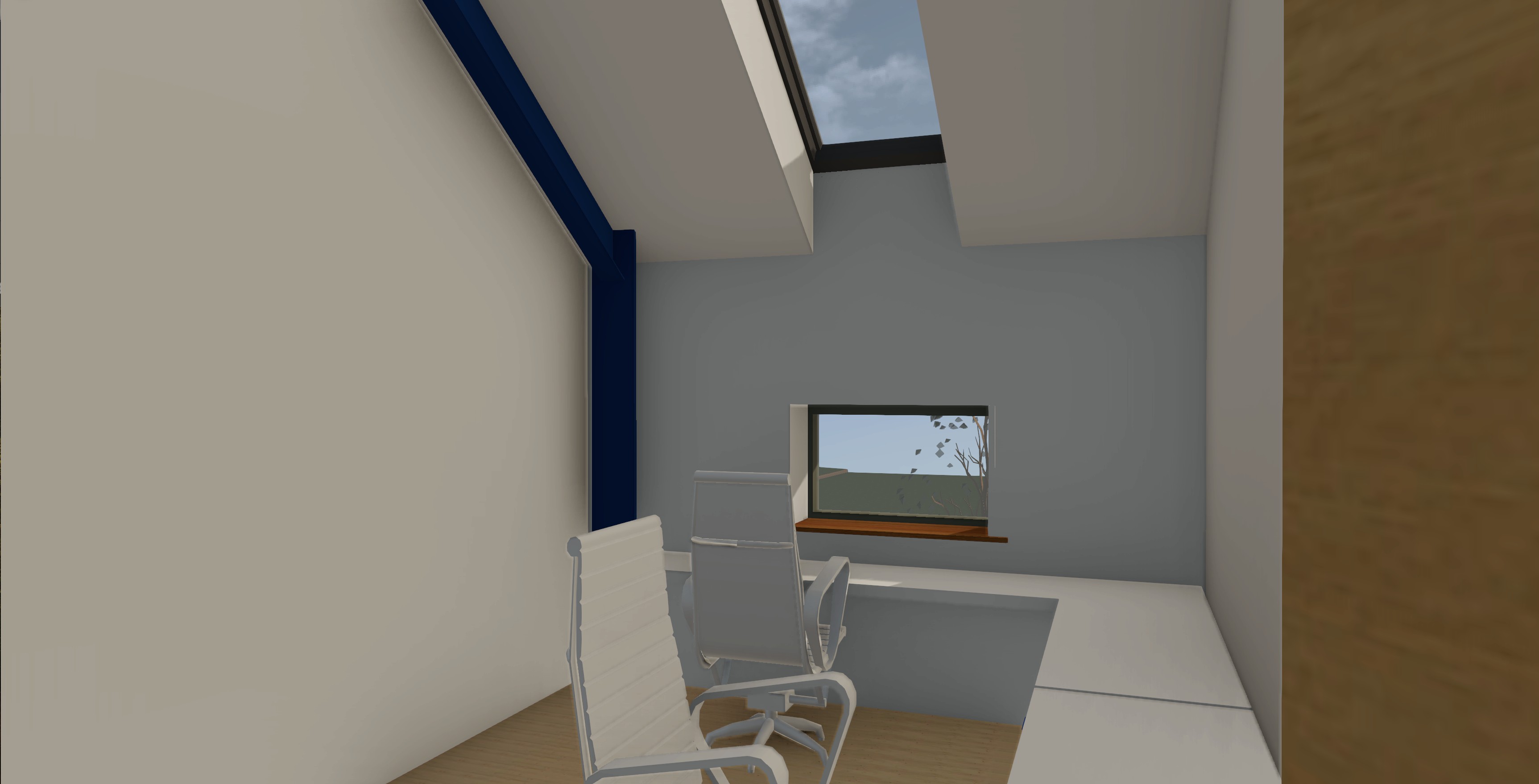
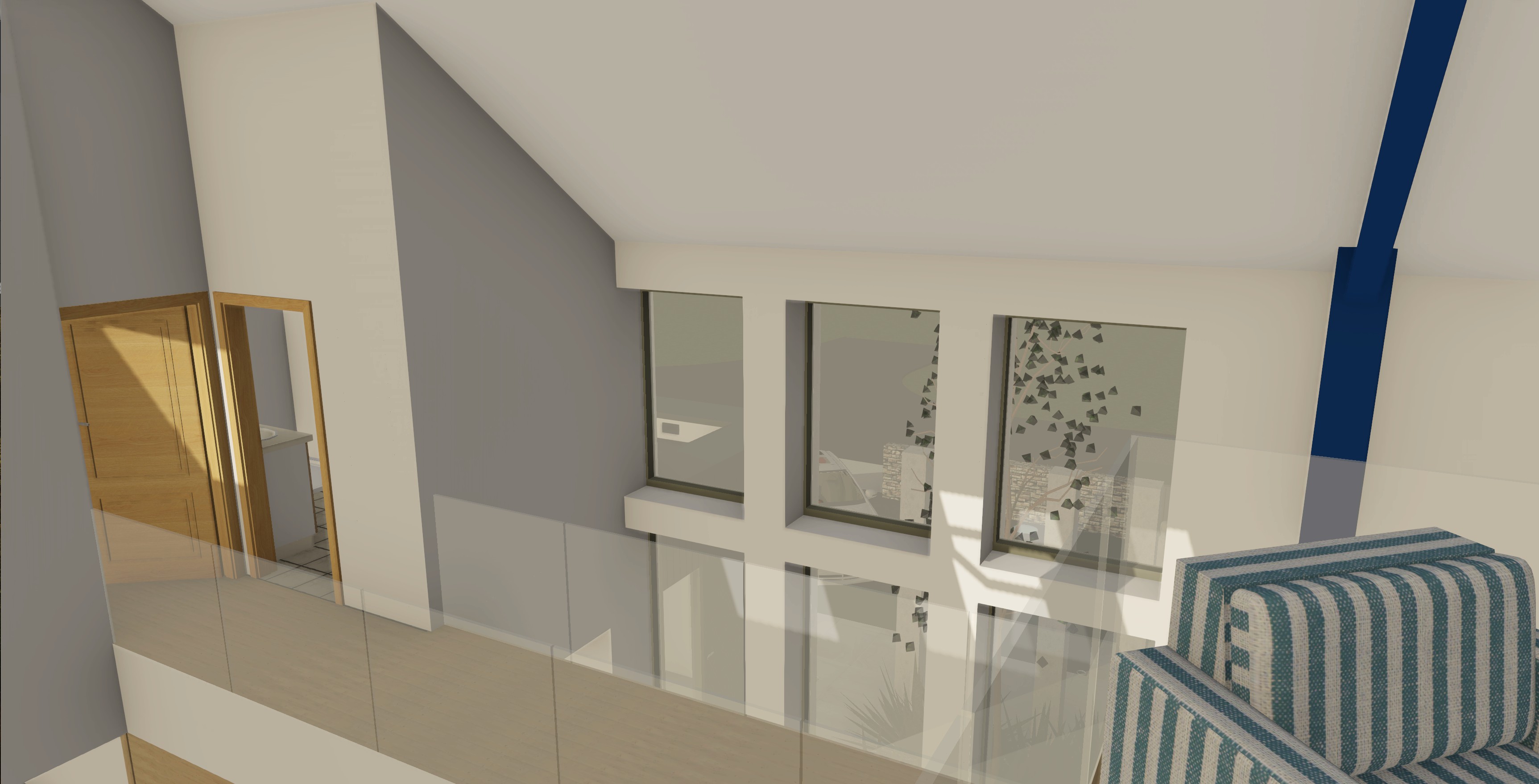
That last picture shows how the curtain glazing at the front has quite noticeably shrunk due to the walls going from 0.4m wide to 0.5m wide. Because both outer walls took 0.2m, but also the two columns in between, those windows went from over a metre wide to under a metre wide. They’re still the central feature of the house design, just not as pronounced as before. Obviously shrinking them did also have an outsize impact on heat loss to the north, so it greatly improved our PHPP numbers, and it’ll also reduce our glazing bill. Still, feels a bit of a shame, equally also very glad to be spending less on glazing now we’ll be spending more on structure.
Finally, there is an alternative render of the house which is kinda cool:
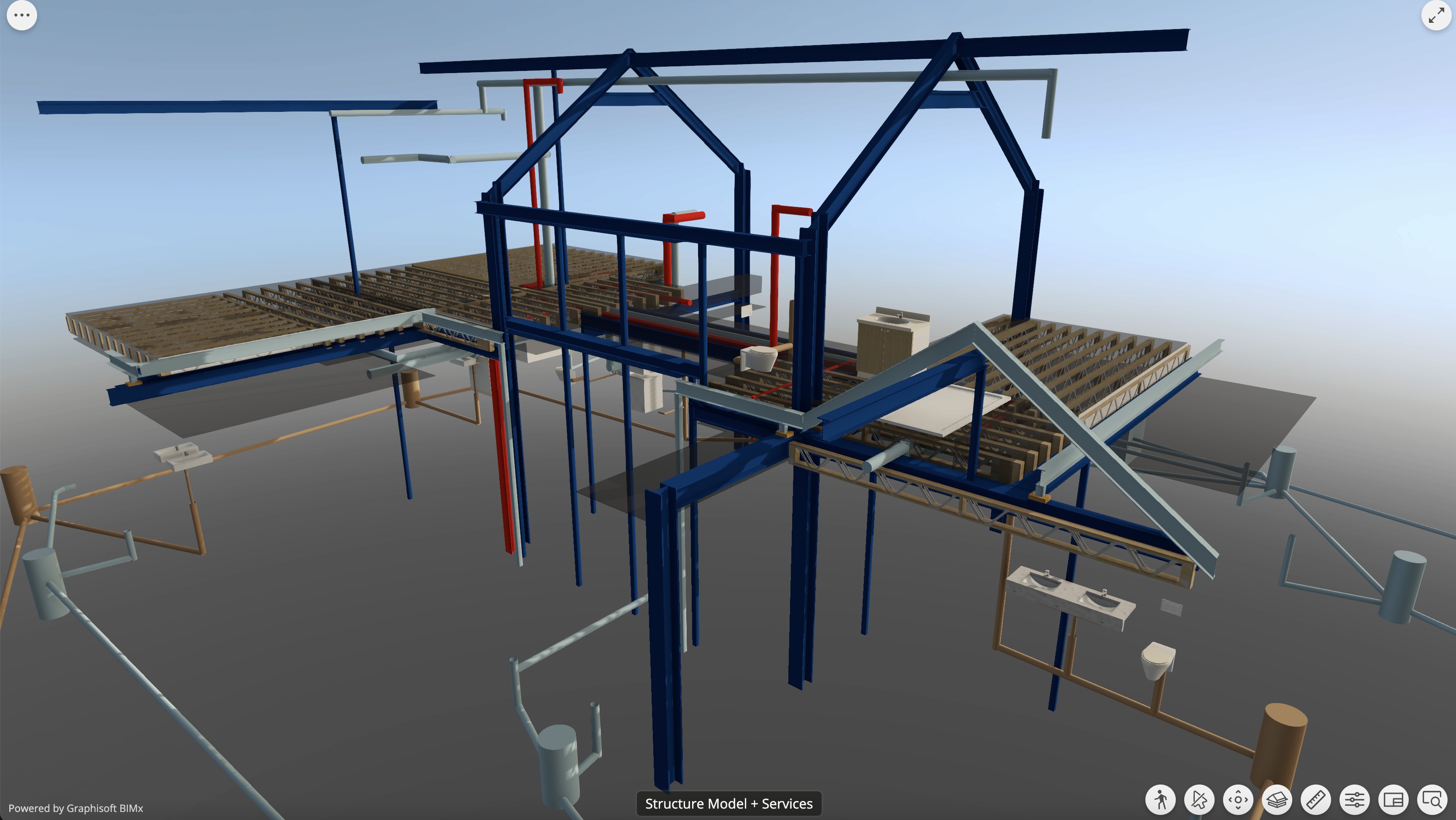
This is the house ‘nude’, as it were, so you can see all its drain pipes, ducts, joists and of course steel frames. Plus all of the gubbins which lives underground like sewerage and storm drains.
What’s next?
Now the €25k deposit is paid to LL Structures, the General Arrangement drawings will begin in about five weeks from from now, so last week of March. That might take a month, so to end of April. Then begins structural engineering design, which might take us to end of June. At this point off-site construction of the timber frames can begin, and the foundations and steel frame can be installed probably during July. The timber frame should therefore get erected in August.
Before then, we need to ‘commence’ before April in order to claim a development contribution levy subsidy. We think installing services popups and the base for the raft foundations is doable before then, so that’s the current next highest priority as it’s a saving of €13-15k or so.
Before we can do that, myself and Megan need to sign off on the final final final plans which once sent to the timber frame manufacturer shall be immutable forever! We’ll do that this weekend, unblocking everything else next week.
Design changes post Passive House design assurance review
Visible changes since the last time I posted computer renders here are few, but quite a lot non-visible did change:
We moved from a 140 mm tinber stud wall filled with phenolic foam to a 300 mm split stud filled with cellulose. This caused the side walls to go from ~0.4m to ~0.5m, which is a lot fatter. The cause was during PH design assurance Robert Ryan our PH certifier found runaway moisture build up in the walls in the humid Cork climate which is our site location. To be clear, it was very close, it took six years in the model for the walls to become saturated due to accumulating more moisture annually than being able to expel it. In the real world, that assembly could have been absolutely fine for twenty years, or riddled with mould and needing demolishing within two. It would depend on the actual weather, obviously. And no shortage of timber frame houses are built in Ireland and are just as close to the margin, and are fine (or not!).
Obviously, had our climate been just a touch dryer e.g. in Dublin, there would have been zero issue. But it just goes to show how careful you need to be with foam insulated timber frames in a humid climate.
Anyway the cellulose airs out much much better. Bob’s modelling found zero moisture build up even if the Cork climate had winter levels of RH for six months of the year. You just need a little bit of wind through the outer cavity, and it’ll dry out.
Obviously due to all the walls getting thicker by a quarter, lots of stuff had to be resized, especially the north curtain glazing which had to shrink in width. This improved heat losses obviously enough, and gave us a nice safety margin for PHPP. Indeed, we used some of those heat loss gains to make other windows a bit wider as we had the energy budget.
Previously, the steel frames had sat within the insulation as foam is rigid and detailing could keep the steel warm. My best understanding is that it isn’t wise to put steel through cellulose (I don’t entirely understand why, google says it doesn’t corrode steel and packs itself very snugly around steel), so our architect moved the steel frames to inside the airtight layer. Hence, we now have steel frames sticking out everywhere.
It could be worse, we knew from the beginning that if we wanted vaulted ceilings, we could be getting exposed steel in return. So we’ve made the best of it, they’ll be painted oxide red and we’ve exposed them everywhere we can so there are clean lines, and you can see how it all hangs together.
As a result of the steel frames coming inside, we had to lose one of the windows in the reading area of the library mezzanine. Bob wanted one more solar panel anyway for safety margin in PHPP to ensure we’d definitely achieve Passive House Plus, so that window has been replaced with an additional solar panel, making thirty-seven in total.
Other than those changes, the house looks as it did before. When Stephen our architect updates all the feedback from all parties solicited to the first release of the draft final plans, I’ll present some screenshots here as barring any surprising changes coming from the structural engineer, that’ll be the final final house design.
Electrical schematics
As we are heading quickly towards the design being written in stone forever, there were a lot of loose ends which needed tidying up.
Firstly, I really needed to get the detailed electrical schematics finished. I kept putting them off, as they’re tedious and time consuming and I’m busy, but earlier tonight I made myself complete every room in the whole house, as I can tarry no further. I still have yet to do the distribution box design and load calculations from tying all the rooms together, but finally I have a schematic with everything every room in the house will have (electrically speaking, anyway). Here are some examples for (i) Master Bedroom (ii) Master Bedroom Bathroom (iii) Utility (which shows all the space heating stuff) (iv) Kitchen south:
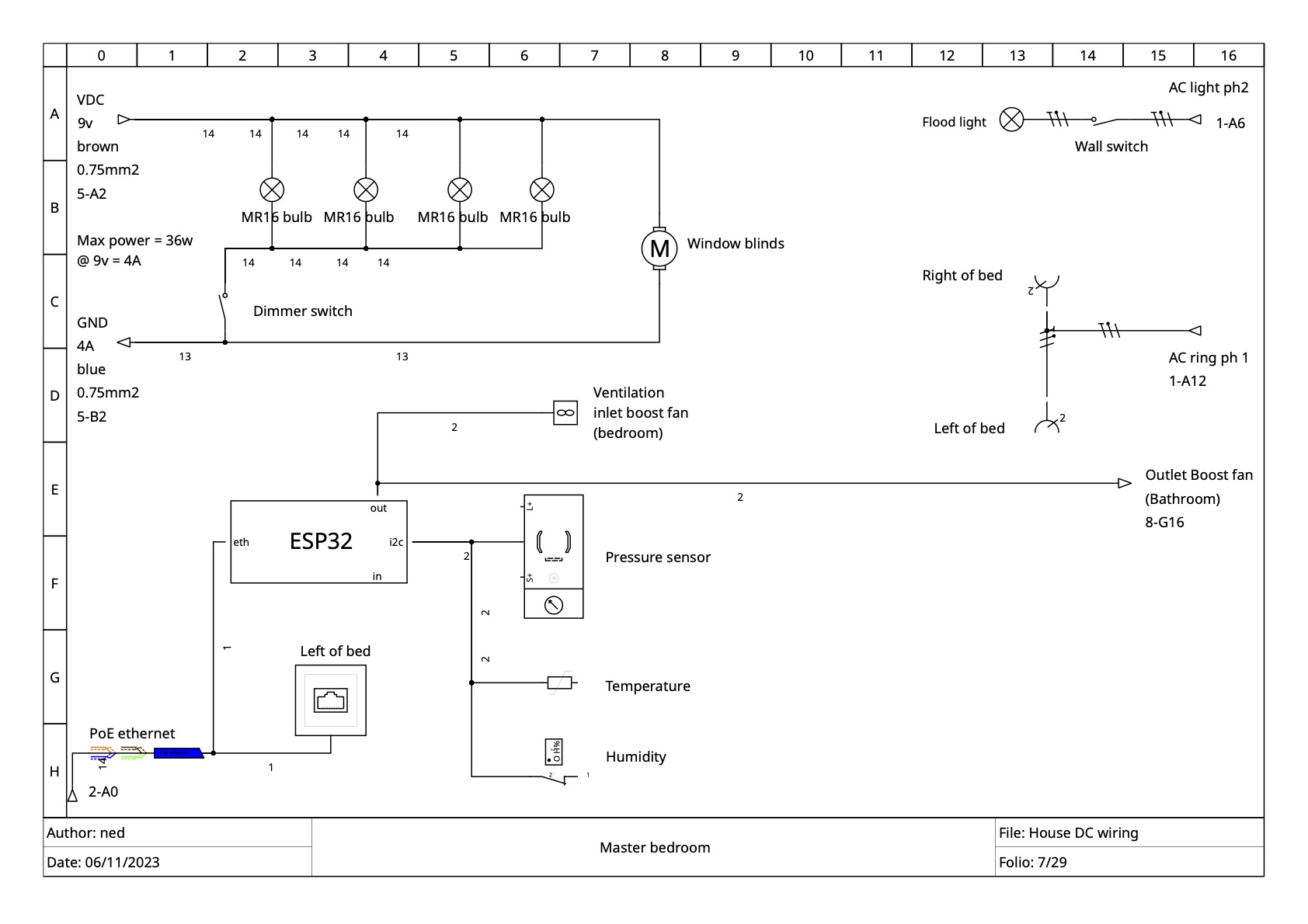
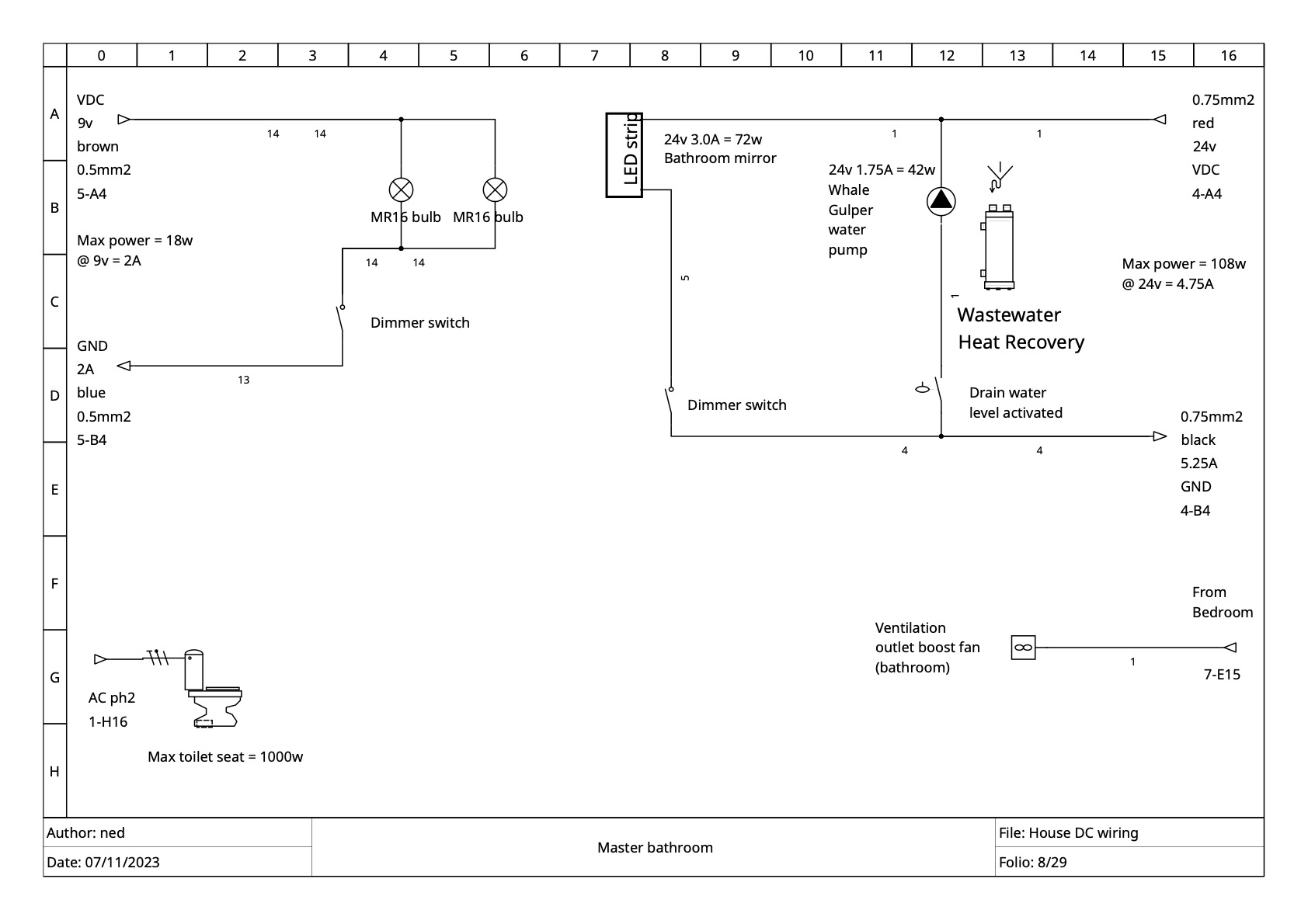
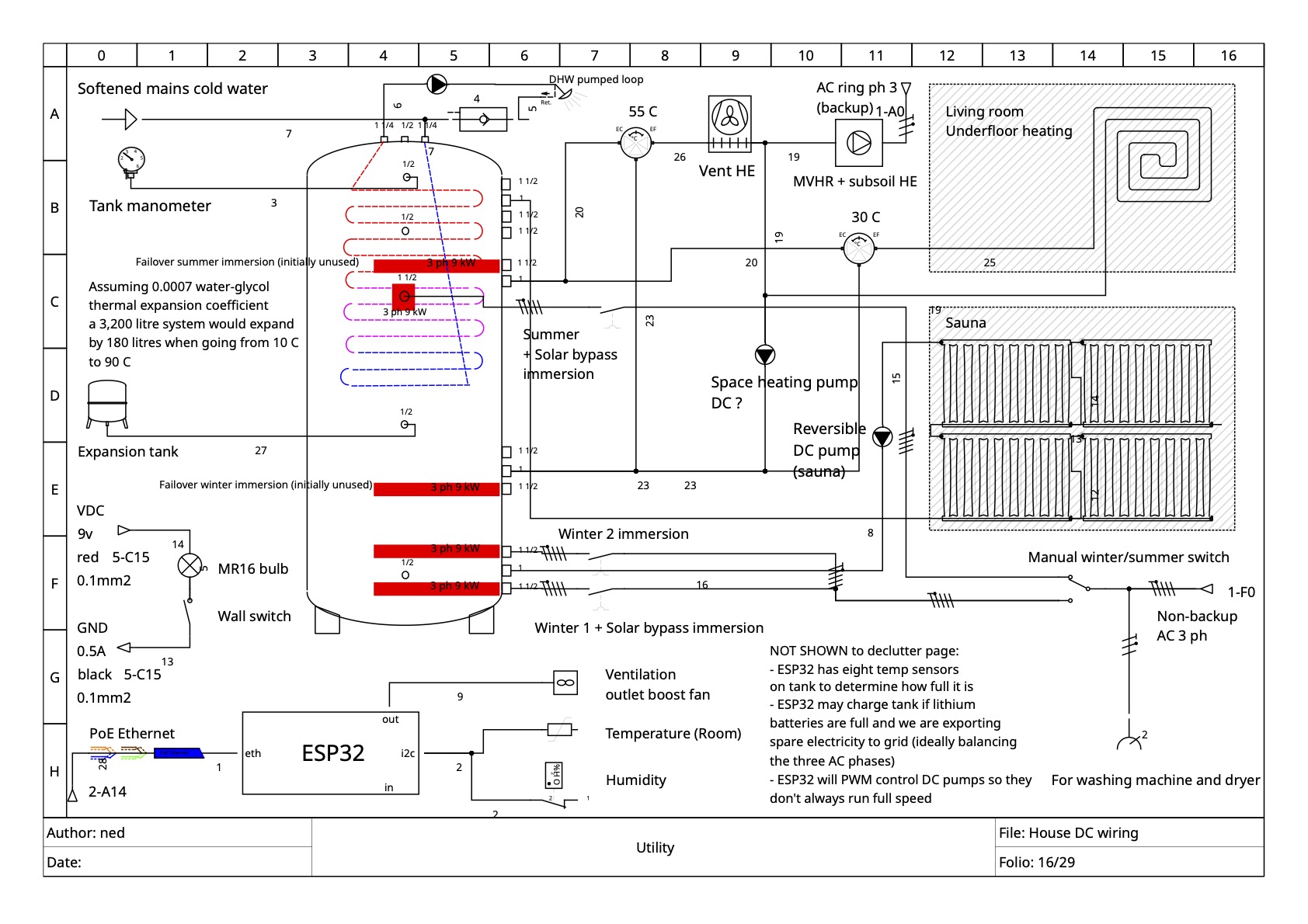
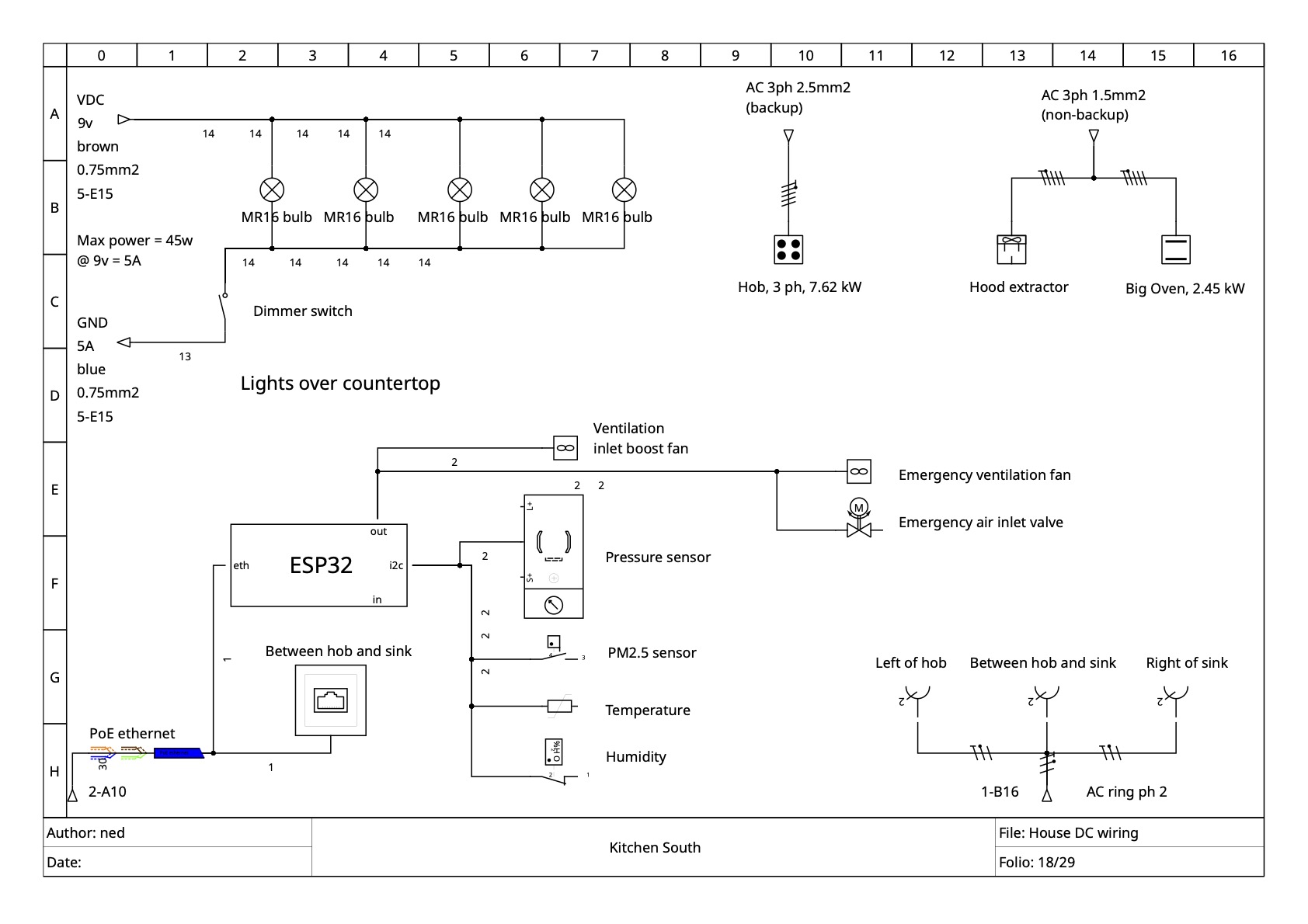
The software I used is QElectroTech. It isn’t too great if I’m honest, there are loads of small annoying bugs and lots of stuff which feels either half arsed or half finished. But it’s free, and it does get the job done. I think the print renderings are especially not half bad, frustrating and tedious as it is to make them in the first place.
As all the socket and light placements have been fixed, I can now design exactly where to trunk the cabling once wire load calculations and distribution box design is done. All that is a few more hours work, the hard part was getting all the rooms done as now I can give a good approximation of what cable trunking will be needed and where, so we can tell the builder and structural engineer exactly where penetrations into the foundations will be e.g. if you need to lay a conduit for some underground cable.
The main entrance door
Another item I’ve been kicking down the road was the front entrance door. Nordan will be supplying all the glazing and doors apart from the entrance door, mainly because Nordan’s entrance doors do not look good. Indeed, their only passive spec entrance door very much looks like a school canteen door. I don’t know who designs their entrance doors, but they should replace them, whomever they are.
Munster Joinery’s only passive spec (u-value <= 0.8) door looks fine from afar, but when you get close to it it does not look good at all. Like most of the composite doors on the Irish market right now, they mould in a wood grain effect to the outer fibreglass, and then paint it with wood paint so from a distance, it does look fairly convincingly like wood. In fairness to MJ, they chose a rough wood grain unlike any of the competitors who have chosen a smooth wood grain. I actually prefer the rough wood grain, but it does make the door look like rough painted wood like you’d get on an eighteenth century cottage. And if it were just that, that would be fine, but unfortunately it also has all of MJ’s quality control issues with trim around windows – you’ll usually find at least one of the trims which doesn’t quite fit, isn’t quite flush, or the paint isn’t even. And this is even in their showroom models. It’s weird, it’s such a small thing to not screw up, but I guess they sell plenty of entrance doors with those issues and obviously the customers don’t care.
The other thing, of course, with painted fibreglass is the paint WILL come off after a few years and then you need to repaint it every few years thereafter. So as much as I appreciate them modelling wood as closely as possible complete with repainting it regularly, I’d rather less maintenance if possible.
Rationel and Palladio are two more sources of composite door with u-value’s below 0.8. Rationel’s website isn’t helpful at saying what door has what u-value, I kinda gave up and moved on to be honest (in fact, most of the big glazing and door manufacturers have REALLY lousy websites, they just show pictures of their products and present no detail which is actually useful like u-values or assembly breakouts). Palladio are of course Irish, they’re the biggest composite door manufacturer in Ireland out of their Limerick factory. Y’know, I really wish all glazing and door manufacturers were like Palladio, they have really comprehensive data about their products all online and all presented in an easy to browse, well categorised format. Every single installation option is shown complete with installation diagrams, assembly diagrams, u-values, materials, all from multiple angles. They are actually by far and away the best for an online presence of any glazing or door manufacturer I’ve seen in Europe. Really really good.
Unfortunately all their doors have a wood print on the fibreglass. I find it looks cheap, it’s too shiny and plasticky looking, and the pattern isn’t quite right. The rest of the door looks fine, no quality control issues like with MJ’s doors, and the u-values come in as low as 0.7 even with a pane. They’re a fine thick door too, 65 mm, which helps offset the lack of heft you get in composite doors as they’re basically 95% polyurethene foam.
Sometime around this point I kinda kicked the whole problem to touch as it was soaking up a lot of time, and I had more urgent issues. Last weekend we went to SelfBuild Limerick and Internorm were there. They had a rather nice looking entrance door with u-values well below 0.8 depending on which assembly you choise. Aha! I thought to myself, despite the lack of a Cork office, perhaps this is the solution?
Well, I went and got a quote after we got back. Now, steady yourself good reader, steel yourself for this: the quote was for €7,584 inc VAT delivered and installed. For a front door. When, the entire house’s passive grade glazing and no less than four other entrance doors comes in for €46k inc VAT delivered and installed. Which makes just the entrance door a whole one sixth of the total cost of all the other glazing and doors.
Needless to say we won’t be taking that option. I did check with the vendor if they had a mistake, and I was told that that thickness (93 mm) to achieve the sub-0.8 u-value was one of the most expensive Internorm has. And yes, it’s a rather nice door, and I appreciate it has three layers of aluminium in there for strength, and it’ll have as a result a nice bit of heft. It’s a superior door. But no way for us. Not in a million years for that kind of money.
So, that returns me to the unpalatable choices before me. I have found a potential light in the darkness however: Northern Ireland’s biggest composite door manufacturer Apeer also mostly produce wood grain effect on their fibreglass, but they do have one option without the wood grain effect, and here it is, along with their hilarious promotional video for it:
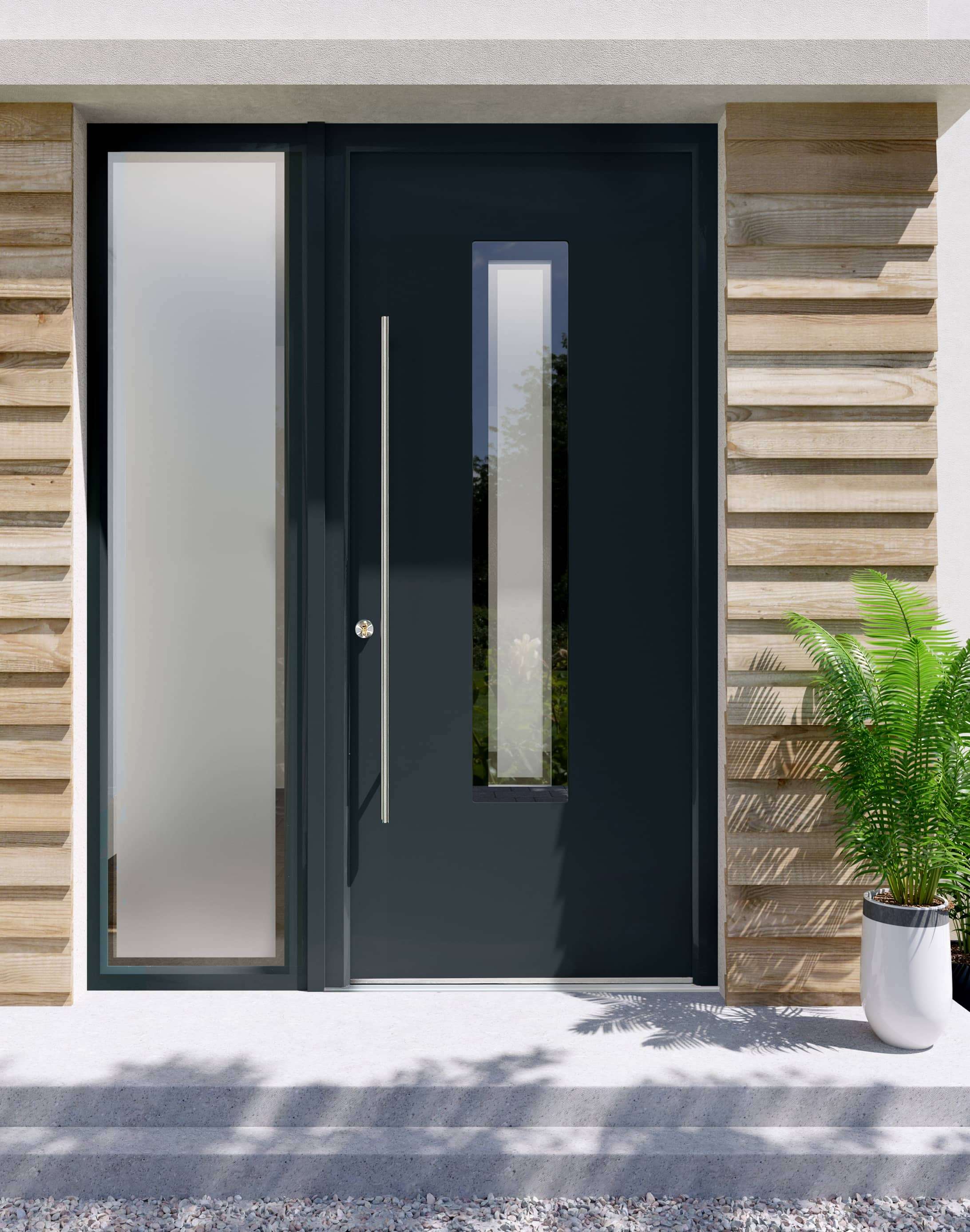
Yeah that’s some video for an entrance door, isn’t it? What they’ve done is use a splatter finish when moulding the fibreglass. Dead simple, but I think it works much much better. Yes when you actually touch the door and move it around, it’ll still feel fake, the door will be too light and the front it is plastic and no amount of splatter finish will eliminate that. But better I think to be pretending you’re something you’re not rather than claiming to be something you’re not.
U-value is < 0.8 installed, so it ticks the PH criterion. Door is 70 mm thick, so a little heftier than the Palladio door.
Let’s hope pricing is reasonable and there is a local Cork agent.
House build spend
It has been three months since the last house build spend update. This will be up to 1st January 2024:
- Spent: €243,207
- Committed to be spent soon: €14,374
- Current three month averaged spend rate: €7,293 per month
The three biggest ticket items in the past three months were: (i) Passive House certification fees (ii) Aliexpress on the Single’s Day heavily discounted sale, where I spent many thousands of euro buying all the lighting, dimmer switches, DC circuit breakers and lots of other odds and ends (iii) Final invoice for the Mechanical and Electrical design.
Last time I did an update on the house build spend I expected a build commencement in March. I would be surprised if we make April now, as the structural engineer is unlikely to get started before the end of January.
His fees will surely be the second largest item next time I do this end of March. I’m rather hoping that the largest fee will be the prepayment for doing the foundations, and the next time I do this house build spend update we will expect to break ground within weeks. Here’s hoping!
If I don’t draw down the mortgage by May, the offer will expire. I would expect that they will extend the offer, but I would prefer to not risk it especially when I have to front the costs of each stage in advance, and then recoup them from the bank after the work is signed off as complete. So if I fronted the cash, the mortgage offer expires before we can get the work signed off, and they then don’t renew the mortgage offer, then I am left in deep do doo .
DC wall dimmer switches
You may remember that my original intent is for the ESP32 microcontrollers or some PWM (Pulse Width Modulation, a common technique for dimming a light) board (e.g. PCA9685 or TLC5947) hanging off them to do the PWM DC dimming for all the lighting. That would have worked fine, however it would also consume a lot of my time to wire them all up and write the firmwares. And it still didn’t solve the problem of what to use as the wall switch, where I wanted a standard rotary push switch, same as a normal dimmer switch, so everybody would know how to turn lights on and off and dim them without having to be taught, or use some app on their phone. I solved this by spending a lot of money on these from Aliexpress during the Single’s Day sales:
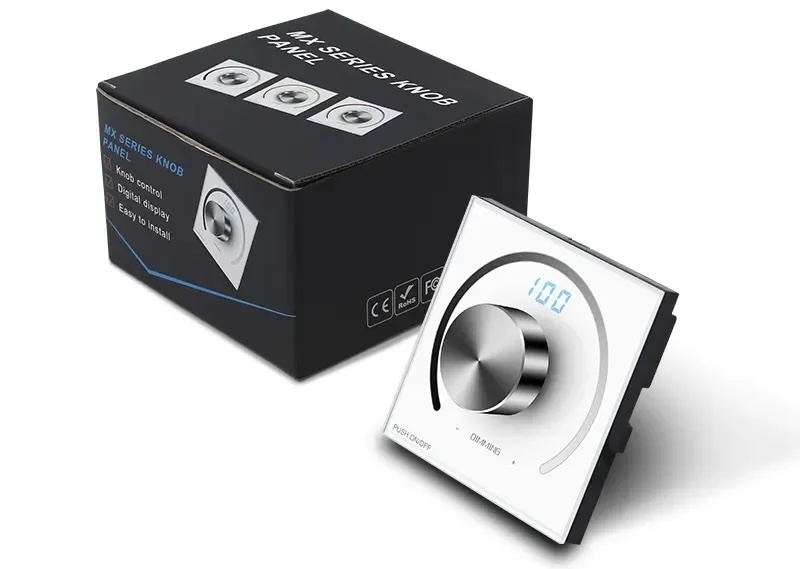
These are the highest claimed frequency DC PWM dimmer units I could find on Aliexpress, and I got them for €17.20 inc VAT delivered each which makes them not cheap, nor do they look especially nice as they’re a bit tacky looking. However, they claim to offer a programmable 500-8,000 Hz PWM frequency, and can work from 5v to 24v. Plus DC dimmer wall switches are very much the unusual item, there isn’t much choice even on Aliexpress, and these I think are the least tacky looking of the three or so models with a physical knob, plus the guide light when off would be handy when searching for them in a dark room. I was thinking before I splurged on them (as I needed rather a lot of them) that if they could work off 5v, then they could be directly supplied from the ESP32 and tell the ESP32 what dimming is requested. Until I got round to wiring in the ESP32s, they could directly drive the LEDs.
I was curious what their insides looked like, so I cracked one open, and also put it onto the oscilloscope to see if it really does emit a 8 kHz PWM:
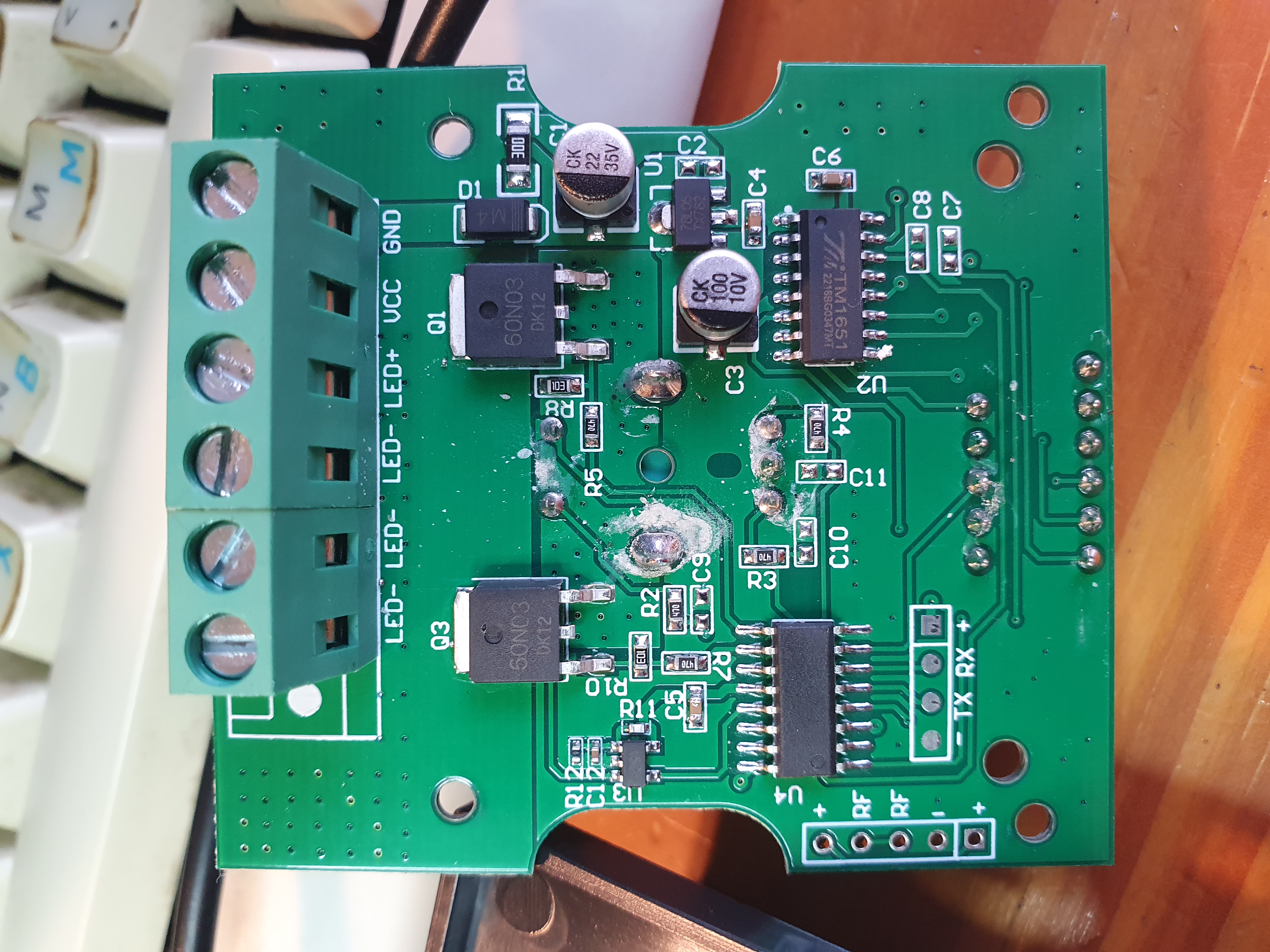
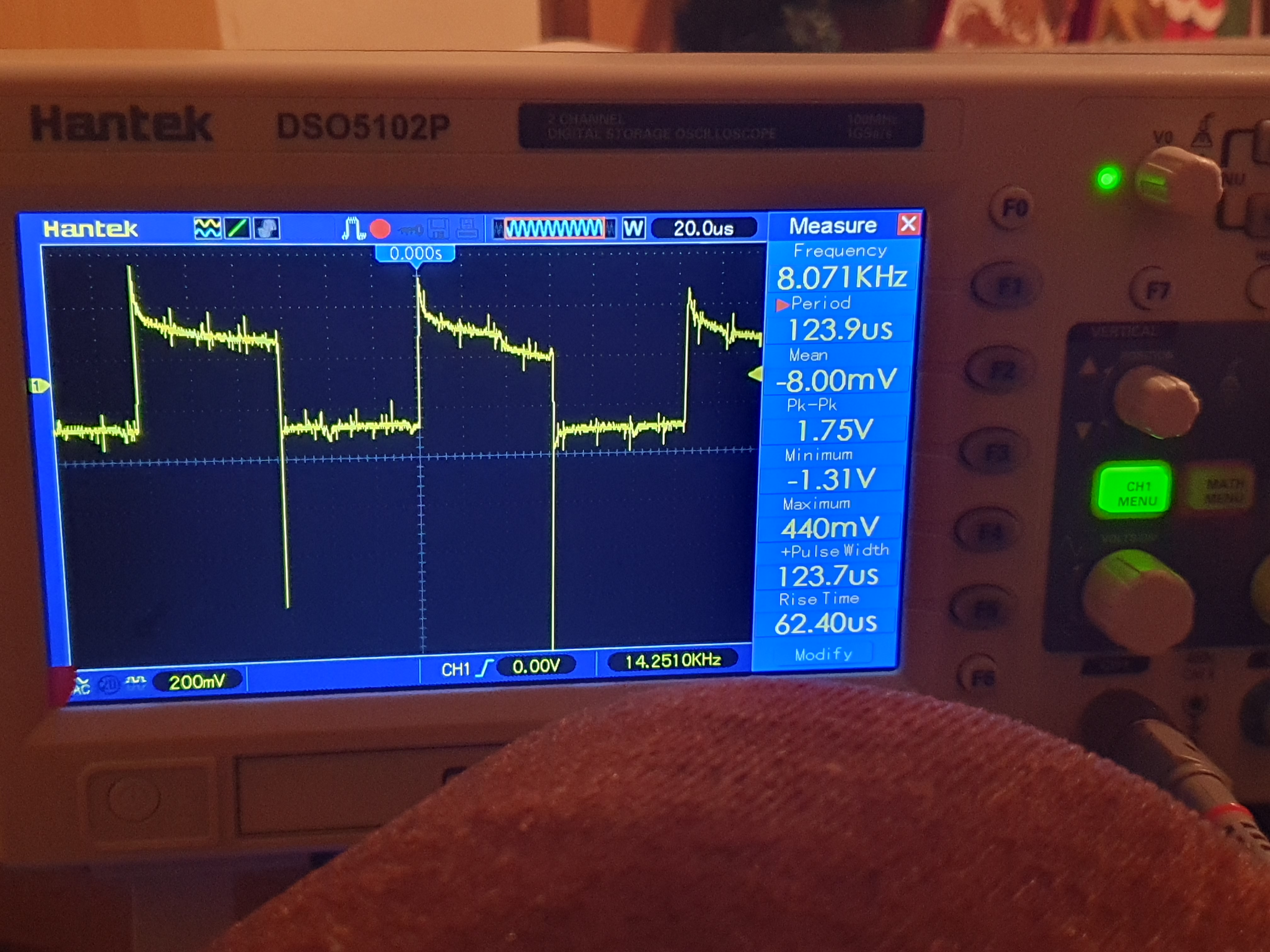
It’s getting increasingly often that if you spend a little more an Aliexpress item, the listing is exactly as described, and this is an example of that. The oscilloscope proves that these do generate a true 8kHz PWM, with the design based around two 60N03 MOSFETs. The MOSFETs can cope with up to 30v and their control signal is TTL, and their datasheet reckons they can push up to 320 watts. Exactly why we need two of them here I am unsure, but my best guess is to seamlessly handle both common anode and common cathode LED strips. There is a TM1651 LED driver control IC, but it is for the eight segment number display only. An unmarked IC appears to do all the real work. A 78L05 voltage regulator takes in 0 - 30v and outputs 5v, its datasheet says it needs a minimum 7.5v to produce 5v. With 5v input it produces 3.5v, which is above TTL so a lot of ICs should still work. All the ICs with identifiers I could see their datasheets all say they’re happy at 3.3v, so only the unmarked IC will be the question. I ended up putting it onto my variable voltage power supply, it appears (just about) happy at 5.0v albeit with the numbers display rather dim, but 4.8v is too little and it hangs. The numbers display appears to reach full brightness at around 8v, so I suspect it needs 5v from that voltage regulator for full brightness but will make do down to TTL.
Basically this is all great, they do exactly what they say they’ll do. Build quality is good, apart from looking a bit tacky and being a bit expensive for a wall dimmer switch (albeit, these are far more sophisticated than a dumb triac based AC dimmer), I think they’ll do very well.
As an example of how much worse they could be:
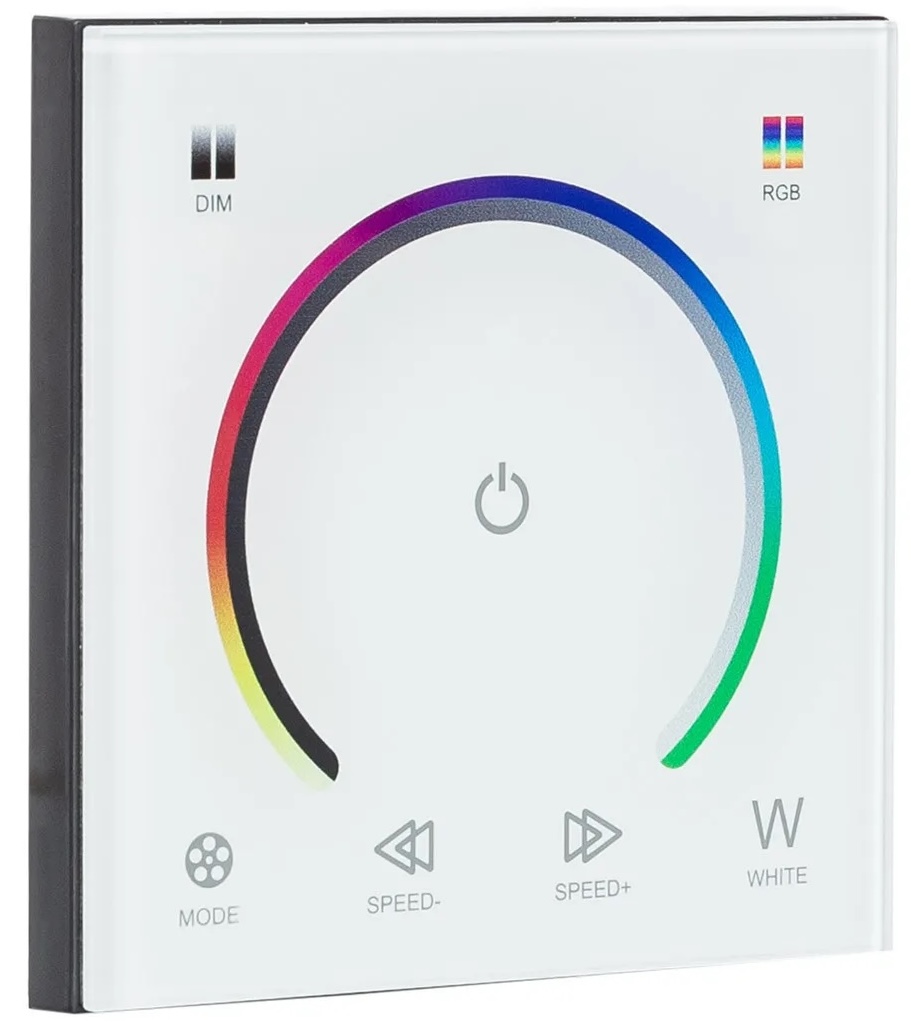
I needed exactly one of these for the single RGBWW LED strip in the house, which will be in the Sauna. Because the strip will be floor level, I just needed something which let you set the colour and brightness and remember your setting each time it turns on. This unit achieves that, but not well. It has a ‘touch’ interface which is finickety to use. Its PWM frequency is well under 500 Hz, and it very obviously flickers when brightness is not full. In fairness it did cost €11.75 inc VAT delivered, and it does do everything it claims (it never claimed anything about its PWM frequency), and there is not a lot of choice within the RGBW DC wall switch market on Aliexpress. Here it is at work with the RGBWW LED strip intended for the Sauna:
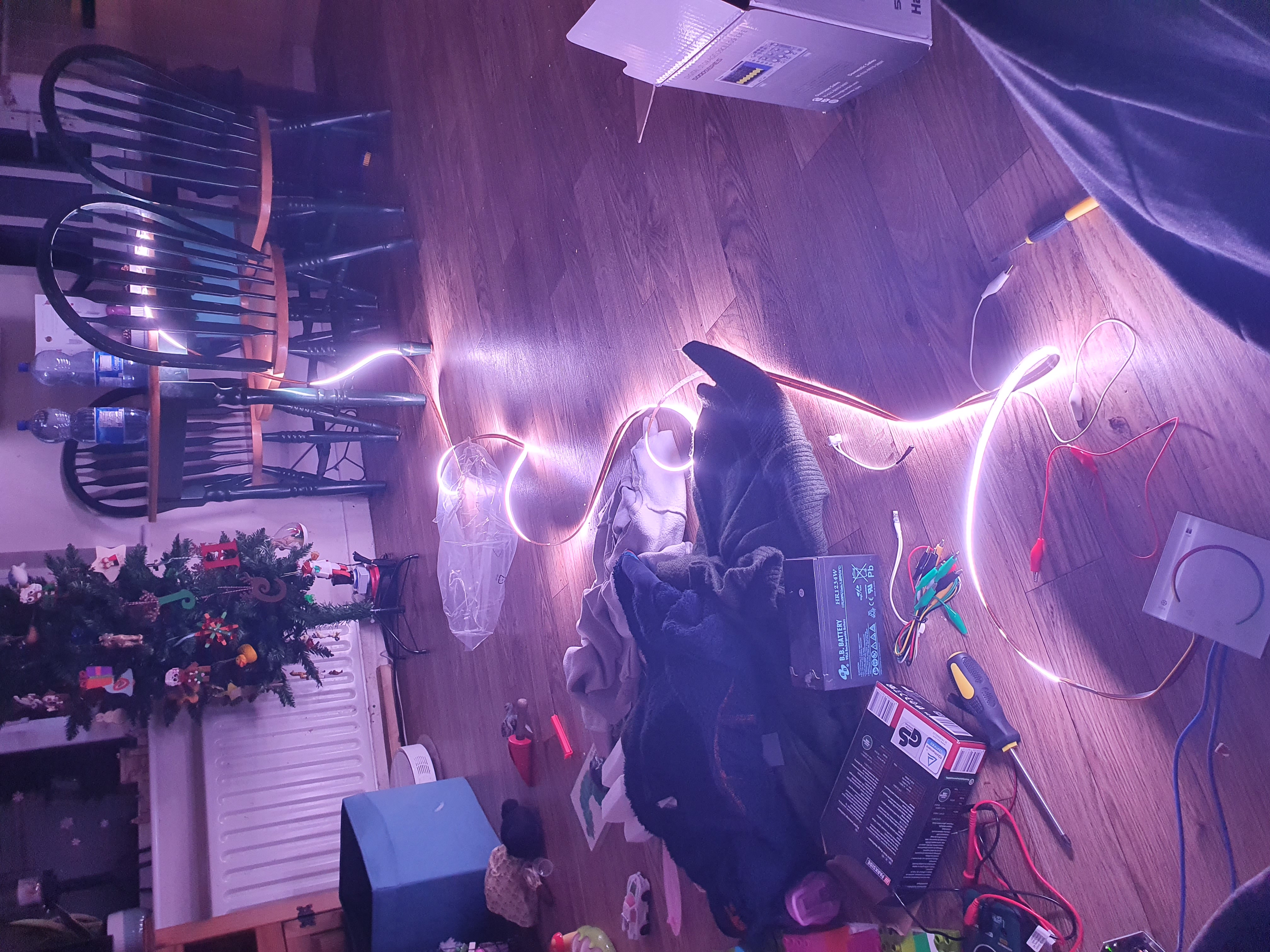
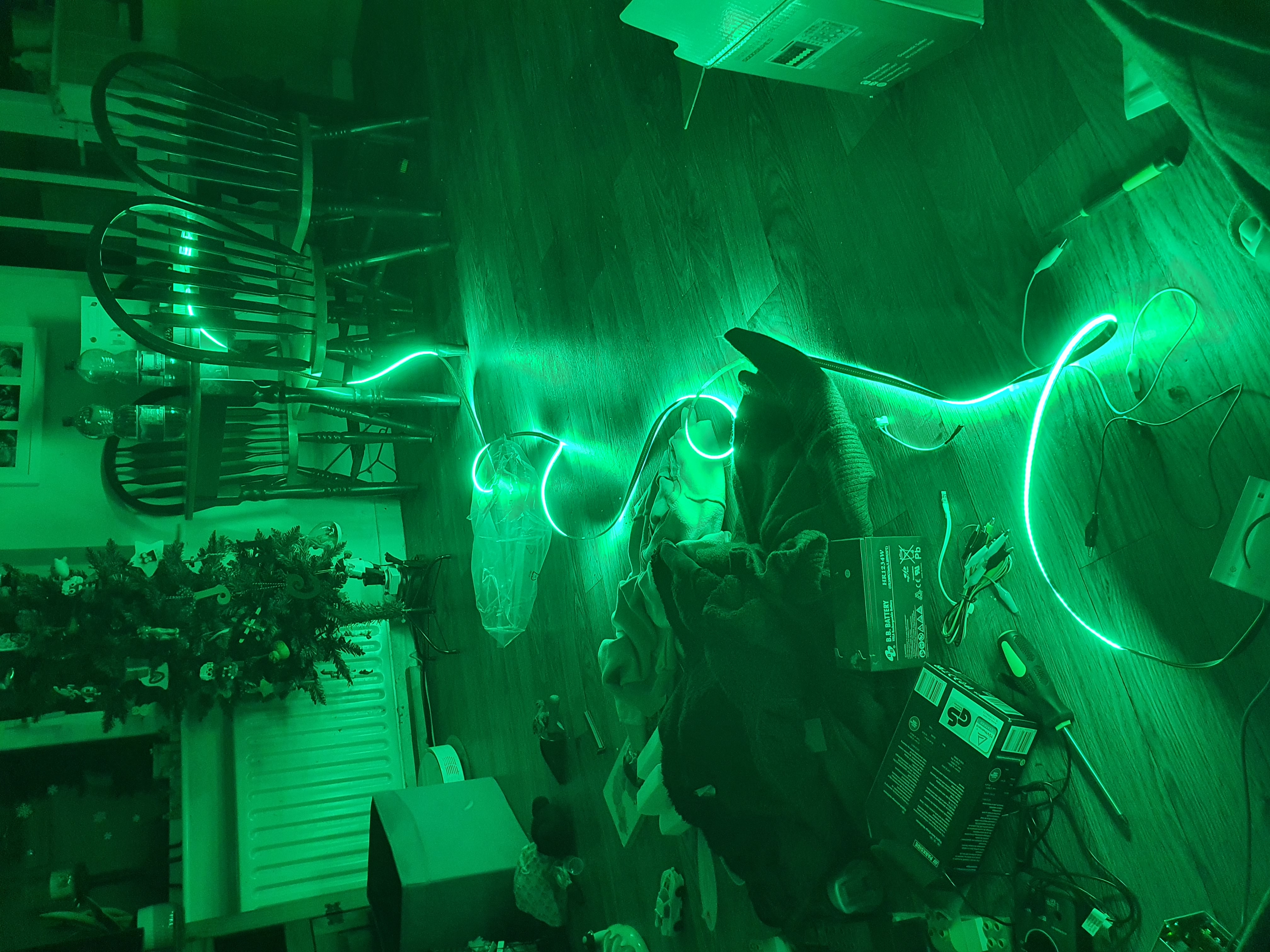
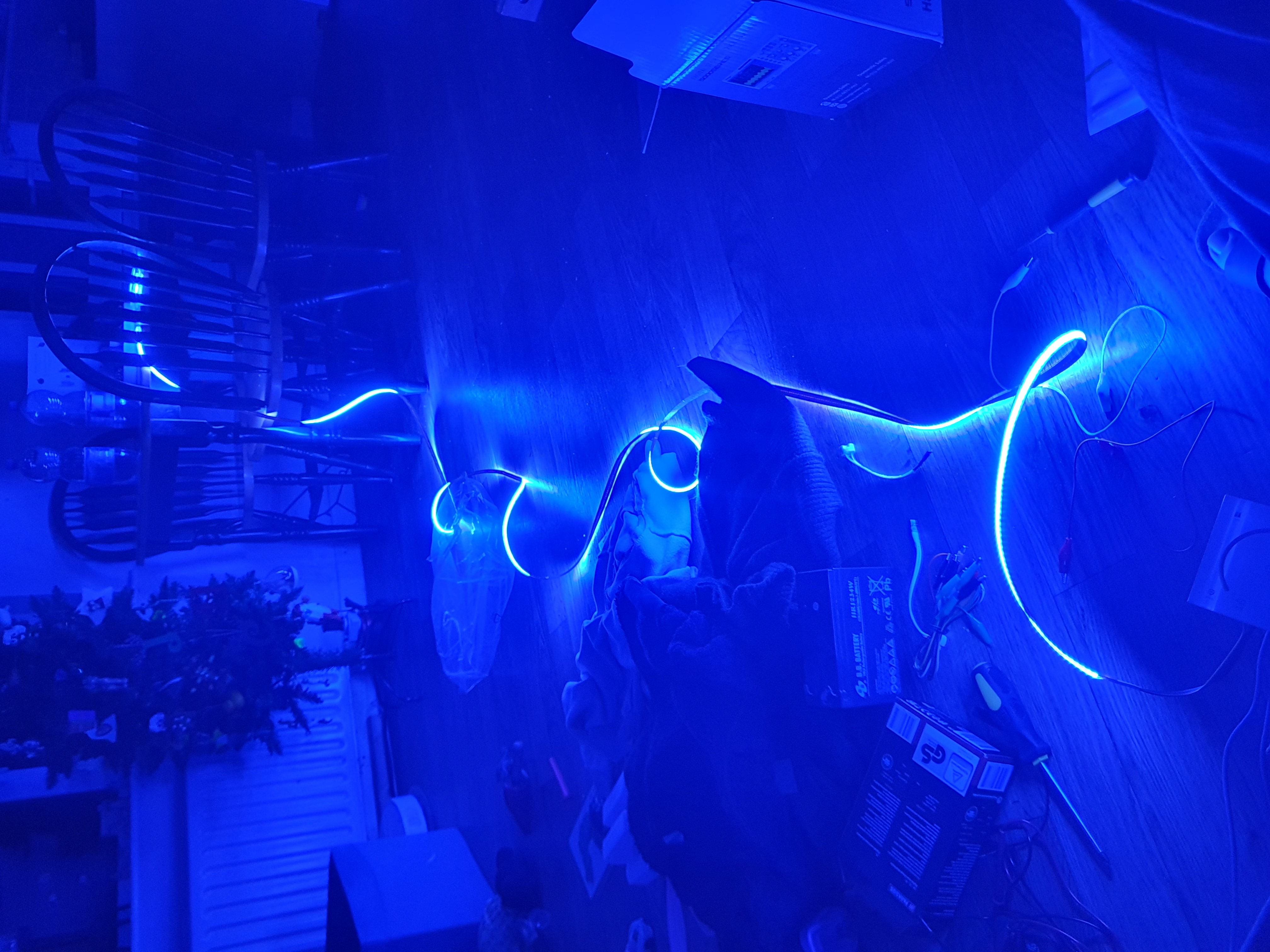
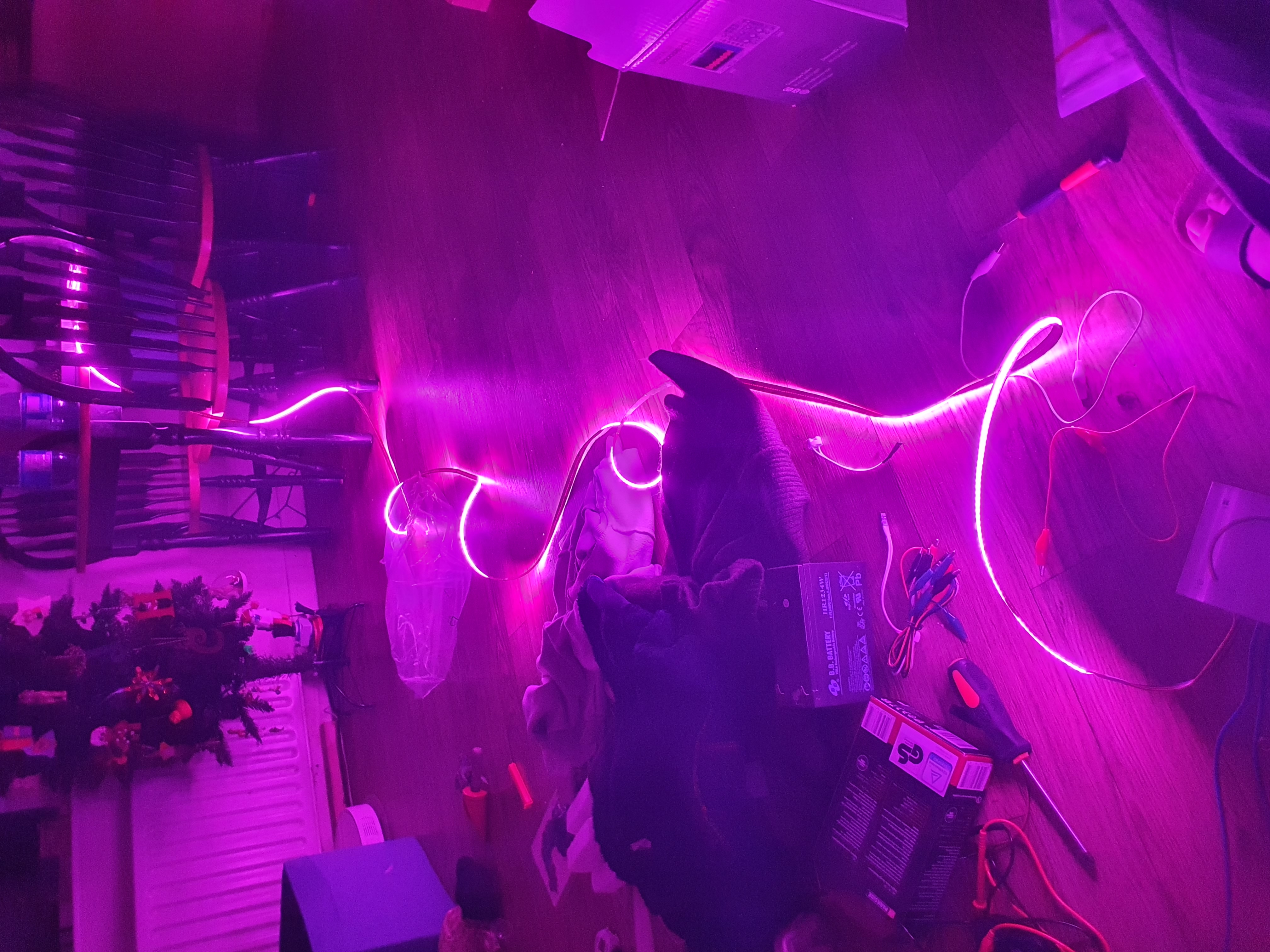
I think it’ll do, but I’m glad it’s the only one.
Ventilation boost fans
Something which will be nearly unique in this house is dynamic ventilation which boosts the air inlet and exhaust on a per room basis using per room sensors. This came about due to concerns that we are using the MVHR air ventilation to do most of the space heating, so any commissioned system (in a normal build each room’s inlet or exhaust is set to balance air flows throughout the house) would be wrong for some of each year, causing some rooms to become too hot or too cold, depending on climate. By having an ESP32 dynamically adjust air flows based on local room conditions, we eliminate that problem. I picked up lots of these during the Single’s Day sales:
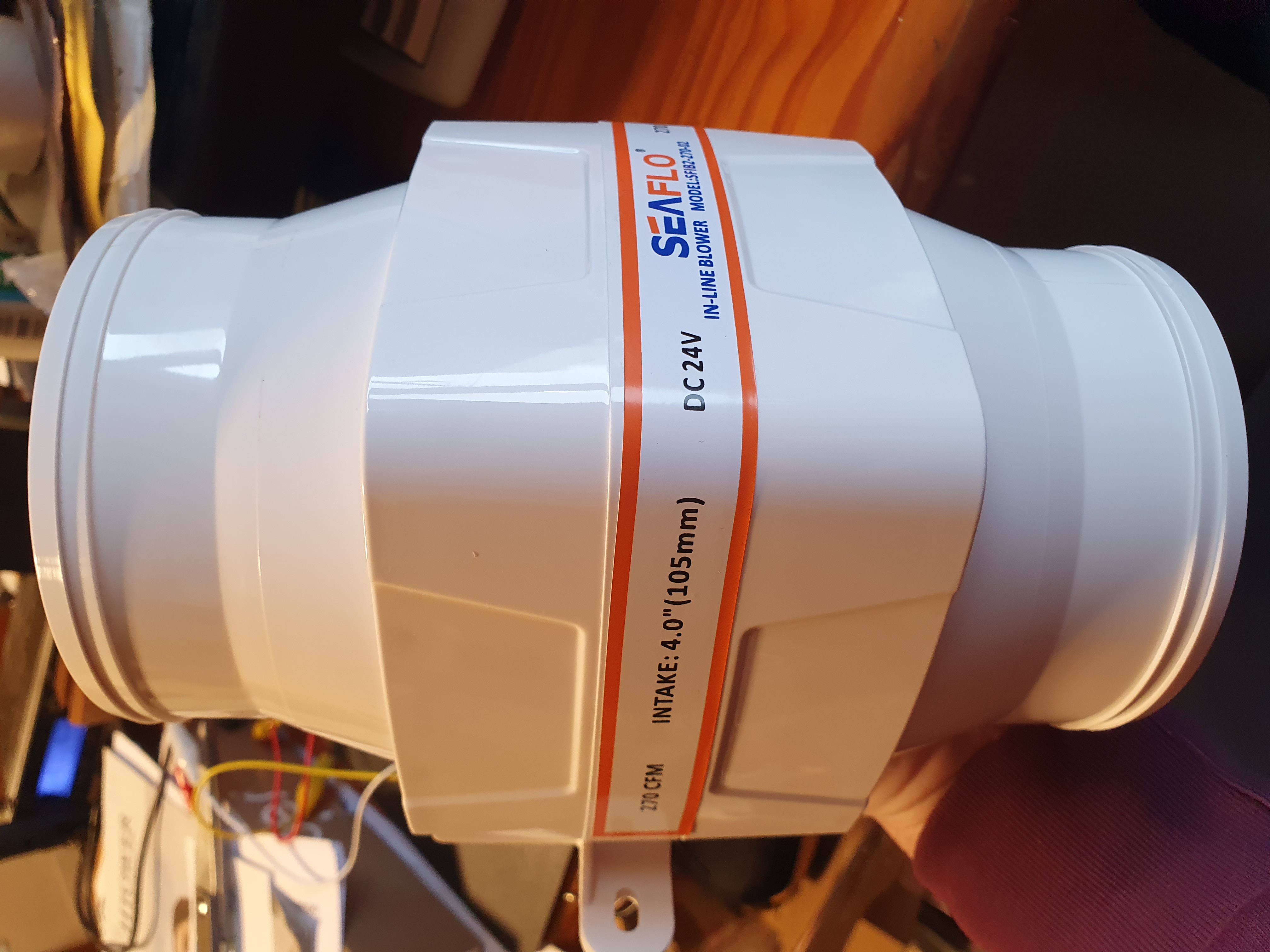
These are bilge ventilators for a boat, and they come in 12v and 24v varieties. I bought exclusively 24v, and in two sizes – the above is the ‘large’ one capable of 158 m3/hr with the slightly smaller (but a good bit cheaper) ones capable of 138 m3/hr, which is one eighth less.
As the MVHR unit maxes out at 600 m3/hr total, these are obviously massive overkill at full belt. However, they will never run full belt, they will also be PWM speed reduced. As they are DC based, they can even be reversed if needed at a mild negative spin if one wanted to stop air flow completely, and I have empirically verified that they work just fine in reverse despite what their documentation claims.
Even at 3.6v, I think they move rather a lot of air, and they are very robustly made. Bearings feel extremely solid, fan turns between ‘clicks’ which shows very strong magnets in there, and there aren’t any balancing issues in the small number of units I tested i.e. vibrations at full whack are minimal. They take a 100mm connection, and have a completely sealed motor assembly which will prevent dust from the motor getting into the ventilation.
They weren’t particularly cheap, a little over €25 inc VAT delivered for the smaller units and a little over €30 inc VAT delivered for the ‘large’ units. I’m pretty impressed with the build quality, and they should be happy running with air at 60 C too.
Overall I’m finding these very much a win!
CAT 6 networking
I’ve decided on a networking design where there are four main clusters of Wifi 6 and networking switches, with each cluster linked by 2.5 Gbps fibre backhaul. Each cluster only has 1 Gbps wired ethernet to keep costs down, but there are ten ports with PoE at each cluster, and maybe another five without PoE.
The networking hardware is highly upgradable, and shall be upgraded as and when costs for the better stuff come down. As I’d rather never touch the final wiring within the walls to the sockets ever again after installation, on that I shall be spending a bit of money.
After much umming and awing, I eventually settled on the twenty year old CAT6 rather than CAT 5e or CAT 6a, never mind CAT 8. Why CAT 6?
- 10 Gbps becomes possible for house-sized cable runs.
- The inner plastic spacer makes the cable stiffer and less prone to kink during cable pulls.
- A low smoke zero halogen AWG 23 100% copper cable is under 10% more expensive if CAT 6 rather than CAT 5e (there is a much bigger difference between copper-clad aluminium cables, but you wouldn’t want CCA cable in a permanent wall installation anyway).
- CAT 6a is 20% more expensive than CAT 6, and the outer shield can introduce ground loop problems if endpoints aren’t grounded properly (and even then, multiple grounds can have potential difference between them leading to earthed currents preferentially choosing your network cable, very bad). If I needed 10 Gbps over larger distances, you’d make the effort, but I’m using fibre optic cables for anything over distance. So for the extra cost and hassle, it doesn’t seem to be worth it.
- CAT 8 is lots more expensive than CAT 6a, so if CAT 6a doesn’t have cost benefit, CAT 8 certainly doesn’t.
CAT 6 needs proper terminators, not the plastic crimp fit things CAT 5e uses. They’re quite a bit more expensive, but they’re more solid. I bought lots of quick fit CAT 6 terminators, in two varieties ‘metal’ and ‘plastic’. I took a two metre length of the CAT 6 cable I bought, and tried out fitting both terminators for practice:
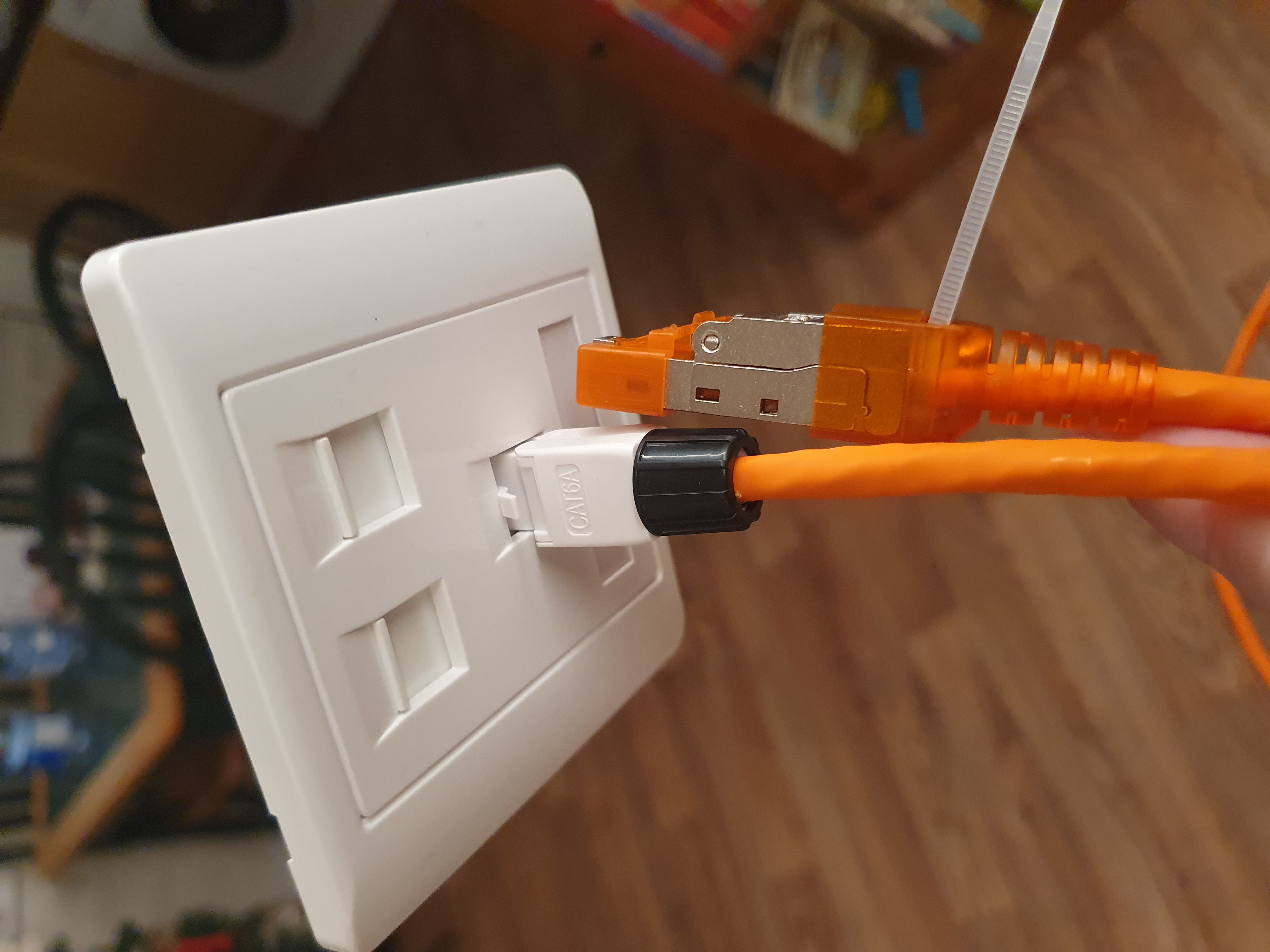
I slightly prefer the plastic ones despite the shorter strain relief, not sure if they’re quite CAT 6 (they are definitely not CAT 6a as what is printed on them as they are 100% plastic and don’t connect the outer shield) but they’re much better than the plastic crimp fit things CAT 5e uses. My very ancient Fluke ethernet validator will only test to 1 Gbps, and the test cable passed that with ease. I think they’ll do nicely, and they didn’t cost too much.
You might be wondering about the three socket wall fitting? Odd choice right? The reason why is that I expect to connect only the bottom port to Ethernet, the other two ports will be power only (specifically, 54v DC mains). The power will come from cheap injectors, not from a 802.3af compliant switch, so rather more than 30 watts should be possible, maybe as much as 60 watts per port. Between the two cables, that means every network socket will supply 120 watts of 54v DC power, plus another 30w might be available from the PoE data cable. As much as it’s tempting to fit even more power capacity here, to be honest if one needed more power, you’d just run a dedicated cable.
Anyway I got ethernet wall sockets for everywhere we’ll need them, and CAT6 terminators for each of the three ports within each. Not especially cheap, however far cheaper from Aliexpress Single’s Day sales than from almost anywhere else!
And certainly cheaper than state of the art networking! I’m old enough to remember the launch of CAT 6. Back then it was unaffordably expensive, not just the cabling, but everything else which could speak more than 1 Gbps. I remember 1 Gbps becoming affordable around 2010 or so, it was a bit of a financial stretch at the time but a 1 Gbps dumb switch was within reach (and indeed that unit I bought back then is powering my rented house internet right now, so it turned out to be a good return on investment).
Since 2010, gotta be honest, 10 Gbps ethernet is still not affordable. 2.5 Gbps ethernet has become affordable, but what supports that and what does not is highly variable, whereas much more stuff supports a binary choice between either 1 Gbps or 10 Gbps.
Maybe before I die 10 Gbps wired ethernet will become affordable. I personally suspect > 2.5 Gbps fibre will become affordable long before the wired variety does, if they can bring down the cost of transceivers then fibre starts looking much better than wired in every way apart from power delivery via PoE. I guess we shall see!
MR16 bulbs for point lighting
Last post I mentioned my choice of one inch recessed MR16 bulbs for the point lighting in the lighting design plan. This is an unusual choice: MR16 bulbs run from 12 volts, and most new builds would choose 230v AC downlighters (usually in GU10 format, which is fixture-compatible but not wiring-compatible with the legacy MR16 format). Having completed the empirical testing, I thought I should write up my notes on how what I bought performs in practice.
As mentioned in the last post, MR16 bulbs are a bit of a throwback. They were first sold in 1965, and run off 12 volts of some form. By ‘some form’ I mean that the original bulbs were halogen, and such bulbs don’t care if they’re fed DC or AC. Thus, real world installations used DC or AC, and like with 12v battery systems in cars a 25% average voltage range was allowed, which is wide by today’s standards (i.e. mean voltage could be as high as 15v, or as low as 9.6v). Dimming took the form of Pulse Width Modulation (PWM) for the DC systems or leading edge phase cut for the AC systems (which is phase aligned PWM).
When LED replacements came along for halogen MR16 bulbs, like with GU10 bulbs accepting 230v AC they need to downconvert the high input voltage to the ~1.5v DC which the LEDs themselves need. As with the GU10 bulbs, this is performed by a small power converting electronic circuit, however due to the history and variety of MR16 bulb deployments, the allowed range of inputs is quite wide. Here are all the MR16 power converting circuits I could find online, with the min and max voltage input range from their datasheets (all will take either DC or AC input):
- The AMC7105 MR16 driver IC will accept between 4.0v and 40v.
- The iW3662 MR16 driver IC will accept between 10.0v and 24v.
- The MAX16840 MR16 driver IC will accept between 5.6v and 46v.
- The MAX31840 MR16 driver IC will accept between 6.5v and 26v.
- The TPS92560 MR16 driver IC will accept between 6.5v and 42v.
To be clear, I’m not saying that this is a definitive list, only that these are what Google found and Google’s search isn’t very good nowadays. But their datasheets do give an idea of how bulbs will behave:
- They will implement constant power for a range of voltages, increasing and decreasing current as necessary to give a constant brightness light.
- Under that voltage range, they usually implement dimming for a certain range – more expensive ICs give a longer, more fluid dim down to lower levels of brightness, and I would assume would use a higher PWM frequency (to be clear here, the IC reads the input power signature and from that decides how much it should then dim the LEDs. And each IC varies how it interprets the input power signature).
- Some use a switched buck voltage downconverter, others use a linear power regulator (i.e. burn excess voltage as heat). Switched converters cost a good few pennies more, so expect cheaper bulbs to use a linear regulator.
- All will take 24v DC input, but none will take 54v DC, so I can’t plug these directly into the DC mains loop (as we shall see later, even if I could, you wouldn’t want to). But I can plug them into the same power source as the 24v LED strips, which is useful to know.
Last post I mentioned I was going to be difficult and mix 3000K, 3500K and 4000K lighting based on how cosy the region should be – so, bedrooms get 3000K, the main living spaces get 3500K, home office and worktops get 4000K. I had a suspicion that the 3500K and 4000K would be close enough that they could be used in the same space without the colour temperature difference clashing garishly, so obviously I was very keen to test that out:


Left is 3000K, middle is 3500K, right is 4000K. All bulbs are 40 degree ‘narrow’ throw angle, 90 CRI or higher, and their true power consumptions are 5.3w, 7.2w and 5.3w respectively (and hence why the middle one is rather brighter than the others). The photo isn’t remotely close to what you see with your eye, the photo suggests that the 3000K is orangey, your eye sees that more like what the bottom yellow bit of the 3500K light looks like. The 4000K in to the photo looks a touch too blue, your eye sees something like the whitest bit of the 3500K light.
My suspicion I think has been absolutely proven true: 3000K and 4000K don’t mix well in the same space, though a 3000K base with 4000K spot is better than vice versa. 3500K though, well even with the bulbs side by side there is an acceptable colour distance between them in my opinion. I think the living room at 3500K and the kitchen countertops at 4000K will work very nicely – there will be ‘just enough’ contrasting difference in colour that I think it will complement beautifully.
In fact, I gotta be honest and say that I really like the light off the 3500K bulbs. The 3000K is a touch too yellow, and the 4000K is a touch too cold. I hate to be that cliche but 3500K is ‘just right’. Why it’s so hard to source I just don’t understand, 3500K has most of the benefits of 4000K in terms of colour reproduction, but with ‘just enough’ yellow to make it feel far friendlier. I absolutely love that shade of white, I really hope it becomes far more popular in the future once more people realise what they’re missing out on with all these excessively yellow ‘warm white’ bulbs which ruin colour fidelity.
Here are the MR16 bulbs I bought:
Cheapest possible claimed CRI 90 MR16 bulbs on Aliexpress in 3000K and 4000K variants, in 38 degree and 120 degree throws. Possible OEM manufacturer is ‘Shenzhen Sundaes Lighting’.
- These were very cheap (under €1 delivered), and appear to have no heatsink at all. They get hot quickly at full power, and will need PWM dimming to get much lifespan from them. They are marked ‘Gatetop’ but most of the MR16 bulbs on Aliexpress look identical and I would assume come from the same OEM manufacturer.
Satco S9497, CRI 80, 3500K, 40 degree throw, 6.5 watts.
- These are called ‘cheap Satco’ below. They were about US$9 each, three quarters the price of the expensive Satco. They have at least some heatsinking compared to the very cheap Chinese bulbs resulting in temperatures a few degrees lower, but otherwise seem very similar i.e. they get hot fast, and may even have an inferior driver IC to those very cheap bulbs (see below).
Satco S8642, CRI 90, 3500K, 40 degree throw, 8 watts.
- These are called ‘expensive Satco’ below. They were about US$12 each. They dim very smoothly over a large range, have clearly superior heatsinking, and their power regulator doesn’t care about input voltage which suggests a fully switched power converter. These are clearly the best bulbs I bought on all measured metrics, but at 15x the cost of the very cheap Aliexpress ones I’d wonder if there is cost benefit?
The Satcos had to come from Amazon US and their price includes import duties, VAT and shipping from the US. I couldn’t source 3500K MR16 bulbs anywhere else unfortunately. Satco has their bulbs made in China, so it is surely doable that they ought to be available outside the US, but there you go.
First thing I did was test heating at 12v DC. This isn’t particularly scientific, I left the bulb run for a while at a particular PWM dimming level and see how hot it gets according to my thermal camera. A ‘while’ will vary, so these results are more indicative than comparable:
3000K very cheap Chinese bulb @ 100%: 72.3 C
3000K very cheap Chinese bulb @ 50%: 60.5 C
3000K very cheap Chinese bulb @ 25%: 46.9 C
4000K very cheap Chinese bulb @ 100%: 73.2 C
4000K very cheap Chinese bulb @ 50%: 44.1 C
4000K very cheap Chinese bulb @ 25%: 33.8 C
3500K cheap Satco CRI80 bulb @ 100%: 66.3 C
3500K expensive Satco CRI90 bulb @ 100%: 49.8 C
3500K expensive Satco CRI90 bulb @ 50%: 46.5 C
Conclusions:
It would seem that the 3000K very cheap bulbs run hotter than the 4000K bulbs. I unfortunately didn’t do any further testing of the 3000K bulbs, I know the 4000K bulb draws a worst case 5.3w and so therefore one must infer that the 3000K bulb has to be drawing more if it gets hotter. OR, possibly it reacts differently to 50% and 25% PWM dimming, perhaps drawing more current?
The ‘cheap Satco’ are no better than the very cheap Chinese bulb except with a bit of added heatsinking, at eight times the price.
The ‘expensive Satco’ show just how good one of these bulbs can be if the manufacturer decides.
I then tried 24v to see what happens:
Very cheap Chinese bulb and cheap Satco bulb experience run away heating, with me pulling the plug at 90 C after only a few minutes to prevent damage. Obviously using a linear voltage regulator.
Expensive Satco had identical results to 12v. As in, you couldn’t tell the difference between a 24v and 12v supply. Must be a switching voltage regulator. Temperature never exceeds 47 C.
I then tried less than 12v:
For the 4000K very cheap Chinese bulb, 100% brightness appears to be 10v with a reduction in heating from 73 C to 60 C as compared to supplying 12v. Very obviously these bulbs ought to be run at less than 12v to save on both power consumption and lifespan. Below 10v, current drops with voltage so these do NOT have a constant power function at low voltage, which is surprising from what I’ve read about how most MR16 bulbs behave. I measured a worst case power consumption of 5.3w which is almost exactly 25% below the 7w claim of their Aliexpress listing. This is par for the course on Aliexpress when you choose the cheapest possible item, however note that I suspect that their 3000K model does draw more power, and side by side on 12v both have equal brightness and I know lower colour temperatures need more wattage than higher to achieve the same brightness all other things being equal, so this make sense. I doubt they are actually CRI 90 as claimed, but the light off them isn’t half bad in my opinion, I’d say they’re somewhere between CRI 80 and CRI 90. For the money, they’re very good.
(Incidentally, they are the only bulb here which is happy being put in series. All but one of the bulbs will consume 10v, and one bulb will consume the balance up to 20v. I have no idea how they negotiate that amongst themselves, which bulb is chosen as ‘it’ appears to be random. In any case, series wiring works with these bulbs. The Satcos can’t do series wiring at all, one bulb takes all the voltage and all the others turn off. I suspect there is some sort of custom power regulating IC in here, or at least one with unusual characteristics)
For the ‘cheap Satco’ 100% brightness is also 10v. These do have a constant power function, but it’s kinda shonky – at 12v they use ~0.56 amps, but as the voltage decreases they rapidly increase current to a worst case of one amp. Worst of all, these claim to be a 6.5w bulb, but they’ll draw more than that at 12v and a LOT more than that at lower voltages. The worst I measured was a full god damn 1 amp at 8v, which is 8 watts. That’s a mild fire risk, it is totally unacceptable to draw more power than stated, especially more current than the specification would suggest.
For the ‘expensive Satco’ 100% brightness is 12v precisely. They have a constant power function, but it’s much better behaved than the ‘cheap Satco’ with current increasing from ~0.60 amps at 12v to a worst case of ~0.73 amp at 10.6v, which is 7.7w and the bulb claims to be an 8w bulb, so unlike with the ‘cheap Satco’ this bulb always remains within specification. From 10.6v downwards the bulb dims smoothly to 3.6v at a fair bit of brightness which is the lowest my variable voltage power supply can do. Attaching these to the PWM dimmer wall switch above produces a smooth dim between 60% and 1% which is just about illuminated. Basically, these bulbs are just excellent and whilst maybe not value for money, they are clearly the best bulbs I have to hand here.
All three varieties of bulb did dim just fine with the PWM dimmer wall switch, but I found that setting the PWM frequency made a big difference to the range and smoothness of the dim. By choosing a programmable frequency dimmer switch, I inadvertently made possible much better compatibility, and there appears to be no obvious reason why a bulb likes or dislikes a given PWM frequency. I assume that it comes down to compatibility of whatever internal clock their voltage converting IC uses.
I tested all the bulbs for flicker at varying dim amounts and I found no flicker with any of them. I checked using the corner of my eyes and also my phone, whose live camera view will strobe if the PWM frequency is low. I have no idea what PWM frequency these bulbs dim at, but whatever it is, I can’t see it and neither can my phone, so it probably is good enough.
Apart from ‘expensive Satco’ which reaches full brightness at 60% PWM duty cycle, the others reached full brightness at 30-50% PWM duty cycle. If they were a 30% PWM duty cycle = 100% brightness, that means thirty total dimming levels available. This would be consistent with cheap dimmable LED bulbs, they tend to offer 32 dimming zones or less, and the lowest brightness level tends to be rather bright. More expensive dimmable LED bulb might offer 256 or more dimming zones, and minimum brightness is barely above off. The reason why is there is a tradeoff between PWM frequency and dimming zones and flicker, so the more zones you have the higher the frequency you need to avoid flicker, and more frequency means more expensive hardware. Ultimately, you get what you pay for there.
Except of course when you don’t get what you pay for! Apart from the overstated wattage, the very cheap Chinese bulbs at under €1 inc VAT delivered each are better than the ‘cheap Satco’ bulbs costing eight times as much! This was surprising, if I am honest. Those ‘Gatetop’ bulbs have many deficiencies, but if I run them at say 9v max they should stay under 55 C and that should keep them running well for many years to come. Whilst not a LED, an electrolytic capacitor halves its lifetime for every +10 C of operating temperature, so 160k hours at 55 C becomes a mere 10k hours at 95 C. So, basically if I undervolt these, their lifetimes should exponentially increase and ‘phospor fatique’ similarly exponentially reduced, thus slowing down damage to colour rendering index.
Stepping down from 54v DC to 24v DC is very efficient as the voltages are close enough to each other, but stepping down from 54v DC to 9v DC is not. It is more efficient to set up a separate three phase AC to 9v DC power supply just for these MR16 bulbs, according to the mathematics. I have ordered that power supply, it should arrive in plenty of time before I’ll need it.
Had I not done all this empirical testing I would not have realised that a dedicated 9v power supply was a better choice here – bulbs will run cooler and therefore for much longer, and power consumption will be reduced by avoiding burning excess power to heat. Unfortunately I had sized the 54v DC mains power supply to include all the lighting, so now it’s going to be rather overkill as it’s a 4,000 watt unit, and if it’s not going to be used for lighting then a 1,500 watt unit would have been more than plenty. Oh well, water under the bridge, as far as mistakes go there can be far worse.
Merry Christmas everybody, and a Happy New Year!
Last post I said only some digger driving remained to complete the Lego concrete blocks to the rear of the site, and we got it done:
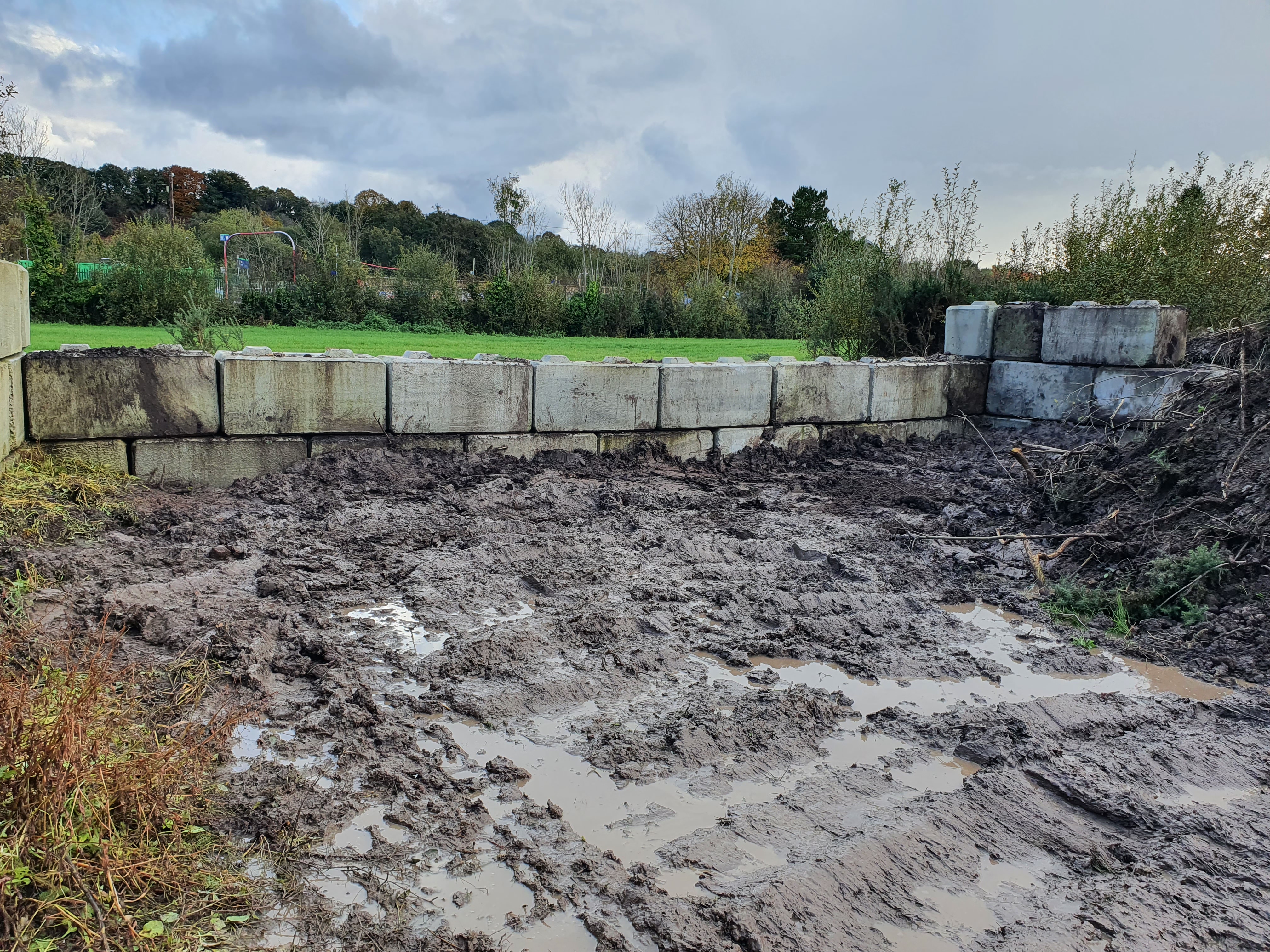
From the neighbour's wall laid in a previous long weekend looking at all new blocks laid

There is now a clear unobstructed view to the south to aid growing my future vegetables
As you can probably tell, the ground was absolutely saturated with recent rainfall and therefore the going was pretty tough as due to being on my own, every time you lay a block it requires leaving the digger cab twice, getting to the block and changing its shackles. This meant your boots sinking into a foot or more of tarry liquid soil, which was both slippy and exhausting. The weather itself held off that long weekend which was good, because we ended up needing all three days to get the work done, plus also laying pounded crushed rock foundations when it’s raining is rather counterproductive. And even then, the ground was so wet sometimes when you had finished tamping when you walked on your ‘foundation’ afterwards it just moved around like liquid. Not ideal at all, but best of what could be done in the circumstances, and as you’ll note, the wall is only two blocks high anyway so perfect foundations shouldn’t hopefully be as important.
Anyway, there above you’re looking at the southern wall of my future walled vegetable garden, which is no small thing! Let’s see how it looks before and after from space:
The 26th Mar 2022 satellite photo was described here previously. The new satellite photo was taken on the 10th Nov 2023 clearly showing the much lower sun Ireland gets in the Winter. The detail has somewhat improved, that’s not me that’s skyfi.com delivering better quality than before for the 75 cm resolution image, which is nice to see. The most obvious change is that my neighbour’s house is now there when it was not previously, however you can also make out the lego concrete blocks we laid as described above to the bottom right of my land (yes, they can be seen from space!). The blocks to the left I can’t make out, however the solar panel array is bright white, as is the gravelled section not obscured by the shipping container.
Laying the last of those blocks completed the site preparation part of things, which means all the other preparation stuff now remains, mainly around financing and design. The good news is that eighteen months after application, the mortgage finally came through. So, assuming we can actually get a build going before the mortgage offer expires, that’s the financing portion mostly covered. I say ‘mostly’ because as with any self build the actual problem will be cash flow, or rather, lack of cash flow i.e. the money is there overall, just not where it needs to be at the time needed.
As an example, we have decided to go with Nordan for the glazing. They will need to be paid for that glazing nearly three months in advance of when we will actually need that glazing. That means cash which could be building foundations or walls becomes ‘out of action’ for three months, because it gets locked up with Nordan. There are lots of instances of this, in fact this year’s Single’s Day on Aliexpress I dropped a little over three grand on parts for the house we won’t need for a year, but by buying them now instead of from Irish or European sources a year from now we saved many thousands of euro. They would be cheaper from Aliexpress in any case, but for Single’s Day Aliexpress lops off a further 20%. Hard to argue with that, just need to plan well in advance to take advantage.
As I bought from Aliexpress most of the light fixtures, I needed to make a lighting design to decide what I was going to buy and why. I should stress that this is a foundational lighting design i.e. it’s there to provide the base lighting for a space. It is by no means a final lighting design, or a desirable lighting design – it’s there to provide base illumination for whatever lighting design we end up upon, which is very much to be decided after we move in.
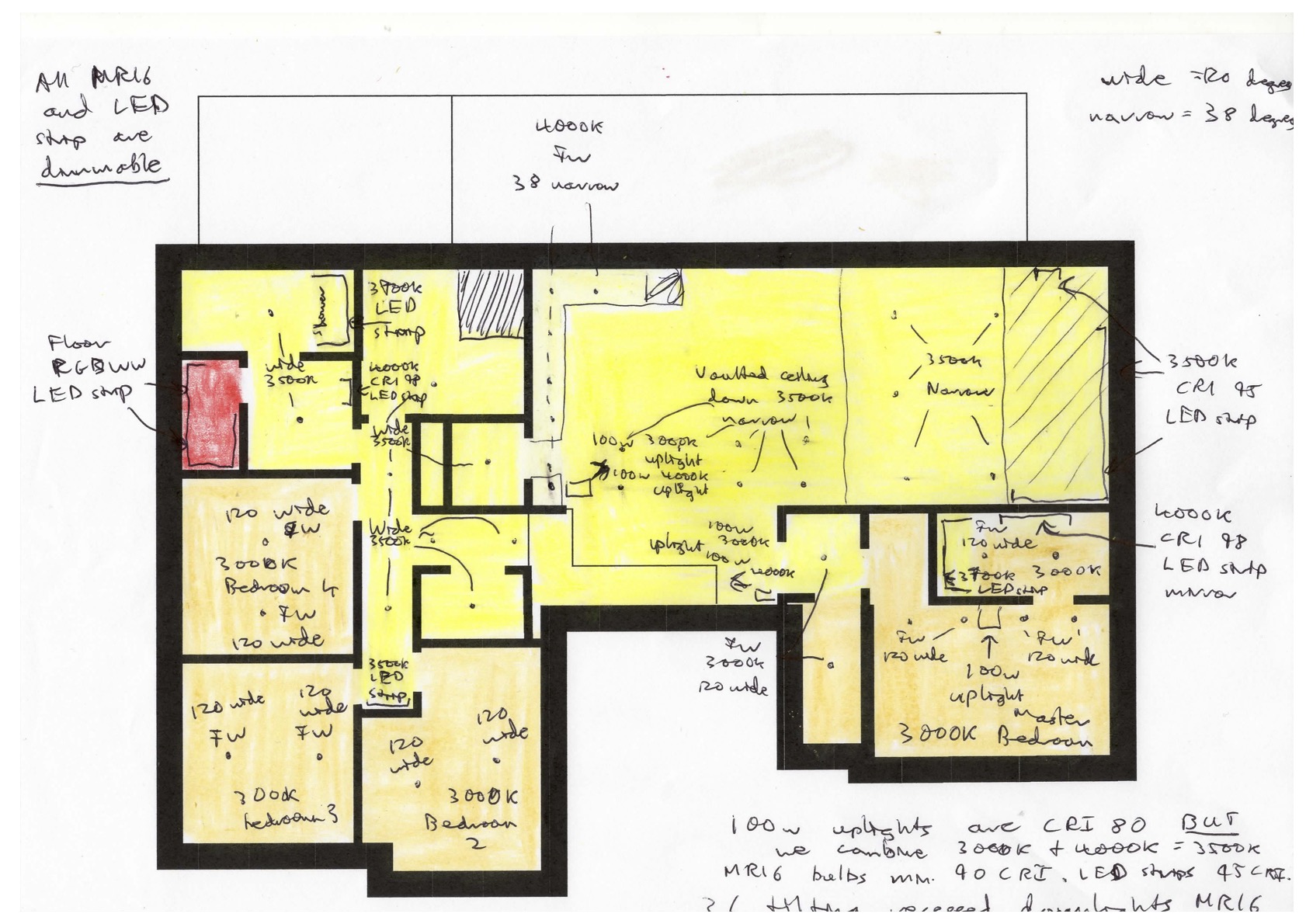
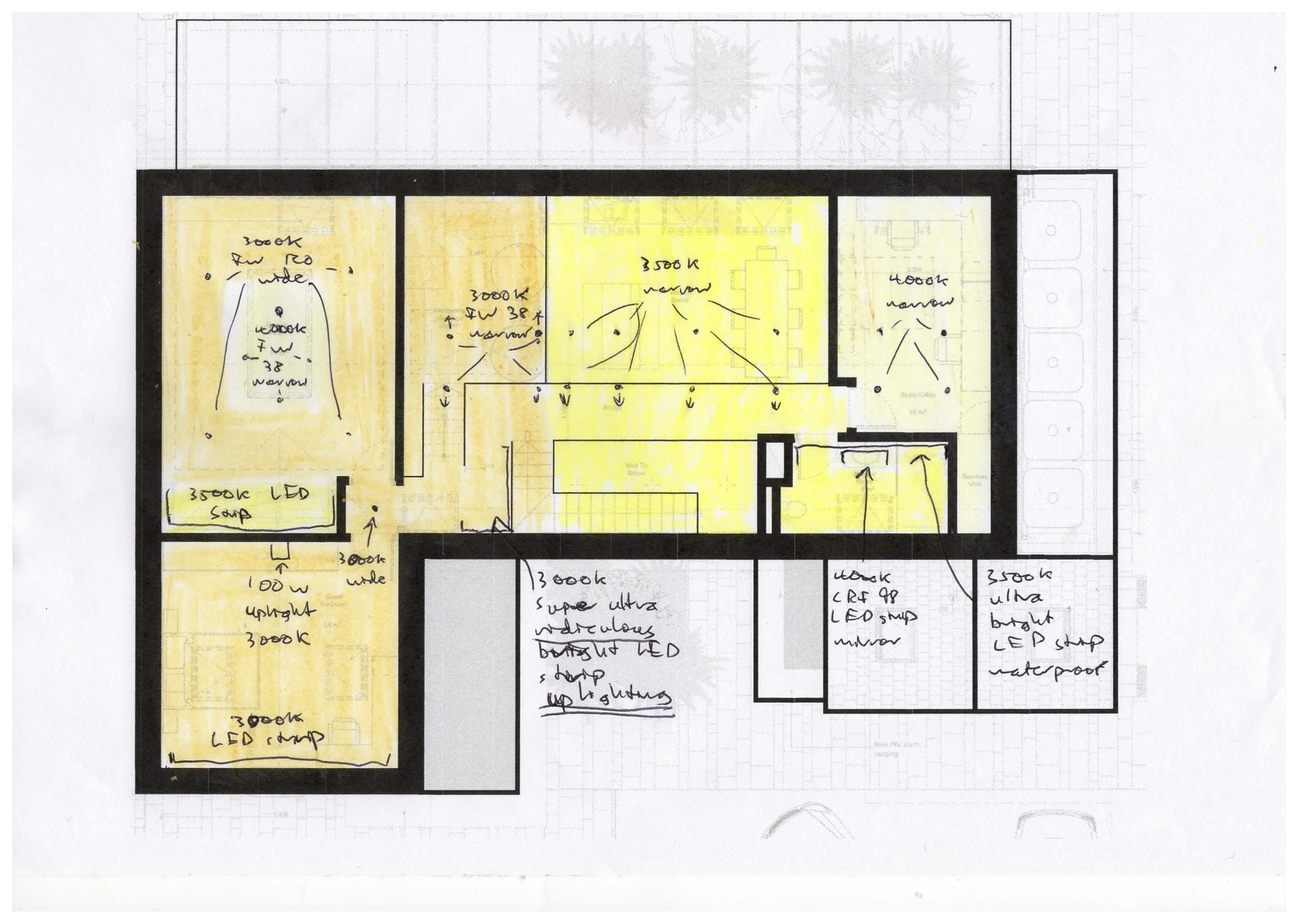
As you will see, there is a mixture of volumetric (i.e. space) and point lighting. These are the base two types of lighting you need in any design (the remaining two are ‘feature lighting’ and ‘accent lighting’ if I remember rightly, it’s been a while). For the space lighting, I have used upward facing industrial floodlights to cheaply and easily light large volumes of vaulted ceiling with a somewhat even base light. Nobody including myself would claim that ideal, but it’s also not a terrible choice either, and the industrial floodlights are cheap and easy and get the box ticked quickly. Point lighting is to ‘top up’ light for specific areas based on use, so for example your kitchen table you will want added light during meals, but not otherwise. So you would have point lights directed at the kitchen table, and you’d switch them on and off as needed. Point lights come in wide (120 degree throw), narrow (40 degree throw), and ultra-narrow – we’ll only be using wide and narrow.
For those point lights, we’ll be using MR16 LED bulbs within recessed tiltable aluminimum ceiling fixtures. Here is one such:
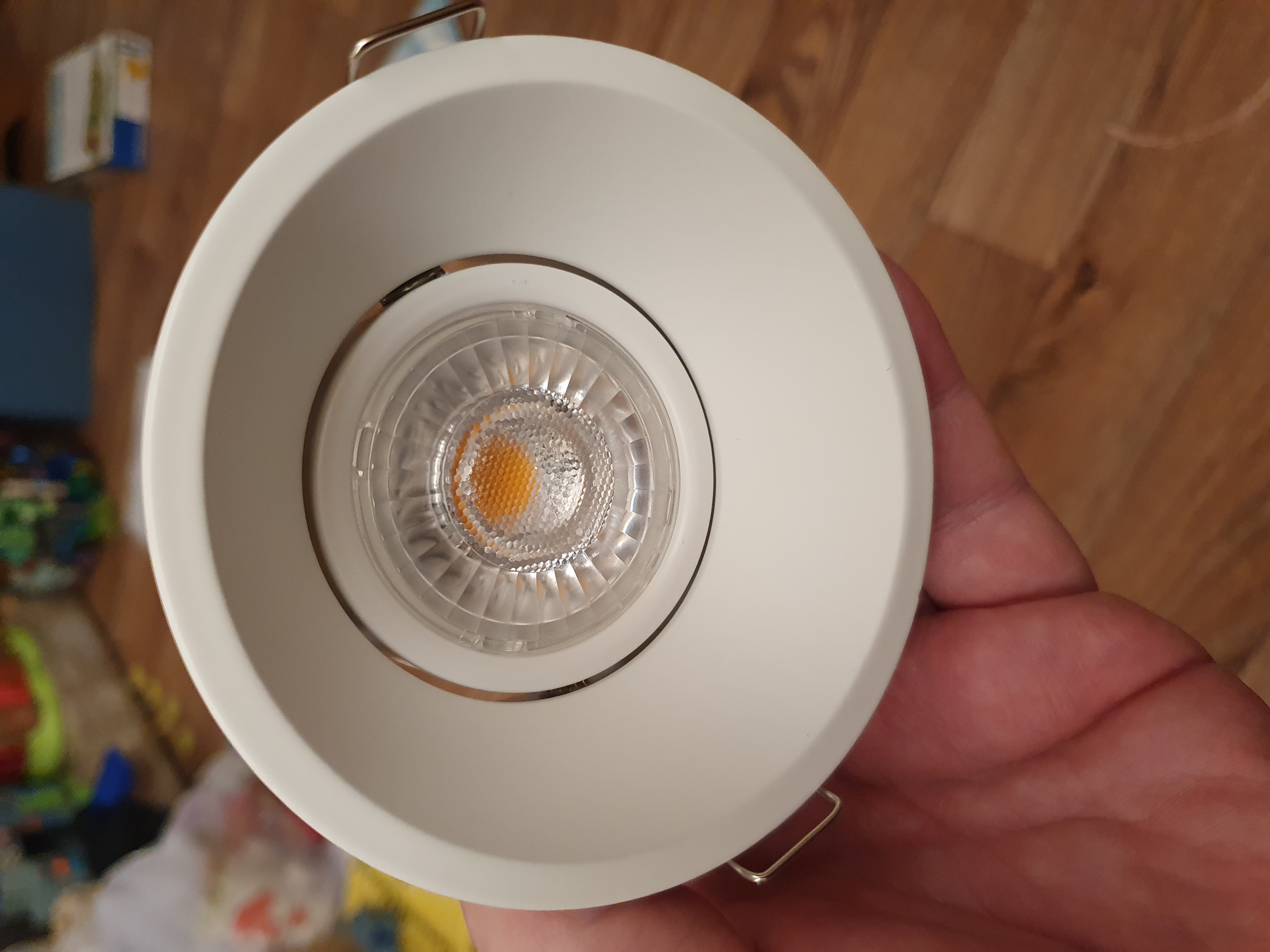
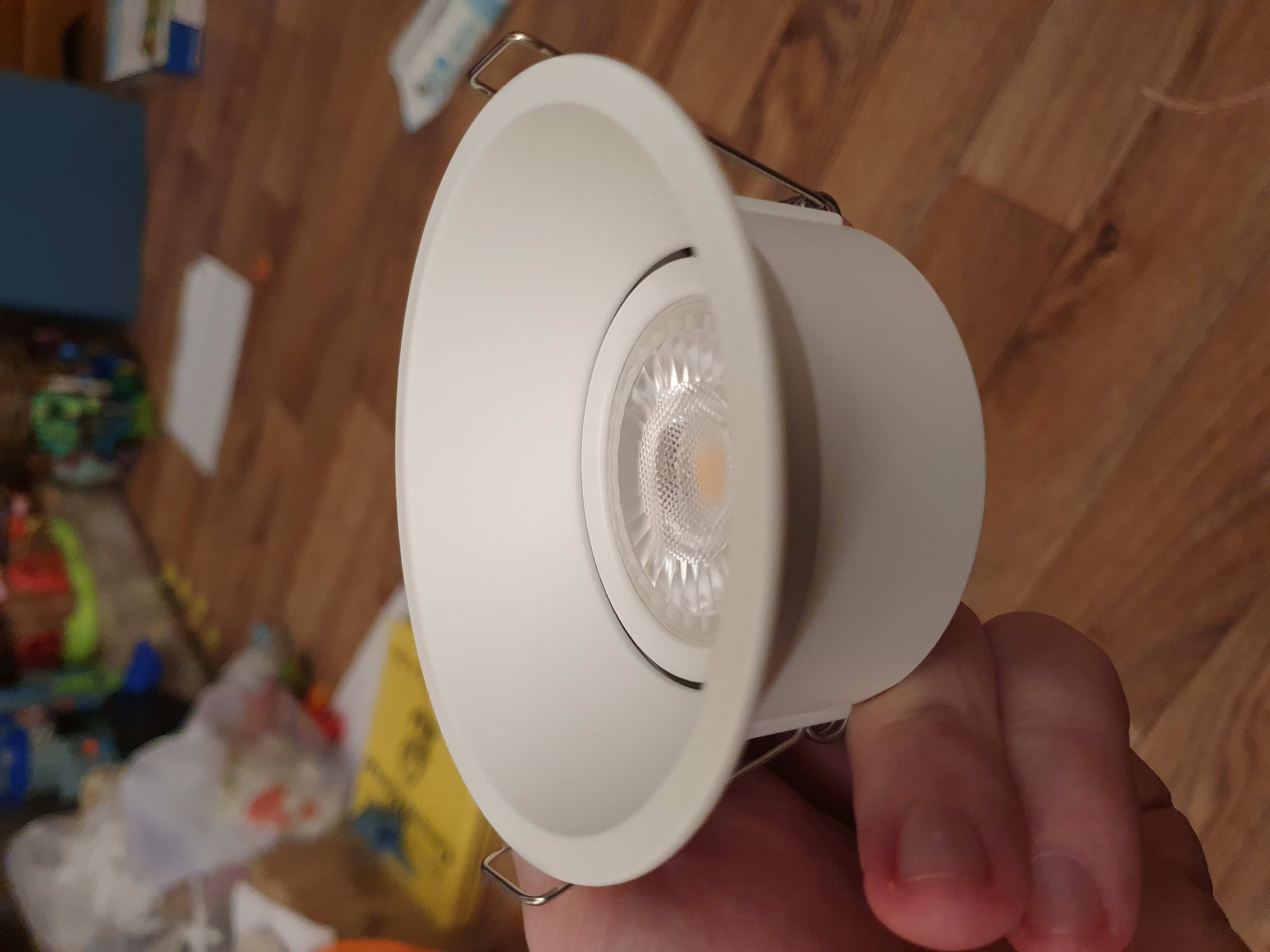
These are a marked step up from the €10/unit cheap and nasty ceiling lights you see in cheaply done home lighting installations, but nobody would claim they are ideal either. They are however cheap, each fixture and bulb is less than five euro, yet the quality of light and fixture will be vastly superior in comparison. For the money I reckon them as good as can be done. The choice of MR16 which is an ancient form of bulb format will seem odd, why use a 12v based light? The reason is because we can drive the lighting from the DC mains, reducing the energy efficiency losses in most home LED lighting from ~40% to ~10%, and swap some of those energy efficiency gains for higher CRI lighting (CRI = Colour Rendering Index, a measure of the quality of the light). Cheap LED lighting like those €10 for a sealed disposable downlight unit mentioned earlier will have a CRI eighty or below, we should average well above ninety throughout the house, and that will be noticeable in how colours and textures and finishings look at night time.
Most European lighting has colour temperatures of < 2700K (very warm white), 3000K (warm white) or 4000K (neutral white) – apart from when somebody fits a 6500K lamp (day light) because they didn’t realise how blue day light looks at lower brightness levels. As you can see above I’ve decided to be difficult and go for these instead:
- 3000K for cosy places like bedrooms, library mezzanine.
- 3500K for main living spaces, bathrooms.
- 4000K for worktops, offices.
It is my belief (and without much proof, to be honest) that 3500K is close enough to 3000K and 4000K that they can be used within the same space without being garish to the eye. The reason I have no proof is that 3500K bulbs are incredibly hard to source, I had to get ours from Amazon US at vast expense during Black Friday. Even with the BF discount, they were very much not cheap. Anyway, I’m looking forward to empirical testing when the bits arrive!
Finally, if you tot up all the lumens all that lighting in the design should emit, you’ll find a typical lumens per sqm (lux) of around 800. This is quite a lot of illumination, most would consider it excessive, putting it another way if all the internal lights are turned on at once the power consumption should be around 1 kW which is a fine amount of power for 100% LED lighting. However nobody would ever turn on all the lighting at maximum power at once – everything is dimmable, there is a fair bit of granularity of lighting control so most lights I would expect to be mostly off most of the time. There is an ulterior motive in fitting so much high wattage bulbs – I know full well they cheap out on the heatsinking because they want bulbs to die frequently so you are constantly replacing them. By speccing all the lights at twice what we need, and then dimming them half or more their power, their heatsinks will better match the power going through them and the bulbs should last a lot longer, plus not suffer from ‘colour fatique’ caused by the LED phosphors slowly burning out from prolonged heat.
Speaking of LED phosphors slowly burning out from prolonged heat, I bought a new TV at a great discount this Black Friday. Here it is playing Starship Troopers:
Yes it is ridiculously far too big for my rented house, and indeed very soon it’s going back into its box because it isn’t stable and I’m scared of the children bringing it down on top of them during their hijinks one day. But I think it’ll do just fine for the wall of my future house, so with a bit of luck by this time next year I’ll be sitting in my new house looking at it on its wall and it will be very reasonably sized for that wall.
The TV is a Philips 65OLED937 which What Hi-Fi? summarised in its review as ‘One of the most all-round spectacular TVs ever made’ (having used it for the past few days, I would concur). Originally retailing at a cool €3,500 in the EU, I got it for €2,300 in the Black Friday sales. Seeing as my ‘new TV’ budget was €1,200 how did I end up spending twice that?
The problem is Ireland and that EU discount retailers will no longer ship TVs to Ireland post-Brexit, so my ruse with the previous TV a Samsung H-series model of buying it from Germany and using the service menu to reconfigure it into a UK-Ireland model and literally saving €450 by doing so was no longer open to me. Believe me on this, I really really tried to repeat that trick – I had been wanting to buy the Philips 55OLED808. In Europe: delivered anywhere in the EU except Ireland, Greece or Malta all in for €1,099. Here in Ireland for the exact same TV: €1,499 with delivery another €75. Fuck that.
It’s like that with TVs for some reason, in Ireland the exact same TV costs at least 50% more in Central Europe, and 100% more is not uncommon. This isn’t new either, back when I bought the Samsung it was the exact same price premium here. The only actual big thing which has changed is eight years ago I could find TVs in the UK at European prices, this year the TVs in the UK even under BF discount had Irish-type price premiums added on top compared to identical models in Europe. Which sucks for the British, but in fairness nothing has got worse here in Ireland – we were always getting price gouged.
Anyway like with most goods different price ranges cause different consumer and vendor behaviours, so you might get one behaviour for TVs under €600, another for TVs €600-€2,500 and still another for TVs > €2,500. I had had a suspicion that this was the case because Philips and other TV manufacturers don’t bother updating their ultra high end every year like with their lower end models. This suggested different release cadences in terms of heavy discounting just before a replacement model launches. The 65OLED937 will be replaced before Christmas with the 65OLED938 – moreover, the 937 is approaching two years old now, so retailers will be especially keen to shift high end clearance stock.
And so it was true: on Cyber Monday, but only that day only, an Irish retailer dropped their price to €2,300 until all remaining stocks cleared. The fellow from their shop who rang me after the sale told me I got the second last one, and the last one sold just after me to a man in Montenotte, Cork. As we were buying a very high end TV (albeit discounted), we got the personal delivery service, and indeed within hours a fellow turned up freshly driven from Dublin with the TV. Obviously this is what it is like to buy > €3k TVs!
So, what do I think of the Philips 65OLED937?
The display is indeed very good. Not quite as good as my Samsung Galaxy S10 phone’s display which remains the best I’ve ever laid eyes upon personally, but no I really could not fault the LG OLED panel in that Philips TV. Colours are rich, bright things are quite bright, dark things are very dark, and lots and lots of detail abounds. If you can feed it high quality 4k input, the display just oozes with detail and contrast. Only if you look really closely and you’re being really critical, the image does have too much white at times. It’s like the white sometimes overwhelms the colour in an unnatural way, and on my phone that never happens. This makes sense: the LG OLED panel has dots purely to add white, whereas the Samsung phone OLED panel does not. Also, the S10’s OLED panel has something like 20% more colour range than the LG OLED panel, and from time to time it is noticeable.
The sound is indeed very good, as every review mentions, and it is easily worth a €1,000 add on soundbar. Which, arguably, makes the TV price actually €1,300 so I only exceeded my budget by €100
 . Again, if fed
high quality input, the audio is clear, balanced, and there is
an attempt to project some space, with only the almost complete
lack of low frequency for some audio kinda glaring. In fairness,
its soundbar’s woofer is no bigger than 1.5 inches, so there
is no point in trying lower frequencies than is physically
possible, and I suspect the cut off is around 100 Hz or so.
I do note a prominent connection for an external
subwoofer of your choice, so clearly the designers intended
if you want proper low frequency audio, you’ll need to add it
yourself. I will admit I was a little disappointed with the
spacial projection of the audio, a MacBook will deliver a
pretty good attempt at 3D surround audio using two speakers. This TV
was nothing like as impressive, though my L-shaped room
probably does not help and in fairness the MacBook’s audio
is class leading.
. Again, if fed
high quality input, the audio is clear, balanced, and there is
an attempt to project some space, with only the almost complete
lack of low frequency for some audio kinda glaring. In fairness,
its soundbar’s woofer is no bigger than 1.5 inches, so there
is no point in trying lower frequencies than is physically
possible, and I suspect the cut off is around 100 Hz or so.
I do note a prominent connection for an external
subwoofer of your choice, so clearly the designers intended
if you want proper low frequency audio, you’ll need to add it
yourself. I will admit I was a little disappointed with the
spacial projection of the audio, a MacBook will deliver a
pretty good attempt at 3D surround audio using two speakers. This TV
was nothing like as impressive, though my L-shaped room
probably does not help and in fairness the MacBook’s audio
is class leading.Android 11 has the least worst audio codec passthrough for Kodi yet. Later Androids are better, but Android 11 which this TV ships with is undoubtedly much less awful than before. I found most Dolby content passes through okay, DTS-MD does not (stuttering) but forcing fallback to DTS Core is a viable workaround. One is still locked into either a 5.1 or 2.0 world here though, Kodi has lots of hacks and workarounds to do either but nothing outside that, and the forcing of content to 5.1 as the only possible surround audio is detectable with this TV as its audio is sufficiently nuanced. At least this removes any thoughts or temptations about a better audio solution in the future, for the vast majority of content 5.1 rendering is what most content will actually render at, no matter its original.
Video codec wise everything I tried to play on Kodi did work fine. Something noticeable was HDR movie content appears to occasionally trigger premature playback end, but Kodi resumes exactly where you left off, and it only happened at most once per movie.
Finally, the OLED display to be honest I’m very glad I went with a heatsinked display like the one in this model. If it isn’t heatsinked, the TV has to back off brightness quickly to prevent pixel burnout. I know from reviews that this particular model has the least aggressive brightness limiter of any LG OLED panel based TV. If that’s the case, I can’t imagine I’d like any of the other LG OLED TVs much at all, I find the brightness backoff a touch distracting and intrusive at times, it actively inteferes with things like scene transitions in a movie. With this TV, it’s okay, I notice it sometimes and that’s annoying, but it’s not too jarring. If other LG OLED TVs are much worse here, and apparently they are, had I bought one of those I would be annoyed.
Oh one last super final point: the TV being new obviously saw a lot of use in its first day or two, and if you have it turned on ‘too long’ it starts to complain at you about it needing to have a period to refresh itself. It’ll get ever increasingly more annoying about this until eventually it just insists i.e. I’m turning off the TV now, I won’t let you turn me on again for at least ten minutes, and whatever you were watching or doing you’re not doing that any more. This only happened once, it never happened any other day so in fairness if it ever gets turned off during a day that seems to placate it. But it did kinda annoy me that it just insisted like that on being turned off.
Obviously the OLED937 is two year old flagship TV, so a bit like with me buying flagship phones two years after release you’re going to be trailing the state of the art somewhat. And that’s okay if the money paid was reasonable.
I don’t pay more than €500 for a phone, and usually more like €400-450. That sets what flagship models are available to me. Until now, I had never paid more than €550 for a television (arguably including playback boxes etc €800) which after inflation all-in might be a grand in today’s money. So it’s been a bit of a leap no doubt.
I don’t know. I don’t regret the purchase per se, it’s a great TV. Did I or the family really need such a nice TV when for half the money there wouldn’t be that much less quality in it? That’s kinda the crunch here, I could get 67-80% of this total package for half the money, even with Irish gouge pricing. There would be cutbacks on so many measures though e.g. viewing angles, this TV has absolutely rock solid viewing angles throughout the L-shape of the rented house. Any non-OLED TV would have substantial colour and gamma distortion instead over such a wide viewing angle. That’s the thing, improvements in multiple areas simultaneously costs money, and as much as heatsinked OLED panels are very much not cheap, they do deliver a display quality across multiple measures simply unachievable with other display technologies (bar maybe Plasma). Even with all their many quirks and annoyances, I suspect I’ll be just fine with the OLED937 in the end.
- Mains electricity is available (via the solar panels and storage batteries).
- Security cameras are monitoring the site.
- There is a live feed via the internet to my rented home and to my phone.
- All lighting is working, work office is functional, shipping container is ready to go.
I started this phase of doing site works myself at the beginning of summer 2022, so it’s kinda of the end of an era. To put it in perspective, I have been there every spare moment for well over a year, and for which I gave up going to the gym or indeed anything resembling ‘me time’. My first post here about this was in July 2022 where I tested my newly purchased security cameras for their night vision. Who would have thought then it would have taken sixteen months to reach now?
Speaking of said cameras, here they are right now at this very moment as I type this:
Thanks to a Wireguard VPN between rented home and site, those appear as if on my local network, so it’s very easy to access them. I didn’t think of taking shots last night when it was dark, but unsurprisingly given my testing of them in July 2022 they see as if daytime at night, and in colour as expected. The site is actually well illuminated by the street lamps on the road, it’s more than enough for the cameras to make out a good picture, albeit everything is rather orange tinted as that’s the colour of the street lamps. In any case, anybody coming on site at night time is registered without issue.
They have basic AI on them, good enough to detect the difference between a cat and a human. I’m still tuning those settings, the mid camera in particular gets plagued by moths at night time due to the illuminator being on (which is to remind anyone thinking of robbing me that they are being recorded), so it keeps tripping. But I’ll figure it out eventually.
Solar installation
I actually got all the panels mounted two weeks ago:
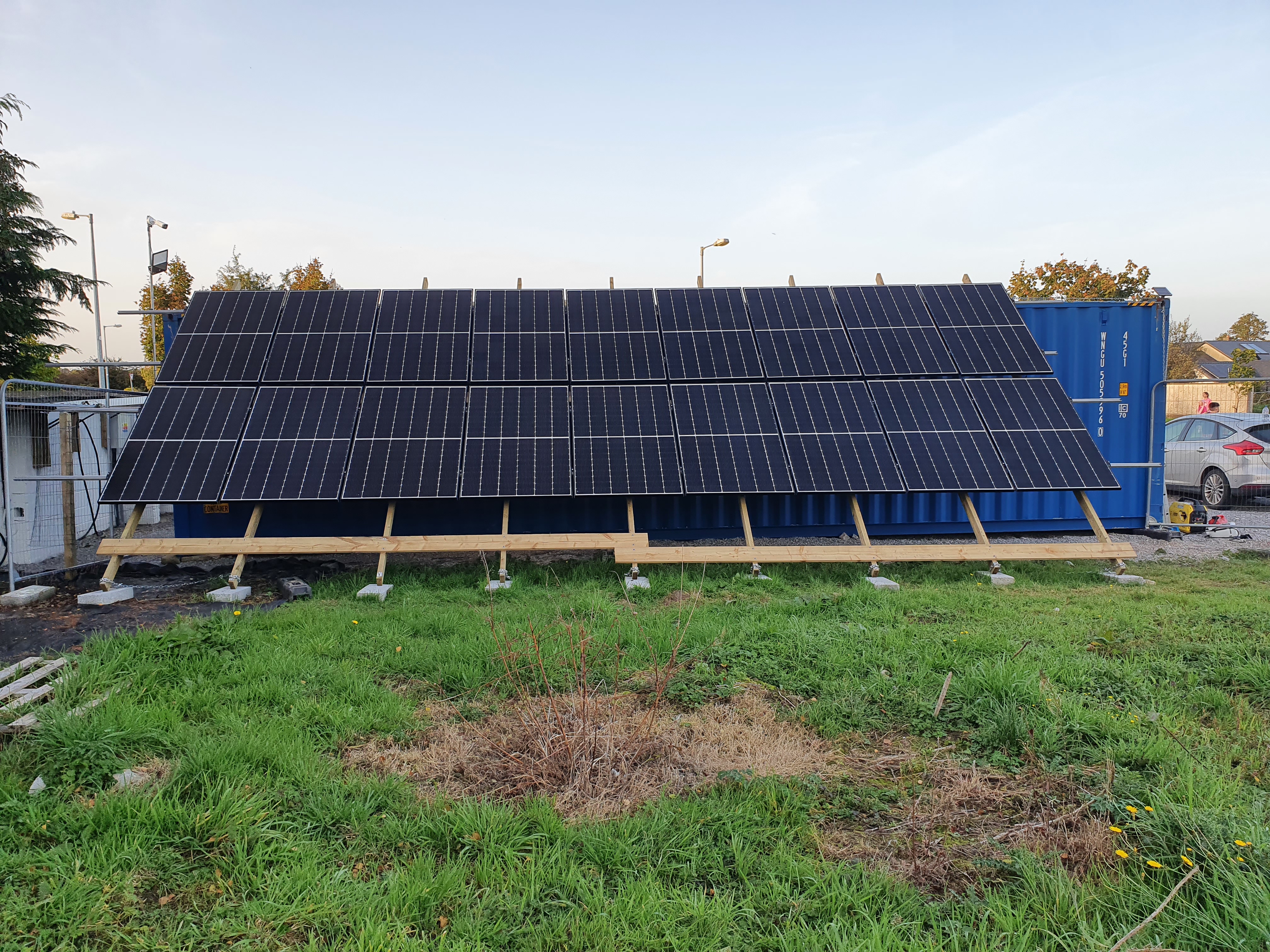
But I didn’t turn everything on until last weekend, as there was a final bit of wiring to be done especially more RCDs and safety stuff for the electricals. This was my first night of non-generator lighting:
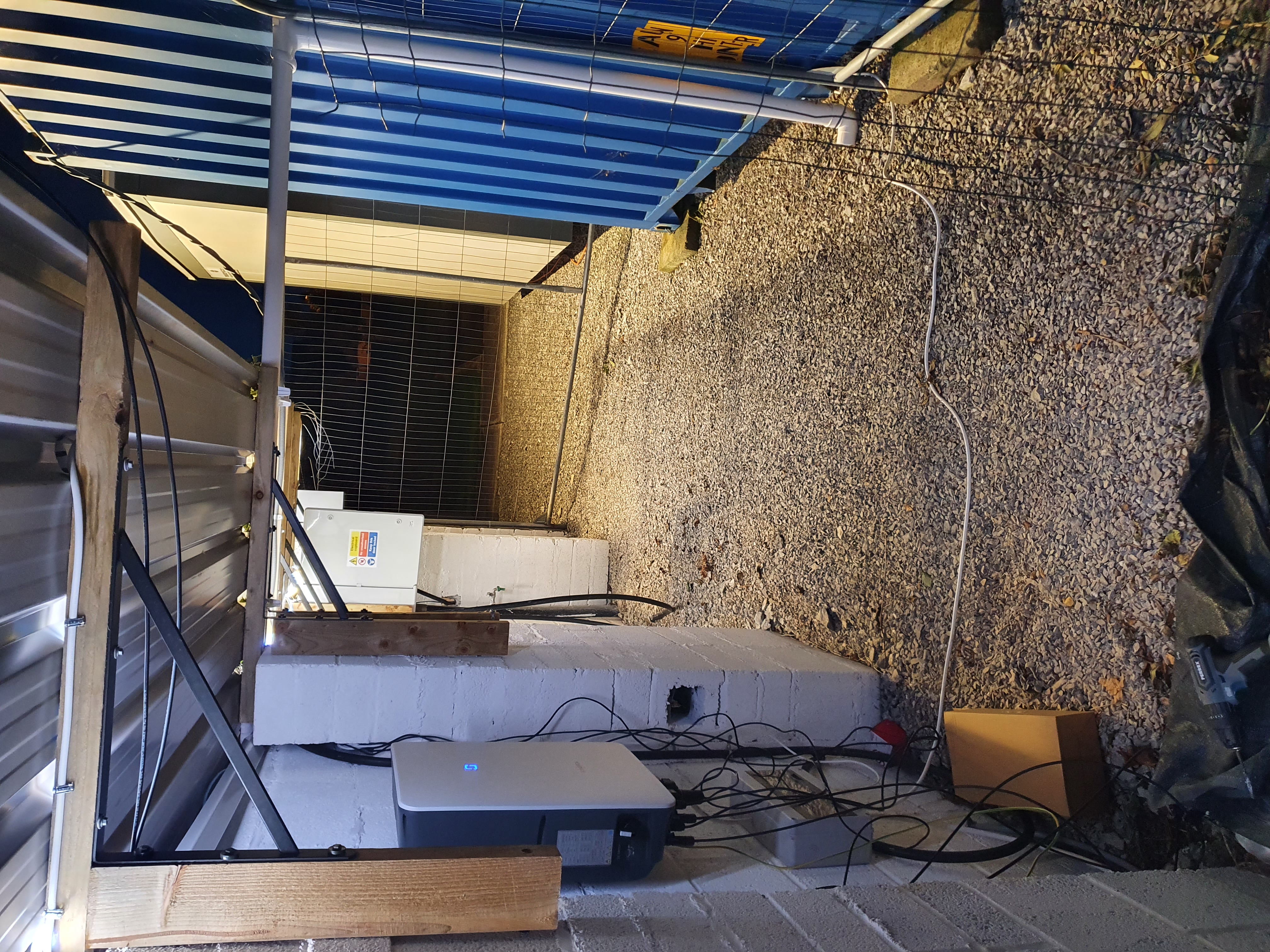
It still took a week of debugging before things became stable and reliable – after all, I’ve never done any of this before, so there was a steep learning curve, one day for example I ran the batteries flat which involved a lot of head scratching, because nowhere in the system does it actually loudly announce ‘your batteries are flat, and I’m going to silently randomly drop out when the daylight slightly dips’. But I think I have it working reliably now.
Sungrow have a cloud integration I’ll be disabling when I get Home Assistant up and running, but for now it’s kinda handy albeit buggy:
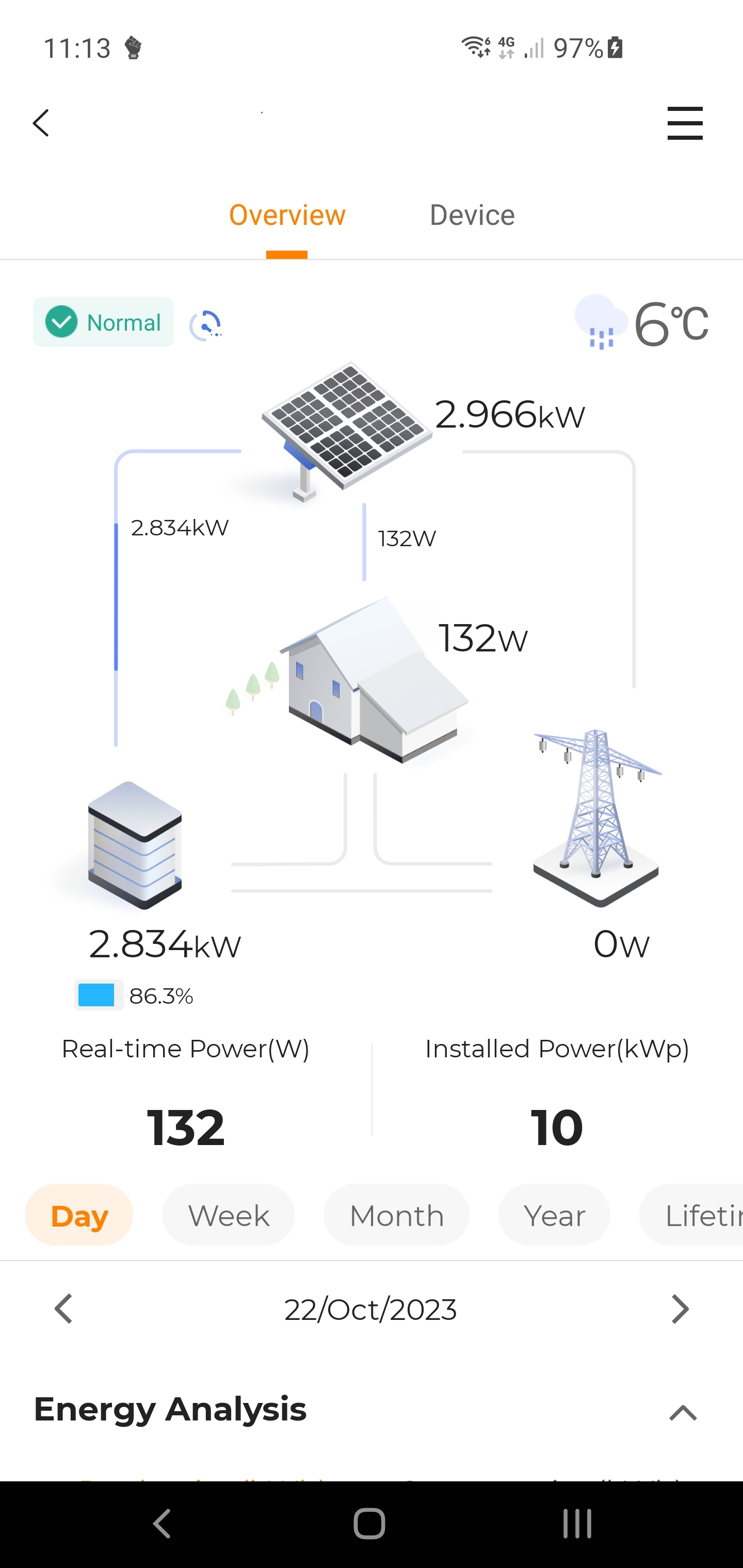
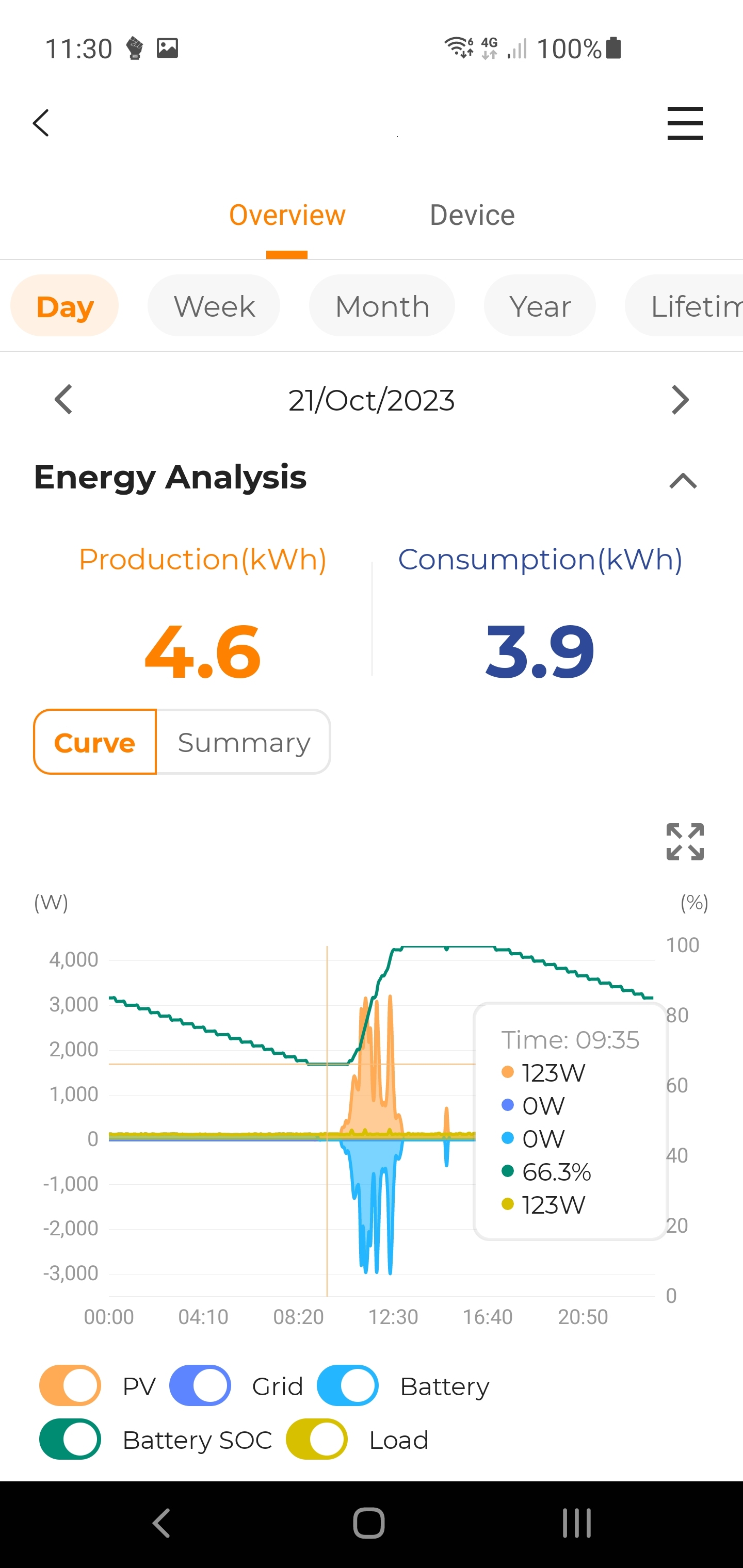
As you can see, right now the panels are generating about 3 kW, which is because it’s sunny. I’ve not yet seen the eighteen 375w panels (a 6.75 kW installation) generate more than 3.2 kW at a time, but I suppose it is October. I’d never expect more than 5.0 kW at best anyway, which is the NMOT maximum according to their datasheet.
The baseline power consumption is 130 watts or so. About fifty of that goes into the 54v DC mains which powers the cameras, routers and network. Assuming a 65% power efficiency (it is a very low wattage for a 4 kW power supply rated for 85% efficiency), that might be 75 watts. The Starlink will certainly draw a further 40 watts, and the remainder is the inverter itself, which seems to need about 10-15 watts depending on what it is doing.
With 10 kWh of battery capacity, the 130 watt baseline load currently drains the batteries to about two thirds of capacity every night. That will get considerably worse next month, and become much worse again in December as the hours of sunlight drops. I’ve noticed that dull days only generate about 300 watts at best, so two dull days in a row would be enough to run out of batteries. In the end, this is Ireland, we are very far north so you can’t expect much solar radiation for one third of the year.
What’s next?
As I mentioned, the long weekend next weekend is expected to complete the build preparation for the physical side of things. I intend to finally resume going to the gym after more than a year of absence, as much as physical labour on the site has been a substitute, I am looking forward to fewer torn muscles and the rather unbalanced exercise which is manual construction.
The design preparation is coming to an end as well:
M&E design is nearly done, they are just writing up the final reports.
We have chosen glazing after a few weeks of work on it: most of the wall glazing will be Nordan as I liked the seals much more than Rational’s or Munster Joinery’s, and their quote was surprisingly competitive (I think within the Passive House spec the budget glazing suppliers have no choice but to charge most of what the premium glazing suppliers charge). Munster Joinery are the only place in Ireland where you can source a passive house capable front door, so for that alone we’ll be going with MJ. For the roof glazing, it will be 1.4m tall Velux for all but the two windows in the mezzanine as Velux don’t have the right width there, so for those alone it’ll be Fakro (the Fakros cost considerably more than Velux for passive house spec). In case you’re wondering, for passive house spec roof windows the only choice is between Velux and Fakro, there are no others available in the Irish market. Both are hideously expensive compared to the wall glazing, but for natural light there is not much alternative.
We are currently working on lighting and socket placement. Once we have those integrated into the plans, I’ll work on ducting placement design.
After that, it’s frame and structural design detail remaining, and theoretically after that the build can begin.
In case you’re wondering about the mortgage, there is still no mortgage in place. They did at least reissue an Approval in Principle for me quicker than the three and a half months it took last time. They keep finding new hoops to jump, ever more bits of documentation to supply, and I like a good horse keep jumping them one after another. At some point they’ll run out of excuses, and they’ll have to either grant or refuse the mortgage. Maybe before Christmas we might learn one way or another, we’ll see.
Finally, this will be my last post from this laptop! I’m selling it to a friend of my sister’s as I was going to replace it anyway in the upcming Black Friday sales. It’s a Dell XPS 13 9380, and here is my post on here when I acquired it in 2019.
In the post I found this laptop worse in most ways to the older Apple Macbook Pro it replaced, which actually became Megan’s laptop after it came back from Apple with most of it replaced under warranty (and with a much less unreliable keyboard fitted, which has since then held up much better than it did for me). However four years of using this laptop I can confidently say it’s also one of the best laptops I’ve ever owned. It still has 70% battery capacity left, I still love its 4k display even though it only can do 65% of the DCI-P3 gamut or so. Its four core CPU feels slower than it did, but it’s still good enough. And I’ve done a lot of mileage on it, both in terms of typing, use and travel and it’s held up very well, it still looks almost new.
Its replacement will probably be either of these:
Huawei MateBook X Pro 13
- 90% DCI-P3 3120 x 2080 IPS display max 550 nits.
- Intel i7-1360P with four real cores and eight tiny cores.
- 16Gb 5200 RAM with PCIe 3.0 1Tb SSD.
- Haptic touchpad which is an inferior edition of Apple’s, but still way better than typical trackpads.
- Speakers almost as good as the MacBook Pro.
Asus Zenbook S 13 OLED (AMD edition)
- 100% DCI-P3 2880 x 1800 OLED display max 365 nits.
- AMD 7840U with eight real cores and much better graphics than Intel.
- 16Gb 6400 RAM with PCIe 4.0 1Tb SSD.
It’s a classic inners vs outers problem: the Huawei has worse inners, but the outers are better; whereas the Asus has worse outers, but the inners are better.
The replacement will definitely not be another Dell, who appear to have once again gone off the reservation for high end laptops after their return to sanity which produced this laptop. Dell’s most recent XPS 13 is highly unconvincing AND expensive, even if were priced like the two above you still wouldn’t pick it. And it’s not priced like the two above, it’s a good two to three hundred euro more expensive for a much worse spec.
As to which of the above I’ll end up choosing, it’ll come down to what’s available and how much it’ll cost during Black Friday. What I’d really prefer is Huawei’s shell with the AMD processor inside, as the Intel one isn’t remotely competitive. But there isn’t anything like that on the market unfortunately.
I did once again look into a Framework laptop, I absolutely love the idea, and they’re way more competitive this time than they were last time. If only they had something like the 16 inch model’s display in their 13 inch model, I’d have gone for it. But they don’t, and their 13 inch model’s screen is no better than my current Dell’s plus its much much lower resolution. So that broke it for me, which is a shame.
The Panels
Before I took the week off I had completed these nine wooden joists, one for each panel:
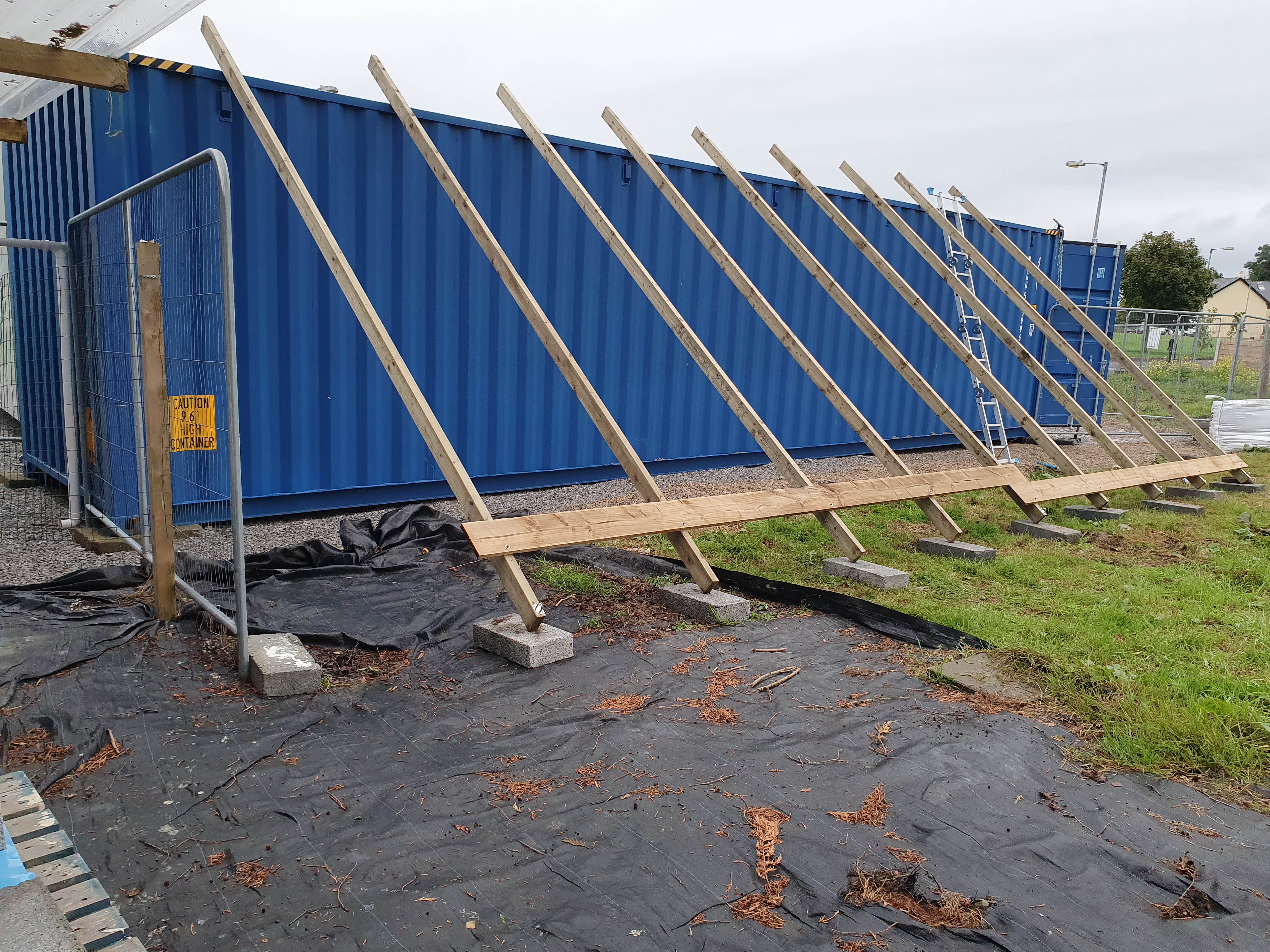
I ended up choosing a forty degree angle rather than forty-five, the way the terrain came out made it easier:
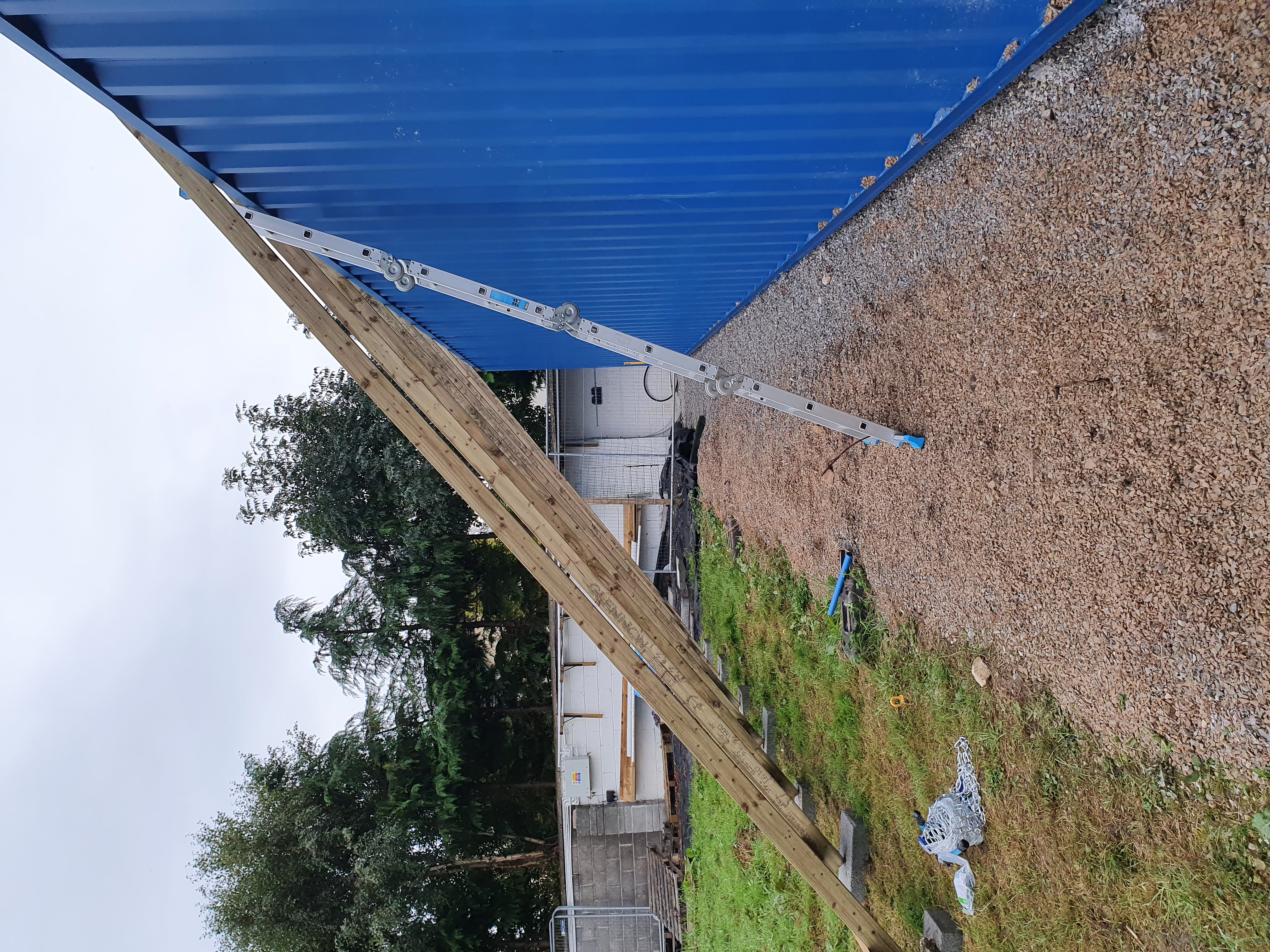
At the bottom the legs are chained horizontally to ground anchors:
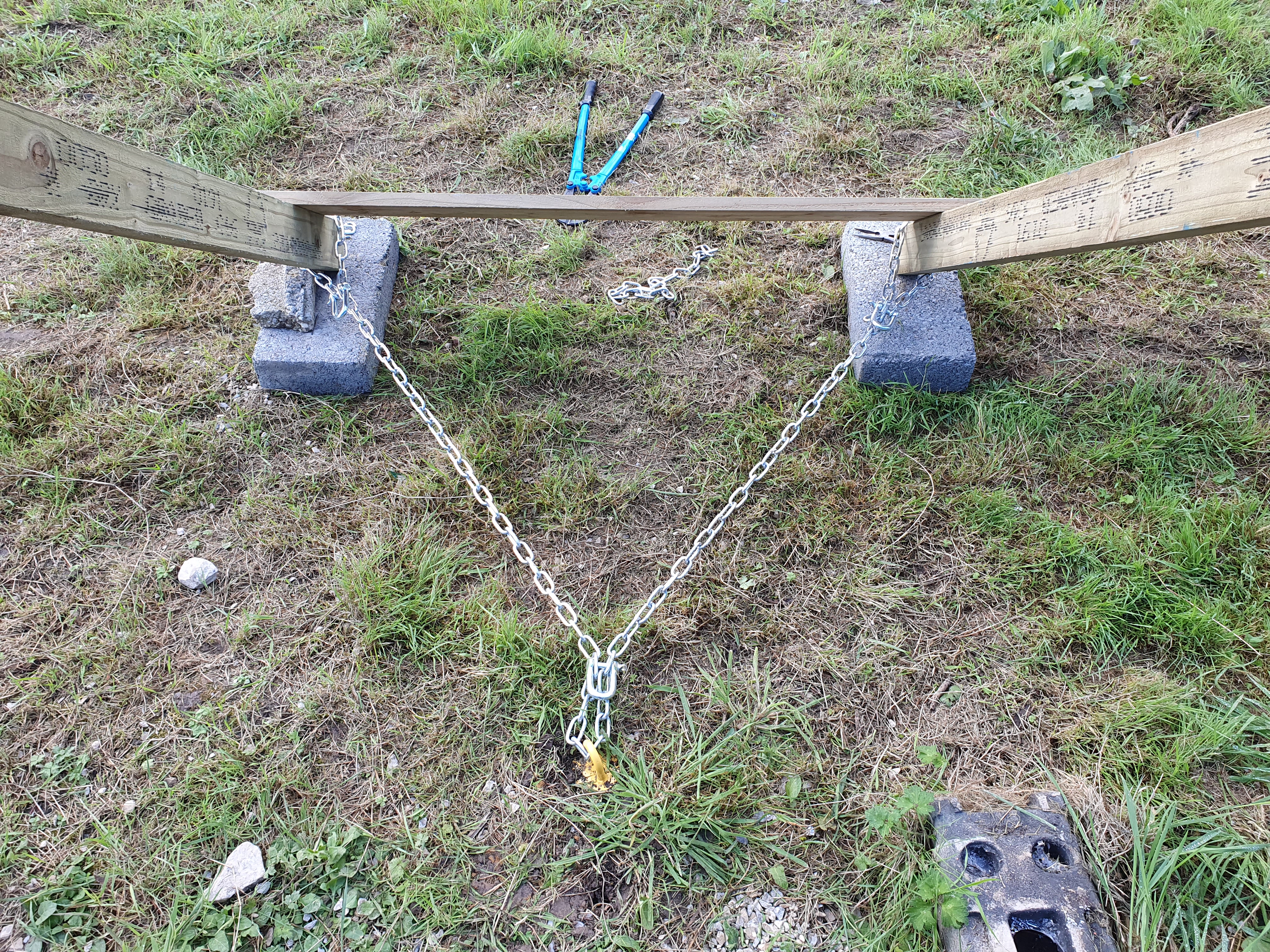
At the top the legs are chained horizontally to the top of the shipping container:
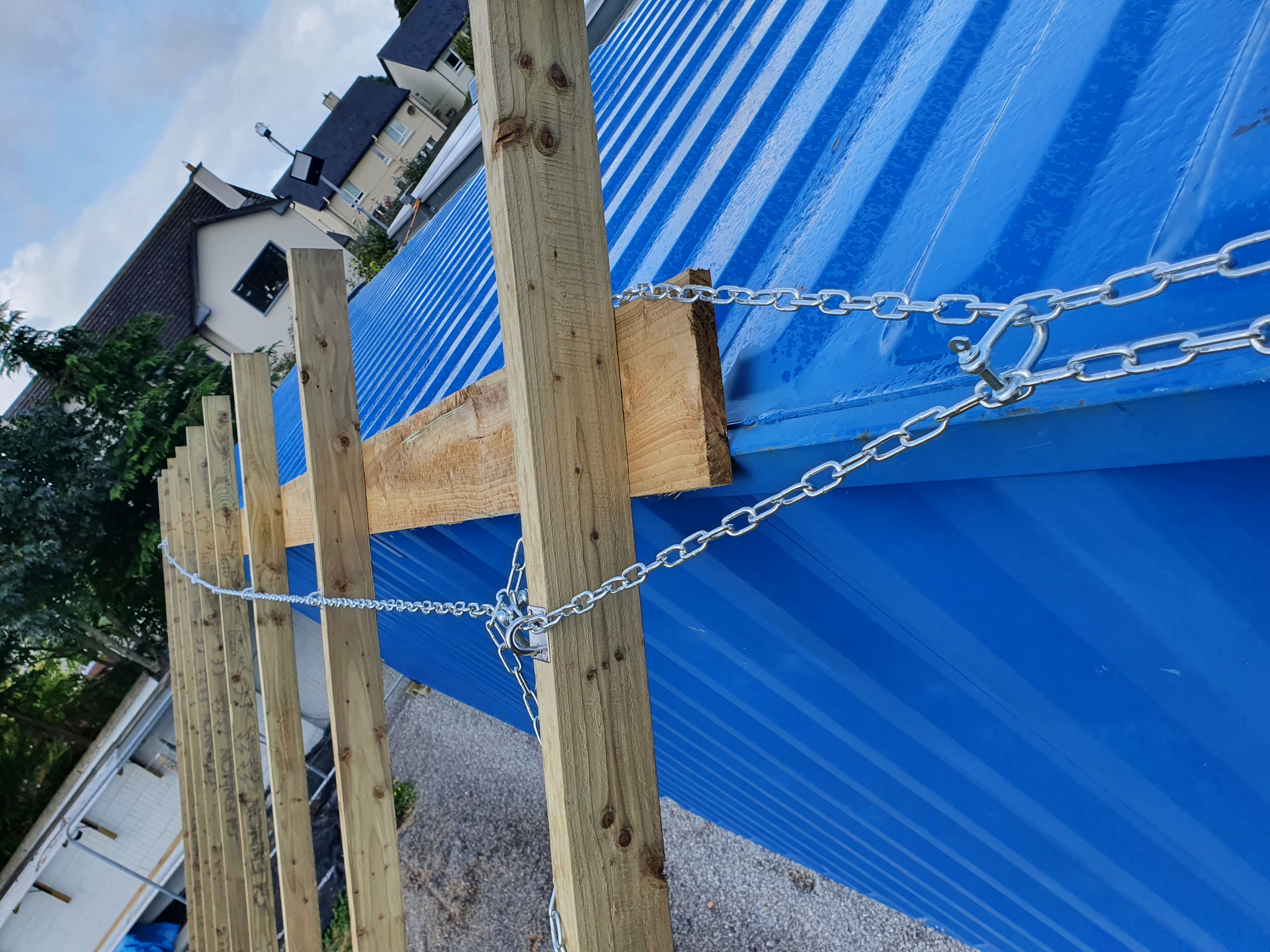
Each of the chains at the bottom can take 250 kg, each of the chains at the top 150 kg. As described last post, the wood should handle 4000 Pascals of wind force, and certainly my weight is not an issue at all.
The Q Cells 375w solar panels arrived since the last post:

They measure 1.72m x 1.05m each, making each panel 1.8 m2. Each weighs 20kg, which I can assure you my whole upper body right now is painfully aware of as I spent today mounting the whole top row:

You’re not really supposed to mount these on your own, and certainly a second person would have made the job far less arduous. But I really have to hand it to the panel mountings manufacturer https://k2-systems.com/en/ they’re really, really well throught through. So much so that whilst it was tough on my muscles, never at any point was I or the panels in danger during the mounting process, despite me doing it alone.
Depending on weather, I might get the second row on next weekend. We’ll see how it goes.
The Inverter
I finally got the hybrid inverter and the batteries to talk to each other, and with that the inverter finally accepted that it is an off grid installation and it stopped tripping out over the lack of a mains input supply. I will say that the Chinese config apps are pretty poorly tested for UI usability, or indeed bugs, or indeed self consistency or logical flow. But eventually I got both batteries and inverter commissioned and for the first time ever, I had non jury rigged mains electricity on the site! Switches turned on lights, internet was working, even the hand dryer in the toilet, all working. Very nice.
I took the opportunity to charge the batteries up a bit as they’d been so long in storage they had sunk to 22% charge. So I filled the generator’s tank, and left it run until the tank ran out. I got 2.3 kWh into the batteries, and they were much happier for it (lithium batteries don’t care for being left long term at low charge). The way you use a single phase generator to charge the batteries is to pretend to be a solar panel:
A video of the generator charging the batteries
As you can see at the end of the video, that power supply unit is feeding the hybrid inverter 490v at 2.3 amps which is about 1.1 kW. If I allowed any more current (the power supply can go up to 4 amps) the generator’s overload would trip out. It supposedly trips out after a sustained 1.9 kW, if so that power supply unit isn’t very efficient, only 60%. As you can probably tell, it came from Aliexpress and it was highly inexpensive compared to almost all other 500v capable power supplies – and, in fairness, its listing did say its maximum efficiency was 75%, so I’ll forgive it. In any case, it gets the job done and given I will only ever need it in December and January, I’ll take the poor efficiency for the cheap price.
Now that the inverter finally produces power, I was finally able to test all the RCDs and other safety equipment and I’m glad to say that they all worked first time. All those many months of testing paid off.
Surge Protection
I already have surge protection on the future mains input, as I have learned to my cost what can come up an ESB mains power cable. I have low voltage surge protection on the DC mains so when someone inevitably connects AC mains to DC mains, it should protect all the DC equipment. I have high voltage surge protection on its way from China for the solar panels, so what remains is what to do about those PoE cameras up high with long runs of Cat5 ethernet between them.
Most ethernet surge protectors are really crap, and at best degrade your connection speed to 10 Mbit without providing any actual protection. Ones which doesn’t interfere with a Gigabit connection and do provide actual protection cost easily €200 each upwards. Even a well known brand name doesn’t mean the protection is any good, as you will see in this depressing video empirically testing many well known ethernet surge protectors:
Now, a 10 kA surge current is indeed a nearby lightening strike, but there are many surge currents not quite as high which can ruin ethernet connected devices, which are only designed to cope with 100 amp surges. Out of those devices reviewed above, the gas discharge based devices from Tupavco seemed a reasonable balance of cost to protection against lower surge currents which will be more common. I had to special order those from US Amazon, fairly disgustingly it arrived next day from Iowa. As a comparison, UK Amazon takes eight to nine days to deliver here. The fact that US Amazon is ‘closer’ than UK-Irish Amazon is something Amazon should be ashamed of. Anyway here it is:
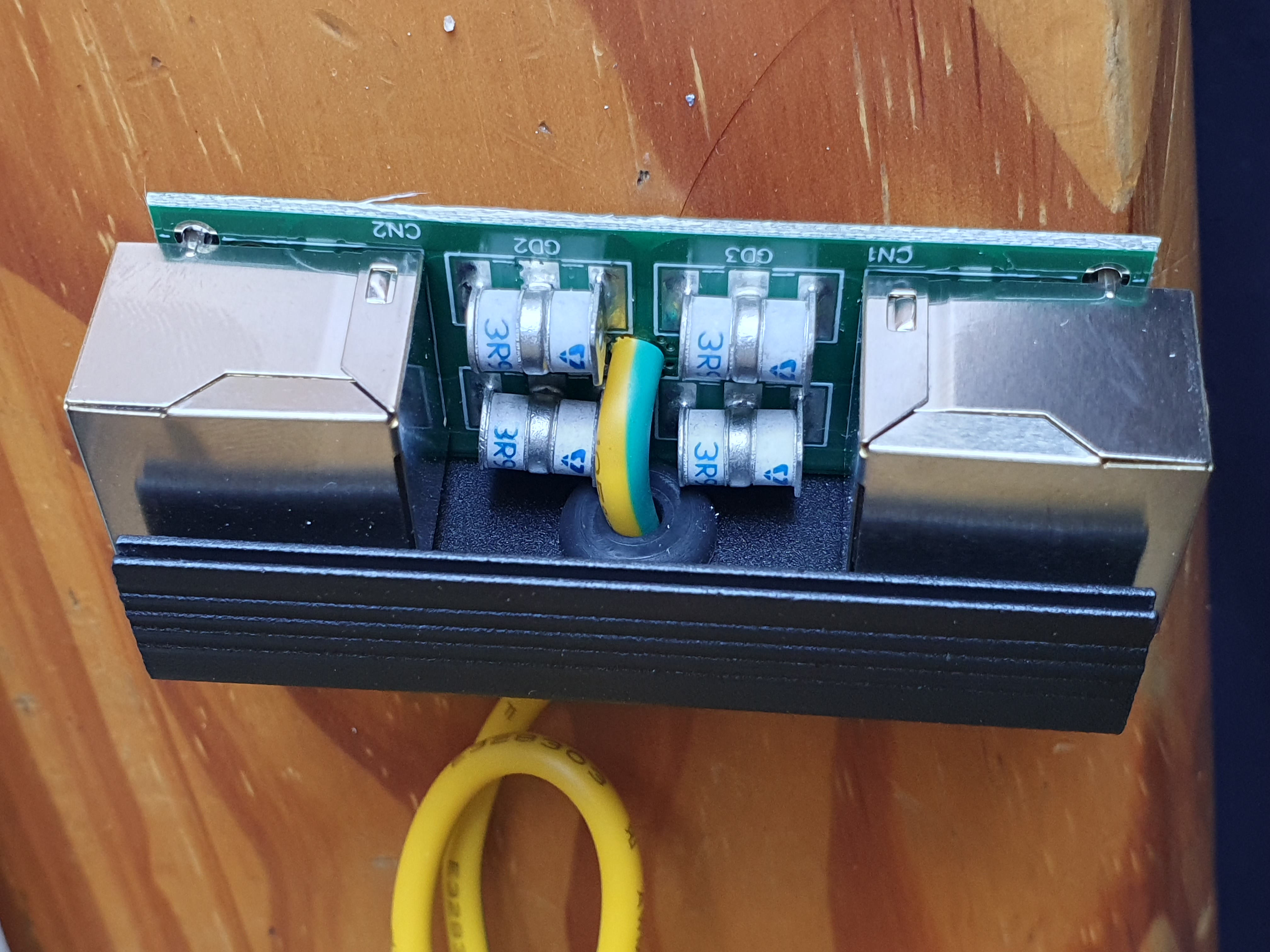
According to Tupavco, this TP302 model will divert to ground any line which exceeds 72v from ground. This allows PoE to work just fine (it’s under 60v), and because it’s a gas discharge tube it doesn’t electrically interfere with the ethernet signalling, thus not affecting connection speeds.
Reading the component’s datasheet (3R90), it claims to trip at around 90v DC, under 600v impulse, and it can cope with 10 kA surge currents at least ten times, or 10 amps of AC power at least ten times, and 15 kA at least once. Obviously as we saw from the YouTube empirical test, this is simply untrue, a single 10 kA impulse not only blew the component but in doing so also blew the protected equipment. Let’s just hope it copes much better with lower surges.
House build spend
It has been three months since the last house build spend update. This will be up to 1st October 2023:
- Spent: €221,328
- Committed to be spent soon: €12,811
- Current three month averaged spend rate: €8,523 per month
The four biggest ticket items in the past three months were: (i) Mechanical and Electrical design (ii) Forty solar panels (iii) Frame design deposit (iv) Six tonne digger rental
By far and away the largest number in there is for the M&E design. It’s going to become the most expensive design fee to date, even more than what the Architect has been paid to date. I had to put my foot down about it actually, they were on track to spend €25k or so and I was like no, I think I’ll take incomplete M&E design for a max €15k spend. We’ll make do with the incompleteness.
I no longer think I’ll be handing any money to an electrician to do the mains any more, their fees went into the early purchase of solar panels and my considerable investment of my precious free time into working around them. But I do expect structural design fees to be the most expensive item next quarter, and if not, then a deposit to the builder.
We theoretically have a build commencement slot in January, which is only three months out. Seems unlikely to me, but a March build commencement date seems achievable. Just need to get the mortgage done before then, last time it took nearly four months from application. And I still haven’t submitted the new application, because the bank are dragging their heels as usual.
- Broadband internet via the Starlink satellite dish.
- Two state of the art Wifi6 access points each end of the western wall connected by 2.5 Gbps fibre backhaul.
- Three state of the art low end Chinese security cameras at far, mid and near points along that western wall.
- Two 22,000 lumen warm white floodlights at far and near points of western wall.
- Under the full length of the roof section there is now RGBWW LED strip lighting.
- Lithium battery storage has been assembled and commissioned and its wiring to the inverter tested.
- The cameras and Wifi boxes are powered from the 54v DC mains supply, rather than from AC. The floodlights and Starlink require AC.
- The office is fully wired and ready to go.
- The shipping container is fully wired with lighting, sockets and ethernet and is ready to go.
- The garden shed is fully wired with lighting, sockets and ethernet and is ready to go.
So the lack of mains electricity is beginning to become a real bore. I’m onto my second electrician now, he also keeps not doing the work despite me pinging him weekly. At this rate I may have to expect no mains power until the house gets built, so I’ve decided on a radical solution for that. But more later on that.
Also, the mortgage Approval in Principle expired this week. The people from the AIB were basically on holiday from July onwards, so were doing absolutely nothing about the mortgage application. Anytime you’d ping them they’d be out of office for some long number of more weeks. Such is the banking industry. Anyway I’ll now have to apply again from scratch for the mortgage, do it all over again. Yay.
Progress
Anyway the first thing I got done after the last post was the middle security camera. Unlike the other two which are high up, this one is under the roofed bit:
What’s neat about this camera is it can see 180 degrees around itself. It does this by combining two camera images and stitching them together. As much as the resulting image is very nice in the daytime, at night time this camera cannot hold a candle to the other two, which have truly superb unilluminated night time vision. This camera won’t need it though, as under the roof we have LED strip lights and at some point I shall be having them turn on at night time automatically, just very dim. But more than enough light for that camera to see with clarity.
Here are the LED strip lights working, they are on a switch. They shine unnecessarily blue because the power source I had them on for test was incapable of supplying all the power they draw, so they are both dim and bluer as a result:

Finally, as this is the last photo of the last thing I completed out of the original western wall plan originally drawn up more than a year ago, this kinda makes me a touch emotional. So much effort to reach now. So much money, and so much time. But plan completion here we are!
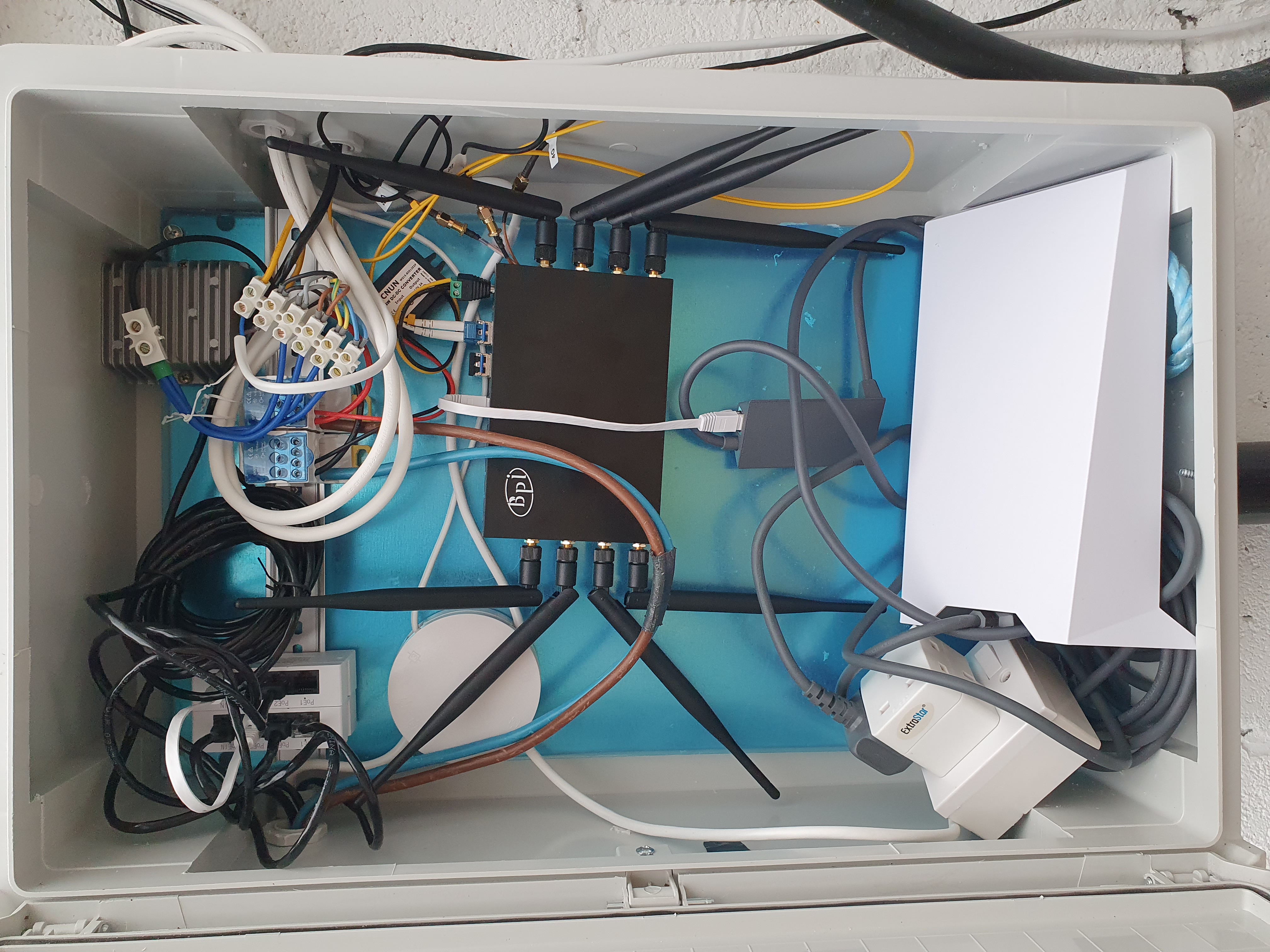
That’s the Starlink power supply at the bottom, it emits a single 1 Gbps ethernet which the BananaPi board (middle) takes as its WAN. It then provides 2.5 Gbps fibre backhaul to the other BananaPi box forty metres away. Up top left are these very neat PoE powered 100 Mbit switches. You can daisy chain them until PoE runs out. Top middle are the junctions for the 54v DC which are the two thick blue and brown cables, very low voltage needs big currents to carry much power so you can’t avoid 16 mm2 cable really. A 12v and a 24v DC-DC converter hangs off that to supply the BananaPi and the LED strip lights. Finally, top right shows an external antenna, this is for a LTE 4G antenna. The BananaPi has a SIM slot, if you fit a SIM it’s capable of using LTE for internet. I reckoned for the small amount of money to buy a low end LTE modem and antenna, this would be a useful backup if the main internet failed.
And there you go, job finished at last!
Bricks
I’m currently moving gravel to clear space for the next stage of all this (described next) and I needed something to shutter in the gravel within its final destination. I thought red brick would look nice, however I was horrified to learn they now cost €1.40 inc VAT for new bricks. And that’s for the cheap bland ones, anything nicer expect two euro.
I then wondered what about reclaimed bricks, and it turns out those have also massively inflated their prices recently. I found on DoneDeal a local chap selling off the end of a pallet for €1.50 per brick, so I went and got a bootful before they all went:
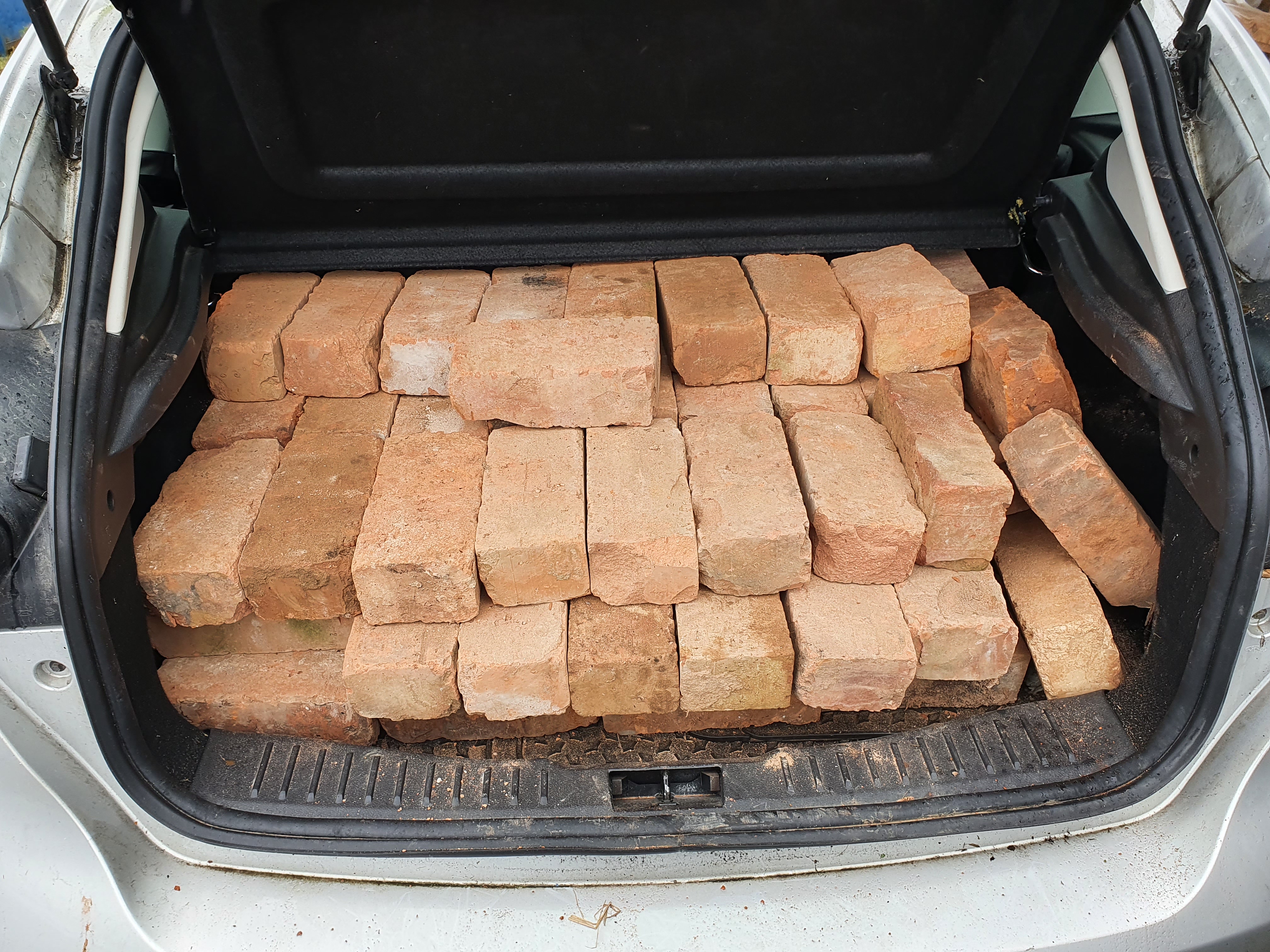
These are old British Imperial bricks made at the height of their empire, or thereabouts. They’re bigger than modern bricks, so in that sense they are likely better value in terms of brickiness per euro. However, they were made early in brick mass production, and therefore weren’t made quite as well. Also, a hundred years of use tends to impact a brick too!
Whilst unpacking them, I was fortunate enough to yield a few with their manufacturer branding (they would insert one of these per bale of bricks so you knew where they came from):
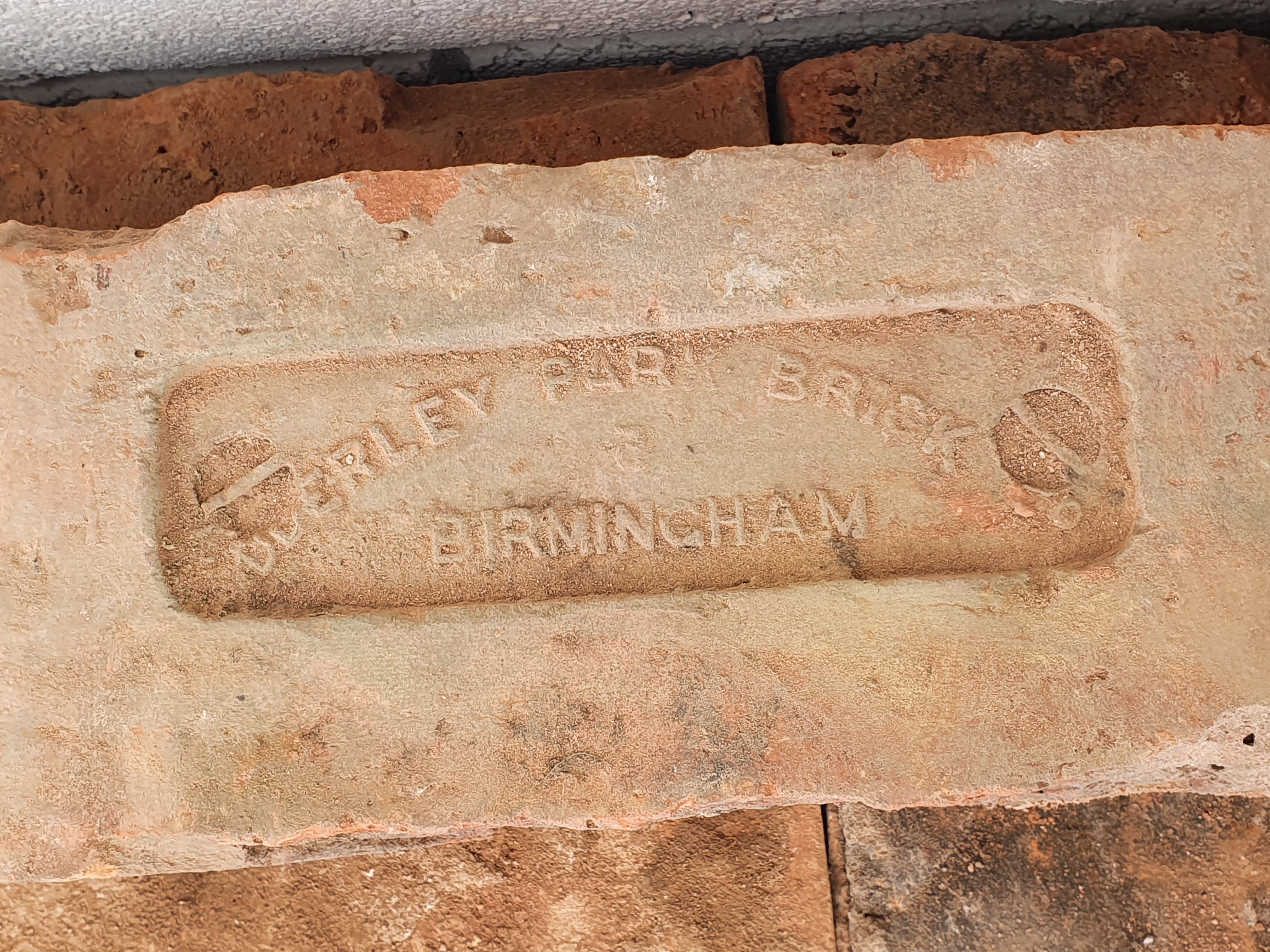
Adderley Park Brick of Birmingham was founded in 1876 through the takeover and industrial modernisation of an existing brickworks which had been manually operated since around 1840. Via coal powered steam engines, the clay was mechanically pressed and made pliable into moulds, which were then fired to cure them, again by coal.
As is often the case with these things, these industries tended to cluster where the clay was good and coal and transport was easy to obtain. Just up the road was Globe Bricks, who also churned out vast numbers of standardised consistent quality bricks like Adderley Park Brick. They, and dozens of other British Imperial brickmakers, made the bricks which built the empire.
We know when Adderley Park Brick was founded, but determining when it ended is harder. I think they stopped printing their full name on their bricks after 1916, they just used A.P.B. after that. And they were certainly still going by 1946, they ended up getting merged into ever larger conglomerates until the cost of energy and labour in Britain became too high compared to elsewhere. So brickmaking went elsewhere, mostly to Europe where energy was historically cheaper.
To date my specific bricks would therefore seem to have a particularly wide window. However, we were in fact really lucky here because we also got this branded brick:
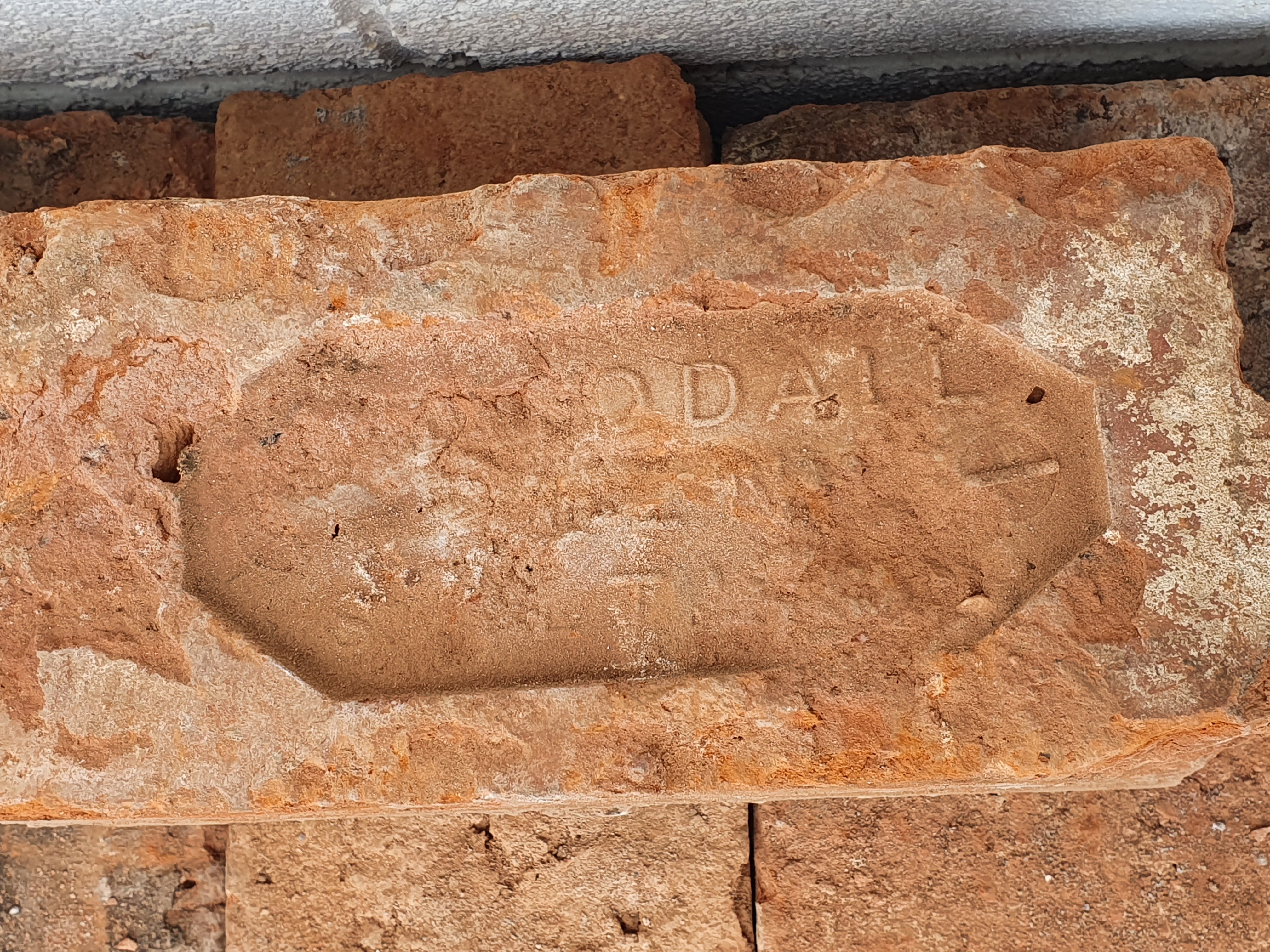
It’s hard to make out – and it took some effort with the search engine to find – but this says “G. Goodall, Saltly”. This is in fact quite the rare brick! Produced only between 1878 and 1883, their yard was right next door to Adderley Park Brick. That narrows my set of bricks to that specific five year window, which makes these bricks between 140 and 145 years old.
(My thanks to the webpage at https://uknamedbricks.blogspot.com/2018/04/birmingham-brickworks-part-2.html which solved the Goodall brick for me. It also has lots more detail about Birmingham brick makers if that sort of thing interests you)
Megan feels sad about using these heritage bricks merely to frame gravel. She’s not wrong that it seems somewhat of a shame. However there is absolutely no shortage of these bricks, billions were made and given the cost of new bricks, reclaiming them is very profitable so there will never be a shortage of supply any time in the next few decades. And, more importantly, they were made to be used – their former use has ended, they’re now getting used for new things. Assuming their makers cared at all, these bricks I have here have a reasonable chance of seeing their two hundredeth birthday assuming myself and Megan live long enough, and one of our children claims the house after we are dead.
Finally, a much newer brick slipped into what I bought:
Marston still make bricks actually, and they’re very nice (and very expensive). But this specific brick is likely from the 1970s back when the Marston Vale was the source of most of the bricks still made in Britain back then. You can tell it is a modern brick because it has modern dimensions i.e. is smaller and thinner. It almost certainly got inserted into the building which our bricks made up as part of repairs and maintenance, probably because the colours roughly matched.
Next Project
I’m getting royally annoyed about the unwillingness of electricians to come turn on my mains electricity, and seeing as I need electricity on site to make forward progress on the build, I went ahead and bought the solar panels for the house now. I’m going to erect eighteen of them now as a temporary installation, that will get me electricity on site and then if/when mains electricity happens it’s no longer a critical blocker to forward progress.
As much as spending lots of money now puts me further away from the mortgage, I had had enough to be honest. I’m stuck here working from home six months later than originally planned now. I have a perfectly good office onsite, it just needs electricity. I need electricity now, not later.
Another motivation factor is that European warehouses are currently with a glut of solar panels, so they are deep discounting to shift the older panels. The cause is the Ukraine war, stockists correctly anticipated a massive increase in demand for solar panel installations, so they ordered lots more stock. There is indeed a massive demand, but there is a big shortage of installers. So the stockists haven’t been able to shift stock as quickly as hoped, and due to running out of warehouse space, they had to firesale some stock.
Anyway, upshot is that I picked up forty Q Cells G10 375w solar panels (which are last year’s model, slightly worse than this year’s model) for a mere €94 ex VAT each. That is a very good price, you would normally be paying €150 ex VAT for a Chinese panel of that size, or €240 ex VAT for a non-Chinese panel of that size. Q Cells is of course Korean-German, and while they do make some of their panels in a Chinese factory, most are made in Korea, Malaysia and especially the United States where they are by far the largest domestic manufacturer.
My temporary solar panel installation shall be onto the side of my shipping container, which is 2.9m high and south facing. I have bought nine 4.8m lengths of 100 x 44 pressure treated timber. If one wanted a 45 degree angle, they would need to be shortened to 4.1m long each; if one wanted them closer to 35 degrees which is the maximum power generating angle throughout the year, you would leave them basically as is. I haven’t decided on that quite yet, I may just stick their ends over the top of the container a little or do something else.
At their bottom I shall have four ground anchors, these screw into the ground and if you can give them mainly lateral loads, they are very secure. The bottom of the timber beams will be pushing outwards mostly, so should be ideal for the ground anchors. At the bottom and top of the timber beams, I have 6mm chain attaching the top to the shipping container and the bottom to the ground anchors and to the shipping container for safety. I did some basic structural loading calculations based on a hurricane producing 4000 Pascal of wind pressure on the panels, and I think this design should be good in that (to give an idea, the Beaufort scale tops out at 1500 Pascal which is 180 km/h wind speeds sustained, something not usually possible at ground level, but I reckon gusts can be quite potent – the highest recorded yet is 408 km/h ten metres above ground).
Anyway, once I get those eighteen panels installed, I finally can commission the inverter which thankfully is an off-grid capable model, and also thankfully I did install a local earth, so I’m good to go once I get all this mounted and wired in. There is absolutely no way I get 375w from each panel – solar panel energy efficiency claims are very like for cars, they are aspirational rather than anything resembling reality. At worst (January), you might get 2.5 kWh in a day. At best (June), you might get 46.8 kWh, which is 81 watts averaged over sixteen hours for all eighteen panels incidentally. Even if just taking noon that day, those eighteen panels might generate 5 kW, which is 278 watts per panel. The NMOT power rating for that panel is 281 watts, so that’s actually pretty good (NMOT = Normal Operating Conditions).
Obviously I will not be able to work from that office in December and January, but for the rest of the year I think it will be not only fine, but there will be plenty spare electricity for space heating. That miserable 2.5 kWh in a day mid-winter becomes > 5 kWh by February, it’s a big difference, mainly caused by daylight hours going from six hours to eight hours within just a month and the sun getting far higher in the sky – and thus losing much less radiation to penetrating atmosphere.
Anyway, getting all that set up with take many weeks. Next time I post here it should be done, and I’ll also have the latest three month build cost spend to the end of September. Obviously due to the mortgage application I’m not allowed to spend much, but there have been little bits here and there over time.